
A comic book coupon cut is the physical removal of a coupon from an interior page, leaving a hole or partial page that grading services classify as a "missing part" defect. This single act, often done decades ago by a kid clipping a mail-order offer, can erase the majority of a comic's market value today. Understanding what a comic book coupon cut means for grading, collectibility, and preservation is one of the most practical skills a serious collector can develop. The difference between a coupon cut on an ad page versus a story page is the difference between a reader copy and a total loss.
What is a comic book coupon cut and how does it affect grading?
A coupon cut is defined by grading services like CGC as a missing part defect, meaning the excision reduces the comic's page count and overall completeness. CGC graders note the defect in their technical assessment, and it appears on the grading label as a qualifier. This is not a minor notation. It changes the label color and the grade itself.

The grading label distinction matters enormously. A comic with a coupon cut typically receives a green label, also called a qualified grade, rather than the standard blue label. The green label signals to buyers that the book has a significant defect that prevents it from receiving a clean grade. A blue label reflects the actual condition of the book as complete. A green label tells the market the grade would be higher if the book were intact.
Coupon cuts cause an 80–90% reduction in a comic's market value. That figure is not an exaggeration. A book that would grade CGC 8.0 in complete condition might sell for $200 intact but fetch $20 to $40 with a coupon cut. The defect effectively removes the book from investment-grade consideration.
Key grading facts collectors need to know:
- CGC notes coupon cuts under the "Missing Part" defect category
- The green label (qualified grade) reflects what the grade would be without the defect
- The blue label reflects the actual, complete condition of the book
- A coupon cut is considered a major defect, not a minor one
- Page count and completeness are core factors in any professional grade
A coupon cut does not destroy a book's identity or historical significance. It does destroy its investment-grade status. That distinction shapes every decision a collector makes about a coupon-cut comic.
What content do coupon cuts remove, and why does it matter?
The content removed by a coupon cut determines how much a collector should care about it. A cut through a story page is far more damaging to desirability than a cut through an advertisement. Most collectors can live with a missing ad. Almost no collector wants a book with missing story panels.
DC Comics during the Bronze Age typically placed coupons on the back of advertisement pages rather than story pages. This was a deliberate publishing choice that minimized narrative loss. A collector who finds a Bronze Age DC with a coupon cut should immediately check whether the cut falls on an ad page or a story page. That single inspection changes the book's desirability significantly.
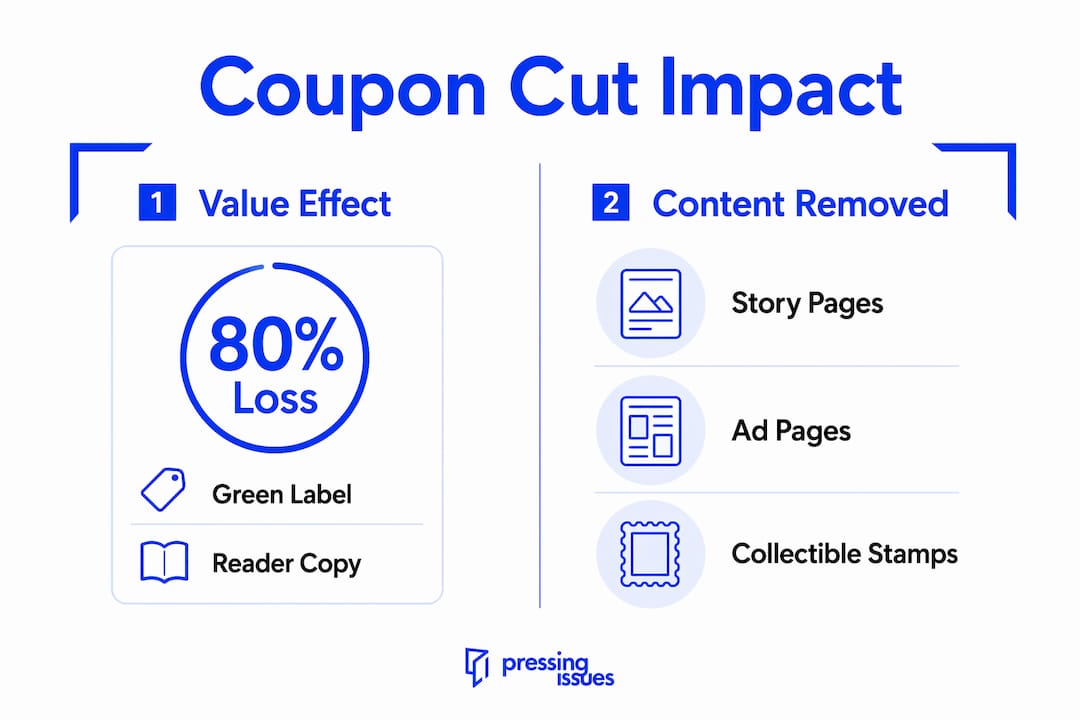
Marvel's approach created a more complicated legacy. The Marvel Value Stamps of 1974 were small collectible stamps printed inside Marvel comics, and fans cut them out in huge numbers. The removal of these stamps permanently damaged many historically significant issues, including Incredible Hulk #181, one of the most valuable Bronze Age keys. A book that would be worth thousands in complete condition is worth a fraction of that with a missing stamp.
Pro Tip: Before buying any Bronze Age comic, flip through every page and check both sides of each leaf. A coupon cut on the back of an ad page is far less damaging than one on the reverse side of a story page. Collector and blogger Joe Torcivia emphasizes this inspection as the single most important step in evaluating a coupon-cut book.
What collectors should evaluate when examining a coupon-cut comic:
- Which page carries the cut, and what is on both sides of that leaf
- Whether the cut removes story content, dialogue, or art
- Whether the cut removes only an advertisement or order form
- The era of the book (Bronze Age DC vs. Marvel Value Stamp era carry different risks)
- Whether the cut is clean or ragged, since a ragged cut can affect adjacent pages
The nature of the removed material is the single most important factor in evaluating a coupon-cut book. Two comics with identical grades and identical coupon cuts can have very different collector appeal based on what was actually removed.
How should collectors treat comics with coupon cuts?
Collectors should treat coupon-cut comics as reader copies or placeholder copies, not as investment-grade books. This framing is not pessimistic. It is practical. A reader copy serves a real purpose in a collection. You can read it, display it, and enjoy it without the anxiety of handling a high-value slab.
Experts advise collectors to view coupon-cut comics as reader copies rather than investment pieces, especially for historically significant or rare issues. The logic is straightforward. If you own a key issue with a coupon cut, the book still tells you the story. It still carries the art. It still represents a piece of comics history. It just will not appreciate in value the way a complete copy would.
Here is a practical framework for deciding what to do with a coupon-cut comic:
- Identify the cut's location. Check both sides of the affected leaf before making any decision.
- Research the complete copy's value. Use recent sales data to understand the gap between a complete copy and a coupon-cut copy.
- Decide on your purpose. Are you reading it, displaying it, or holding it as a placeholder until you find a better copy?
- Price it accordingly when selling. Disclose the coupon cut clearly. Buyers who want reader copies will pay a fair price for honest listings.
- Consider professional comic book appraisal before selling rare issues. Even a coupon-cut copy of a key issue can have real market value when priced correctly.
Pro Tip: If you are building a reading collection of Bronze Age keys, coupon-cut copies are actually a smart entry point. You get the story, the art, and the historical context at a fraction of the cost of a complete copy. Many collectors use them as placeholders while hunting for clean copies.
Long-term marketability for coupon-cut comics is limited but real. Collector communities on platforms like eBay and Heritage Auctions regularly trade coupon-cut copies of key issues. The factors affecting comic book value include grade, completeness, and demand, and coupon-cut copies satisfy the demand for affordable reading copies of otherwise expensive books.
What are the best preservation practices for comics with coupon cuts?
Preservation still matters for coupon-cut comics. A coupon-cut book in poor physical condition is worth less than a coupon-cut book in good physical condition. Protecting what remains is always worth the effort.
Professional pressing and cleaning can improve the condition of a coupon-cut comic but cannot restore the missing section. This is a hard limit. No pressing service, no matter how skilled, can replace excised paper. What pressing and cleaning can do is address the other defects that often accompany coupon-cut books, including spine stress, surface dirt, and minor creases.
What preservation services can and cannot do for coupon-cut comics:
- Can do: Remove surface dirt and oxidation through professional cleaning
- Can do: Reduce spine stress marks and minor creases through pressing
- Can do: Improve the overall presentation and remaining page quality
- Cannot do: Replace or repair the missing coupon section
- Cannot do: Change the grading label from green to blue
Pro Tip: If you plan to submit a coupon-cut comic for CGC grading, clean and press it first. The book will still receive a green label, but a higher qualified grade reflects better in the market than a lower one. A CGC 7.0 green label sells better than a CGC 5.0 green label, even with the same defect.
When to seek professional comic book cleaning services for a coupon-cut book depends on the book's remaining value. If the complete copy sells for $500 or more, professional care on the coupon-cut copy is worth considering. If the complete copy sells for $30, the cost of professional services may exceed the book's market value.
CGC submission handling through a professional service is worth considering for any coupon-cut key issue. Proper preparation before submission maximizes the qualified grade the book receives. That grade directly affects resale value, even for a green-label book.
Key Takeaways
A coupon cut is a permanent, major defect that typically reduces comic book market value by 80–90%, but its true impact depends on whether it removed story content or just an advertisement.
| Point | Details |
|---|---|
| Definition of coupon cut | Physical removal of a coupon from an interior page, classified as a missing part defect by CGC. |
| Grading label impact | Coupon cuts result in a green (qualified) label, not a standard blue label, signaling a major defect. |
| Value reduction | Coupon cuts typically cause an 80–90% drop in market value compared to a complete copy. |
| Content location matters | A cut on an ad page is far less damaging to desirability than a cut on a story page. |
| Preservation still helps | Pressing and cleaning improve remaining condition but cannot restore the missing section. |
Coupon cuts, nostalgia, and what they really tell us about collecting
I have handled hundreds of Bronze Age books over the years, and coupon cuts never stop being a little heartbreaking. You pick up a gorgeous copy of a key issue, the cover is clean, the spine is tight, and then you open it and find that half-page hole where a kid once clipped a mail-order offer for sea monkeys. It is a small act of destruction that made perfect sense in 1974 and makes no sense at all in 2026.
What I find most interesting is how coupon cuts reveal the tension at the heart of comic collecting. These books were made to be read, used, and yes, cut up. The publishers printed those coupons because they expected readers to use them. The idea that a comic book would one day be worth thousands of dollars in a sealed plastic case would have seemed absurd to the kid who clipped that stamp. Collecting culture created the value, and collecting culture also created the grief over the missing piece.
New collectors sometimes ask me whether they should avoid coupon-cut books entirely. My answer is always no. A coupon-cut copy of Incredible Hulk #181 still gives you the story of Wolverine's first appearance. It still carries John Romita Sr.'s cover. It still belongs in a collection that cares about comics history. The comic book encapsulation market has made us think of grade as the only measure of a book's worth. It is not. Context, history, and the story inside the cover matter too.
That said, I would never recommend paying complete-copy prices for a coupon-cut book, and I would never recommend submitting one for grading without professional preparation first. Know what you have, price it honestly, and enjoy it for what it is.
— Charles
How Pressing Issues helps collectors protect what they have
Even a comic with a coupon cut deserves proper care. The pages that remain are still part of comics history, and keeping them in the best possible condition protects both the book's story and its market value.
At Pressing Issues, we specialize in comic pressing and cleaning for collectors in Seattle and Portland. We work with coupon-cut books regularly, addressing the surface dirt, spine stress, and page wear that accumulate over decades. We cannot replace what was cut out, but we can make sure everything else is as clean and sharp as possible before you display it, sell it, or submit it for grading. If you want to know what professional care can do for your collection, visit Pressing Issues to learn about our services and turnaround times.
FAQ
What is a coupon cut in a comic book?
A coupon cut is the physical removal of a coupon from an interior page of a comic book, leaving a hole or partial page. Grading services like CGC classify it as a missing part defect.
How much does a coupon cut reduce a comic's value?
Coupon cuts typically cause an 80–90% reduction in market value compared to a complete copy of the same issue.
Does a coupon cut always affect story pages?
Not always. DC Comics during the Bronze Age commonly placed coupons on advertisement pages, so many coupon cuts remove only ad content and leave story pages intact.
What grading label does a coupon-cut comic receive from CGC?
CGC assigns a green label, also called a qualified grade, to coupon-cut comics. The green label notes what the grade would be if the book were complete.
Can pressing and cleaning fix a coupon cut?
Professional pressing and cleaning improve the overall condition of a coupon-cut comic but cannot restore the missing section. The defect remains permanent regardless of restoration work.