
Comic book resale value is determined primarily by four factors: issue importance, condition, scarcity, and cultural relevance. These comic book resale value factors do not operate in isolation. A key issue in poor condition loses ground to a lesser issue in near-mint grade. A scarce variant no one wants still sits on the shelf. Understanding how these forces interact gives you a real edge when buying, selling, or deciding which books deserve professional attention.
1. Key issue status: the single biggest value driver
Key issue status is the most powerful of all factors affecting comic book value. A "key issue" is any comic that marks a first appearance, an origin story, a major character death, or a pivotal plot event. Collectors prize these above all others because they anchor the history of a character or universe.
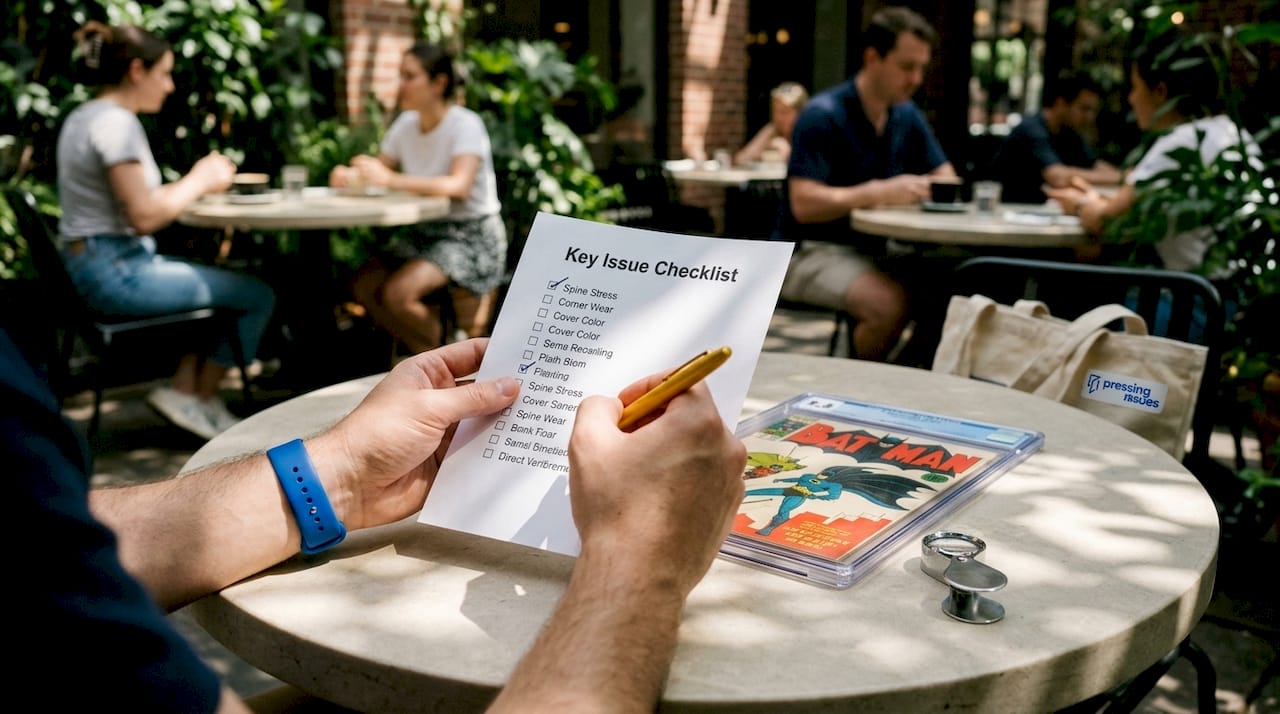
The gap in value between a key issue and a filler issue from the same run is enormous. High-grade copies of key issues can command 50 to 100 times higher prices than low-grade copies of the same book. That multiplier shows exactly why condition and key status work together rather than separately.
Key issues to watch include:
- First appearances: The debut of a character in print, such as Amazing Fantasy #15 (Spider-Man) or Incredible Hulk #181 (Wolverine)
- Origin stories: Issues that explain a hero or villain's backstory, which tend to hold long-term collector interest
- Major deaths or transformations: Storyline-defining moments that permanently change a character's arc
- First team appearances or crossover events: Issues where iconic groups first assemble
Vintage status alone rarely guarantees value. Experienced collectors prioritize key issue status over age every time. A 1940s filler issue from a minor title will almost always trail a 1980s key issue in demand and price.
Pro Tip: Before buying any Silver or Bronze Age book, cross-reference it against a key issue checklist. Paying a premium for a non-key is one of the most common and costly mistakes new collectors make.
2. Condition and the comic book grading system
Condition is the second pillar of collectible comic value, and the professional grading system makes it measurable. The industry-standard scale runs from 0.5 (Poor) to 10.0 (Gem Mint), with grades like CGC 9.8 (Near Mint/Mint) commanding dramatic premiums over a CGC 2.0 (Good) copy of the same issue.
Professional grading through services like CGC (Certified Guaranty Company) or CBCS (Comic Book Certification Service) encapsulates a comic in a tamper-evident holder with its grade displayed. This process builds buyer trust, especially in online markets where a collector cannot physically inspect a book. Grading increases liquidity and attaches a premium to high-grade slabs that raw copies simply cannot match.
Deciding when to grade is a financial calculation. The process runs $30–$150 per book depending on the service tier. Grading makes financial sense when:
- The raw market value of the comic exceeds $150
- The book is a recognized key issue with strong collector demand
- The grade you expect will meaningfully increase the sale price
- You plan to sell through auction or a high-traffic marketplace
Restoration is a separate issue that grading exposes directly. Restoration indicators such as color touch, trimming, and staple replacement are flagged on the grading label. A restored comic occupies a distinct market lane with generally lower prices than an unrestored copy at the same apparent grade. Buyers pay less for restored books because the alteration breaks the chain of original condition.
Pro Tip: If your comic has any creases, spine ticks, or cover stress lines, professional pressing before grading submission can recover lost grade points. Pressing is not restoration. It is a legitimate preparation step that removes non-color-breaking defects.
3. Scarcity: print runs, variants, and surviving copies
Scarcity drives price through a simple equation: limited copies plus high demand equals higher prices. The tricky part is that scarcity is not the same as age. Modern comics with massive print runs from the 1990s are often worth less than rare Bronze Age issues in low grade. Millions of copies were printed during the speculator boom of that era, and most were bagged and boarded immediately, meaning high-grade copies are plentiful.
Newsstand vs. direct editions
Newsstand editions were distributed through retail newsstands and drugstores in smaller quantities than direct editions sold through comic shops. Newsstand editions with smaller print runs command premiums compared to their direct edition counterparts. The difference can be significant for key issues from the late 1970s through the 1990s.
| Edition type | Typical print volume | Collector premium |
|---|---|---|
| Direct edition | Higher print run | Standard market price |
| Newsstand edition | Lower print run | Notable premium on key issues |
| Low-print variant | Very limited | High premium when confirmed |
| Error or misprint | Unintentional rarity | Variable, often speculative |
Census data from grading services like CGC gives you a real-time count of how many copies of a specific issue exist in each grade. A book with only three copies graded above 9.0 is genuinely scarce. That number directly informs how to price comics and what a buyer should expect to pay.
4. Cultural relevance and why media affects comic book prices
Media announcements are the single fastest trigger for short-term price spikes in the comic market. When a character gets cast in a major film or television production, collectors rush to buy that character's key issues before prices climb. Media announcements cause price spikes of 200–500% in key issues ahead of movie releases. That is not a gradual appreciation. It is a buying frenzy compressed into days or weeks.
The Doctor Doom casting news in 2026 illustrates this perfectly. Prices for Fantastic Four #5 (1962) surged dramatically after Robert Downey Jr. was announced in the role. Collectors who already held copies benefited enormously. Those who bought at peak hype paid prices that may take years to recover.
The key distinction is between speculative hype and lasting cultural impact:
- Lasting value: Characters with decades of fan loyalty, multiple media appearances, and strong licensing histories tend to hold value after the initial spike
- Speculative hype: Minor characters cast in a single project often spike and then collapse once the film underperforms or the project is canceled
- Timing strategy: Savvy collectors buy pre-hype and sell during peak demand, not after the general public has already driven prices up
Understanding why media affects comic book prices means separating the signal from the noise. A casting announcement is a signal. Whether that character has the cultural staying power to sustain elevated prices is the real question.
Pro Tip: Track industry news sources and casting announcements closely. The window between a confirmed announcement and peak market price is often 48–72 hours. After that, you are buying into hype, not value.
5. Completeness, originality, and market liquidity
Completeness is a factor that catches many collectors off guard. A comic graded at CGC 8.0 with a missing coupon or cut insert is worth significantly less than a complete copy at the same grade. Missing original components can halve a comic's value relative to a complete, graded copy. This matters most for Bronze Age and Copper Age books where subscription coupons, posters, and centerfold inserts were common.
Key completeness and presentation points that affect final sale price:
- Original inserts: Posters, centerfolds, and subscription cards must be present and intact
- Staples: Original staples in good condition signal authenticity; replaced staples are a restoration flag
- Presentation quality: High-quality listings with detailed photos and accurate descriptions command stronger prices and faster sales
- Transparency: Disclosing known defects builds buyer trust and reduces disputes that damage seller reputation
Liquidity matters almost as much as price guides. A comic priced at $500 that sits unsold for six months is worth less in practical terms than a $300 book that sells in a week. Presentation, accurate grading, and honest descriptions all accelerate sales and improve the realized price you actually receive.
Key takeaways
Comic book resale value is determined by issue importance, condition, scarcity, and cultural relevance working together, not by any single factor alone.
| Point | Details |
|---|---|
| Key issue status leads | First appearances and origin stories command the highest premiums regardless of era. |
| Grade multipliers are real | A CGC 9.8 copy can sell for 50 to 100 times more than a low-grade copy of the same key issue. |
| Scarcity beats age | A rare Bronze Age book in low grade often outperforms a common 1990s book in high grade. |
| Media hype is short-lived | Buy before announcements and sell at peak; prices often collapse after the initial surge. |
| Completeness protects value | Missing inserts or replaced staples can cut a comic's realized price by half. |
What I've learned about chasing comic book value the right way
The collectors I respect most are not the ones chasing every media announcement. They are the ones who did the research three years before the announcement came. I have watched people pay $800 for a book that was $80 six months earlier, convinced the movie would push it to $2,000. Sometimes it does. More often, the film underperforms, the character gets recast, and that $800 book is back to $150.
The discipline that actually builds a collection worth something is knowing your key issues cold before the market tells you to care about them. That means reading census data, understanding print run history, and recognizing which characters have genuine cultural staying power versus a single moment of hype.
I also think collectors underestimate the role of condition preparation. A book that could grade CGC 8.5 raw might grade CGC 9.4 after professional pressing. That grade jump on a key issue is not cosmetic. It is the difference between a $400 sale and a $1,200 sale. The grading upgrade sweet spots are real, and ignoring them leaves money on the table.
The balanced approach works best. Not every book needs to be slabbed. Not every book should be sold raw. Learn to read which books sit in the sweet spot where grading costs are justified by the grade premium you will earn. That judgment, built over time, is what separates a serious collector from someone who just owns a lot of comics.
— Charles
How Pressing Issues helps you protect and grow your collection's value
Condition is the one comic book resale value factor you can actually control. Everything else, from issue importance to media timing, is largely fixed once you own a book. But the physical state of your comic is something you can improve before a grading submission.
At Pressing Issues, we specialize in professional comic pressing and cleaning for collectors in Seattle and Portland. Our process removes non-color-breaking defects like spine ticks, creases, and cover stress lines, giving your book the best possible chance at a higher grade. We work with everything from raw submissions to pre-grading preparation for high-value keys. Check our services and turnaround times to see how we can help your books reach their full potential before they go to the grading table.
FAQ
What is the most important factor in comic book resale value?
Key issue status is the single most important driver of comic book resale value. First appearances, origin stories, and major character events consistently command the highest prices regardless of era.
Does professional grading always increase a comic's value?
Professional grading increases value when the raw market price exceeds $150 and the book is a recognized key issue. Grading costs $30–$150 per book, so the math only works when the grade premium justifies the expense.
How does media affect comic book prices?
Media announcements trigger price spikes of 200–500% on key issues tied to newly cast characters. These spikes are often short-lived, so collectors who buy before announcements and sell at peak demand capture the most value.
What does "restored" mean on a grading label?
A restored comic has had physical alterations such as color touch, trimming, or staple replacement. Grading services flag these changes on the label, and restored copies sell at lower prices than unrestored copies at the same apparent grade.
Why do 1990s comics have low resale value?
Most 1990s comics were printed in massive quantities during the speculator boom, meaning high-grade copies are common and supply far exceeds demand. Scarcity, not age, is what drives collectible comic value upward.
Recommended
- Comic Book Cleaning | Comic Services | Pressing Issues — Pressing Issues
- What Is Comic Book Flipping? A 2026 Investor's Guide — Pressing Issues
- The Grading Upgrade Game: Where Are the Sweet Spots for Pressing and Cleaning? — Pressing Issues
- Comic Dealer Heritage Auction Preparation: 2026 Guide — Pressing Issues