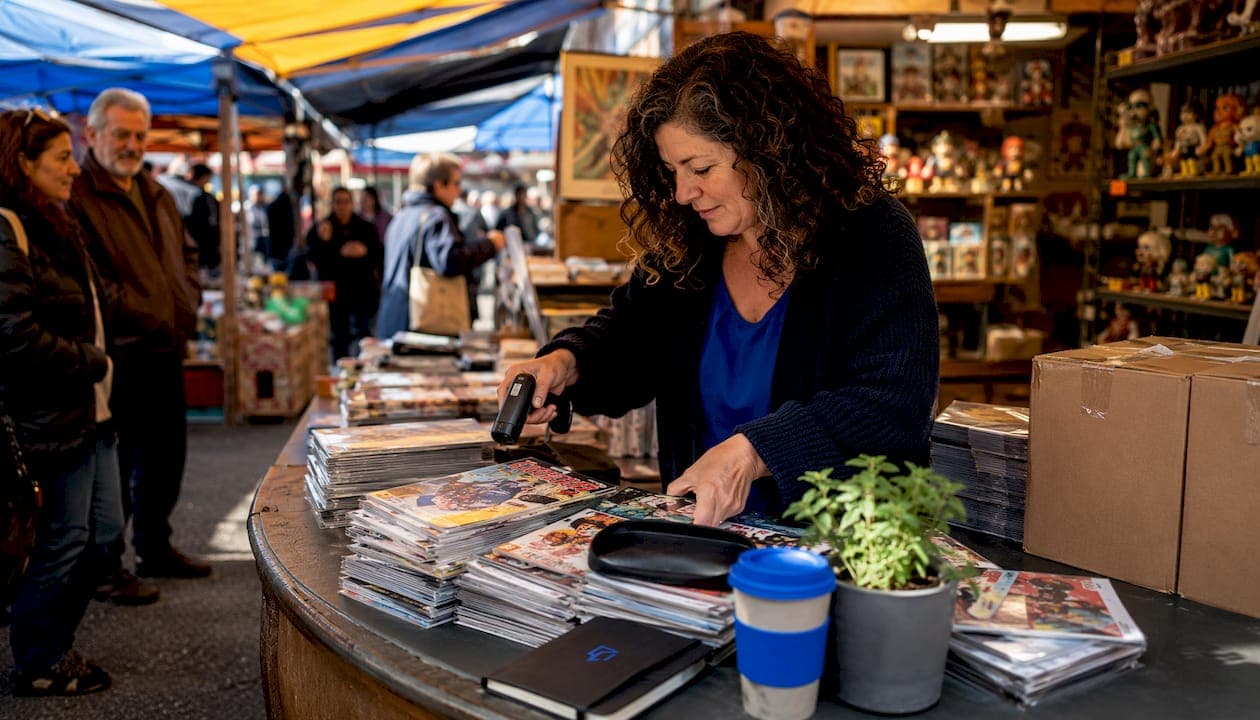
Solid comic book store inventory best practices come down to three non-negotiables: protect cash flow by stocking high-turn items first, track condition from the moment a book hits your shelves, and flag grading candidates before they get handled to death. Start here today:
- Reconcile new-release receipts against your distributor invoice the same afternoon they arrive
- Mark any street-date titles "do not sell until [date]" in your POS immediately
- Log high-value books (key issues, first appearances, low-print runs) in a separate grading-prep queue for CGC submission review
- Check three KPIs before you close: sell-through rate on this week's new releases, days of inventory on slow back-issue bins, and open preorder count
The Year 1 sales mix recommended by experienced U.S. operators balances new comics, graphic novels and trades, merchandise, and back issues to maintain cash flow and limit slow stock exposure. That ratio keeps cash moving and limits exposure to slow stock. Pressing Issues sees the downstream effect of this directly: books that were properly tracked and stored from day one arrive in far better condition for cleaning, pressing, and CGC submission.
Table of Contents
- What sales mix should you use in Year 1?
- How should you organize your shop floor for maximum turnover?
- Which inventory tracking systems actually work for comic shops?
- How do you set reorder points and handle transmedia demand spikes?
- How do you prep books for cleaning, pressing, and CGC submission?
- What storage and shipping standards protect condition?
- How do you handle consignment and dealer buying correctly?
- Which KPIs should every comic shop track weekly?
- What inventory mistakes cost comic shops the most?
- Key Takeaways
- The inventory detail most dealers overlook
- Pressing Issues: professional cleaning, pressing, and CGC submission
- Sources and further reading
What sales mix should you use in Year 1?
The 40/30/20/10 split is not arbitrary. New comics provide weekly foot traffic and pull-list subscribers. Graphic novels serve browsers looking for complete stories. Merchandise captures impulse buys at checkout. Back issues add collection depth without tying up excessive capital in slow-moving inventory.
| Category | % of Budget | Purpose |
|---|---|---|
| New comics | 40% | Weekly traffic, pull lists, subscriber retention |
| Graphic novels/trades | 30% | Browser sales, gift purchases, complete-story readers |
| Merchandise | 20% | Impulse buys, margin booster at checkout |
| Back issues | 10% | Depth and collector appeal, low initial exposure |
Start wide, not deep on your first orders. Order smaller quantities across many titles, then use your first four to six weeks of sales data and direct customer feedback to refine reorders. Locking capital into deep stacks of unproven titles is the fastest way to kill cash flow in Year 1.
Pro Tip: If your store sits near a college campus or a family neighborhood, shift merchandise up to 25% and trim back issues to 5%. Local demographics should always override the general 40% new comics, 30% graphic novels/trades, 20% merchandise, and 10% back issues mix.
How should you organize your shop floor for maximum turnover?
The single most important layout rule: current issues front and center, visible from the door. Everything else follows from that.
- Group back issues alphabetically by series title in clearly labeled bins
- Use adjustable shelving to accommodate oversized hardcovers and omnibus editions without bending spines
- Place high-demand collectibles (variant covers, pins, graded slabs) in a locked display case near the register
- Keep a dedicated pull-list/holds zone behind the counter or in a labeled rack, separated from general stock
- Reserve lower shelves for all-ages and kids' titles; mature content goes higher or behind the counter
- Keep aisles sufficiently clear to allow two customers to browse simultaneously without friction.
Eye appeal drives impulse buys more than most dealers expect. Presentation and visual appeal affect realized prices and sell-through rates, whether you are selling raw copies off the shelf or graded slabs in a case.
Pro Tip: Bold, genre-specific signage ("Horror," "Manga," "Indie Gems") reduces the time customers spend searching and increases the time they spend browsing. Dwell time and basket size move together.
Which inventory tracking systems actually work for comic shops?
Automate where possible. Comic retailers receive numerous new SKUs each week, often arriving across multiple shipments and distributor invoices, with frequent delivery schedules. Manual spreadsheets collapse under that volume.
A practical SKU format for new issues: [PUBLISHER]-[TITLE ABBREVIATION]-[ISSUE#]-[VARIANT]. For back issues and graded books, use the UPC when one exists; assign a custom SKU for pre-barcode era books and slabs. Your POS should support inventory variants, customer pull lists, barcode label printing, and sales reporting at minimum.
| Routine | Cadence | What to check |
|---|---|---|
| Receipt reconciliation | Daily (on arrival) | Distributor invoice vs. physical count |
| Pull-list sync | Weekly (Wednesday) | Subscriber holds vs. available stock |
| Cycle count (new releases) | Weekly | Sell-through vs. POS sales |
| Full back-issue count | Monthly | Shrink, misfiled, and damaged items |

Street-date controls are non-negotiable. A "do not sell until" flag in your POS prevents premature sales that violate distributor agreements and create revenue-recognition headaches. An RFID pilot at scale can push inventory accuracy to approximately 98%, though tagging costs and shelf interference should be assessed before committing.
Pro Tip: Manage Comics integrates pull-list management directly with Shopify and Lightspeed, auto-generating Final Order Cutoff orders and syncing subscriber holds. It removes the double-entry problem that plagues stores running POS and pull lists on separate systems.
How do you set reorder points and handle transmedia demand spikes?
Tie reorder points to sell-through rate and lead time, not gut feel. A basic formula: Reorder Point = (Average Weekly Sales × Lead Time in Weeks) + Safety Stock. For a title selling 10 copies per week with a two-week lead time and a two-week safety buffer, your reorder point is 40 units.
- Pull weekly velocity data from your POS for your top 25 SKUs
- Calculate lead time per distributor (typically one to two weeks for major distributors)
- Set safety stock at two weeks of average demand for high-velocity titles, one week for mid-tier
- Flag any title with a transmedia event (film trailer, streaming announcement) for an uplift review
- Apply conservative uplift multipliers: 3x baseline for unknown adaptations, 5x for high-profile releases with confirmed trailers
- Cover the upside with pre-orders rather than speculative inventory; pre-orders de-risk the spike without locking cash into unsold stock
Pro Tip: Pre-orders are your hedge. When a Marvel or DC property gets a major streaming announcement, open a pre-order window immediately. You get real demand data before you commit to a buy.
How do you prep books for cleaning, pressing, and CGC submission?
Condition visibility and documented provenance raise realized grades and resale value. Prepare books before they reach a cleaner or CGC, not after.
Grading-prep checklist:
- Triage by estimated value: books with a realistic grade uplift that covers CGC submission fees plus pressing costs are candidates; the rest are not
- Bag and board every candidate in Mylar or polypropylene bags with acid-free boards immediately after triage
- Document existing defects (spine ticks, corner blunts, surface dirt) with written notes and photographs before any handling
- Distinguish non-restorative cleaning (surface dirt removal, light pressing) from restoration (color touch, tape removal); CGC grades these differently and disclosure matters
- Label each book with consignor name or inventory ID, estimated grade, and submission tier
Photography guidelines: shoot under diffuse natural light or a daylight-balanced LED panel. Capture the cover, back cover, spine, and any known defect areas. White balance to neutral. These images become your condition record and your estimate baseline.
Quick ROI check before submitting:
- Estimate current raw grade
- Estimate post-press grade (realistic, not optimistic)
- Look up CGC census data for that grade's market value
- Subtract CGC submission fee plus pressing fee
- If the net gain exceeds 20% of the book's current raw value, submit
Pro Tip: Pressing Issues provides a complimentary value analysis before any paid service. Send photos and we will tell you whether pressing makes financial sense for your specific book, including realistic grade expectations and turnaround notes.
What storage and shipping standards protect condition?
A stable environment reduces condition loss more reliably than any restoration step. Store comics at 65–70°F and 30–50% relative humidity. Fluctuations cause paper expansion and contraction that creates spine stress and tanning over time.
- Use Mylar D or polypropylene bags with acid-free backer boards for all stored stock
- Store boxes horizontally for long-term archival; vertical storage in short-term display bins is acceptable with proper dividers
- Keep graded slabs flat or in a dedicated slab box, never stacked loose
For shipments to Pressing Issues or CGC, pack each book individually in a bag and board, then wrap in bubble wrap. Place books in a rigid box with at least one inch of foam or packing material on all sides. Use tamper-evident tape on the outer box.
| Scenario | Inner packaging | Outer box | Protection level |
|---|---|---|---|
| In-store daily handling | Bag + board | N/A | Standard |
| Insured shipping to grader | Bag + board + bubble wrap | Rigid box, foam padding | High |
| Long-term archival storage | Mylar + acid-free board | Acid-free box, climate-controlled | Maximum |
Pro Tip: For pressing modern vs. vintage comics, packing requirements differ. Vintage books with brittle paper need extra rigidity; modern books tolerate standard bubble wrap well. When in doubt, overpack.
How do you handle consignment and dealer buying correctly?
Treat consigned stock as a payable liability, not store-owned inventory. Track consigned items in a memo log separate from your main inventory system. When a consigned book sells, your revenue is the commission only; the principal goes to the consignor. Unsold returns never touch your COGS.
Consignment intake checklist:
- Record: item description, issue number, grade/condition notes, consignor name and contact, agreed split percentage, date received, return terms
- Photograph the book at intake (cover, spine, back)
- Assign a memo-log ID that matches the physical tag on the bag
- Flag the item in your POS as "consignment" so it cannot be counted in store-owned inventory reports
For convention and dealer buying, run a quick provenance check (ask about prior ownership, look for restoration signs), tag the book immediately with your purchase price and date, and decide on store credit vs. cash based on your current cash position. Store credit issued is deferred revenue; book it as a liability until redeemed.
Which KPIs should every comic shop track weekly?
Track sell-through, days of inventory, and reorder frequency as your primary operating controls.
- Sell-through rate: Units sold ÷ Units received × 100. Target 70%+ on new releases within four weeks
- Days of inventory: Current stock units ÷ Average daily sales. Target under 60 days for new comics, under 180 days for back issues
- Gross margin return on inventory (GMROI): Gross profit ÷ Average inventory cost. A GMROI above 2.0 means each dollar of inventory generates two dollars of gross profit
- Hold backlog: Open pull-list holds not yet fulfilled; a growing backlog signals ordering shortfalls
Weekly dashboard review: top 25 SKUs by velocity, open preorders by title, and consignment aging (flag anything unsold past 90 days). Monthly: full GMROI by category, reorder point accuracy, and shrink rate.
What inventory mistakes cost comic shops the most?
The most damaging errors are overstocking slow categories, skipping receiving controls, and ignoring condition documentation from day one.
- Overstocking back issues: Move slow SKUs to a $1–$5 promotional bin within 90 days; do not let dead stock occupy prime shelf space
- No receiving checklist: Enforce a physical count against the distributor invoice on every delivery; discrepancies caught at receiving are free to fix, discrepancies caught at month-end are expensive
- Ignoring condition at intake: Log damage at receiving, not at sale; a book that arrives dinged and gets sold as Near Mint creates returns and reputation damage
- Store credit booked as revenue: It is a liability until redeemed; booking it as immediate revenue overstates cash flow
- No street-date enforcement: A single premature sale can cost distributor access
Loss prevention: Place CCTV cameras at high-value display cases and the back-issue bins closest to the exit. Use locked acrylic cases for graded slabs and key variants. For mid-to-large stores, an RFID pilot can reduce shrink and speed weekly counts significantly.
- Audit your bottom 20% of SKUs by velocity every 90 days
- Move stagnant stock to promotional pricing or liquidation channels before it ties up shelf space
- Review your receiving checklist compliance weekly, not quarterly
Key Takeaways
Strong comic book inventory management connects every operational decision, from your opening buy to your CGC submission workflow, into one system that protects cash, condition, and collector value.
| Point | Details |
|---|---|
| Year 1 sales mix | Allocate 40% new comics, 30% graphic novels and trades, 20% merchandise, 10% back issues to protect cash flow. |
| Automate tracking early | Comic shops receive 100–300 new SKUs weekly; manual systems break down fast without barcode scanning and POS sync. |
| Condition documentation | Log defects at receiving, not at sale; books tracked from day one arrive in better shape for CGC submission. |
| Reorder formula | Set reorder points using weekly velocity, lead time, and safety stock; apply 3x–5x uplift for transmedia events. |
| Pressing Issues | Professional cleaning, pressing, and CGC submission handling for U.S. collectors and dealers, with complimentary value analysis before any paid service. |
The inventory detail most dealers overlook
Most comic shop guides stop at "bag and board your key issues." That is the floor, not the ceiling. What we see consistently at Pressing Issues is that the stores and dealers who get the best results from pressing and CGC submission are the ones who treated condition as an inventory attribute from the moment a book arrived, not an afterthought when they decided to sell.
A book that was handled without gloves, stored in a warm back room, and pulled from a bin without a board has already lost grade points before it reaches us. The operational habits described in this guide, receiving checklists, condition logging, proper storage, and grading-prep triage, are not just retail housekeeping. They are the upstream work that determines what grade a book can realistically achieve. Dealers who connect those dots consistently outperform those who treat pressing as a last-minute fix.
Pressing Issues: professional cleaning, pressing, and CGC submission
When your inventory triage surfaces a key issue worth submitting, the next step is getting it cleaned, pressed, and graded correctly. Pressing Issues performs professional, non-restorative cleaning and pressing for collectors and dealers across the United States, and manages the full CGC submission process including shipping, paperwork, and tracking.

Submit a book and you receive a condition assessment, a realistic grade estimate, and clear fee disclosure before any work begins. There are no surprises on turnaround or cost. Whether you are clearing a single key issue or processing a dealer lot, Pressing Issues handles the details so you can focus on your inventory. Review our services and rates or go straight to the comic book pressing page to get started.
Sources and further reading
- How to Open a Comic Book Store — Source for the Year 1 sales mix (40/30/20/10) and shop floor organization principles.
- Ordering Tips (Sequart) — Practical guidance on starting wide, not deep, and using customer feedback to refine reorders.
- Shopify Comic Store Setup Guide — Covers weekly SKU volume (100–300), street-date controls, and multi-distributor receiving workflows.
- Comic Store RFID Case Study (Sensormatic) — Documents an RFID pilot achieving approximately 98% inventory accuracy across 35,000+ tagged items.
- Comic Shop Bookkeeping: Consignment Guide — Authoritative source on memo-log consignment tracking, store credit as deferred revenue, and COGS treatment.
- Transmedia Waves Playbook — Source for conservative uplift multipliers (3x and 5x) for transmedia-driven demand spikes.
- POS and Inventory Guide for Comic Shops — Covers POS feature requirements including variant support, pull lists, and barcode printing.
- CGC Submission Do's and Don'ts (Pressing Issues) — Step-by-step packing and submission guidance for CGC; essential reading before your first submission.
- Eye Appeal and Market Value (Pressing Issues) — Explains how presentation affects sell-through and realized prices for raw and graded books.
Recommended
- Comic Book Consignment Best Practices for Collectors — Pressing Issues
- CGC Submission Do's and Don'ts: How to Save Money and Avoid Shipping Headaches — Pressing Issues
- Comic Dealer Population Report Strategy: 2026 Guide — Pressing Issues
- Beyond the Number: Why Eye Appeal is the Secret to Winning in the Comic Market — Pressing Issues