Professional pressing flattens non-color-breaking dents, bends, spine rolls, ripples, and stacking marks, restoring a comic's presentation without adding a single fiber of material. It cannot fix color-breaking creases, tears, missing paper, or most stains, and results always depend on how old and brittle the paper already is. Pressers manage that variability with controlled humidity, heat, and pressure, and the best outcomes come from books that still have enough structural integrity left to respond.
TL;DR:
- Pressing can effectively fix non-color-breaking bends, spine rolls, ripples, and stacking bends in comics with sufficient paper integrity.
- The best results occur on books graded between 4.0 and 8.0, especially mid-grade comics with correctable defects like spine stress and corner dings.
- Proper pressing involves multiple steps: inspection, dry cleaning, humidification, heat and pressure cycling, slow cooling, and cold stabilization, taking 36 to 72 hours.
- It cannot repair color-breaking creases, tears, missing paper, stains, or ink cracks, and pressing over such damage can worsen the defects.
- Reputable services document screening, use controlled processes, provide before-and-after photos, and avoid rushing the stabilization step to ensure safe, effective results.
Table of Contents
- Comic Pressing Before and After: A Labeled Photo Gallery
- What Defects Can Comic Pressing Actually Fix?
- How Does the Comic Pressing Process Actually Work?
- What Pressing Can't Fix, and Where It Can Go Wrong
- How to Choose a Comic Book Presser
- A Labeled Case Study From Pressing Issues
- A Note From Charles
- Ready to See What Pressing Can Do for Your Comics?
- Sources
Comic Pressing Before and After: A Labeled Photo Gallery
Collectors ask to see proof before they trust a process that involves heat and pressure near a book they've owned for decades. Fair enough. A gallery organized by defect type tells you more than a generic "before and after" slider ever could, because pressing behaves differently depending on what's actually wrong with the paper.
Here's how the most common defect categories typically respond, based on the patterns pressers see across thousands of submissions:
- Corner crunch. A soft crease at the corner tip, not yet broken through the color layer, usually flattens out almost completely under heat and pressure. If the crease has already cracked the ink, a shadow line often remains.
- Spine roll. Books stored upright on a shelf for years develop a curve along the spine. Controlled humidification relaxes the paper enough for pressure to reset it flat, and this is one of the most reliable fixes pressing offers.
- Ripples and waves. Humidity swings cause wavy distortion across a cover or interior pages. Pressing re-flattens the paper fiber by fiber, though heavily rippled Silver Age books sometimes need a second cycle.
- Stacking bends (spine ticks). Small horizontal creases from books leaning against each other in long boxes. Minor ticks disappear; deeper ones that have already broken color usually leave a faint trace.
- Light surface dirt and shelf wear. A separate dry cleaning pass before pressing lifts surface grime, and the combination often produces the most visually dramatic before-and-after pairs in any gallery.
- Non-color-breaking cover bends. A general soft bend across the front cover, the kind that happens from a book getting tucked into a bag wrong, tends to press out cleanly in a single cycle.
Every one of these before-and-after pairs should be captioned honestly: what the defect was, whether pressing resolved it fully or partially, and any limitation that remained. A presser who only shows you flawless transformations isn't showing you the full picture.
Pro Tip: When you photograph your own comic to request an estimate, shoot under raking light (a lamp held at a low angle across the surface) rather than straight overhead lighting. Raking light throws shadows into every ripple and crease, which is exactly what a presser needs to see. Include a ruler or a loupe in the frame for scale, and keep your framing consistent between shots so a reviewer can compare the same section before and after.
The community has documented this extensively too. Forum before-and-after threads across collector boards consistently show the same pattern: pressing improves the visual defects listed above, but color-breaking creases and stains show up again and again as the exceptions nobody manages to fix. That's not a knock on any particular presser's skill. It's a paper physics limitation that applies to the whole process.
What Defects Can Comic Pressing Actually Fix?
Pressing works on structural distortion, not on damage that has already broken through the printed surface. The defects that respond best share one trait: the paper fiber has bent, but the ink layer on top hasn't cracked.
That list includes non-color-breaking bends and dings, spine roll, general waviness from humidity exposure, corner creases that haven't gone white, stacking bends, and mild warping from improper storage. A book with a soft diagonal crease running across the cover, one that shows as a shadow rather than a white line, is a textbook candidate. A book with the same crease broken all the way through to white paper is not, no matter how skilled the presser is.
Where this gets interesting for value is the grade curve. Books in the 4.0 to 8.0 range tend to offer the best return on a pressing investment, because they typically carry exactly the kind of correctable defects, spine stress, corner dings, general handling wear, that pressing addresses directly, and they still have enough paper quality left to hold the improvement. A book that presses from a 6.0 to an 8.0 can see a meaningful jump in market value relative to the cost of the service.
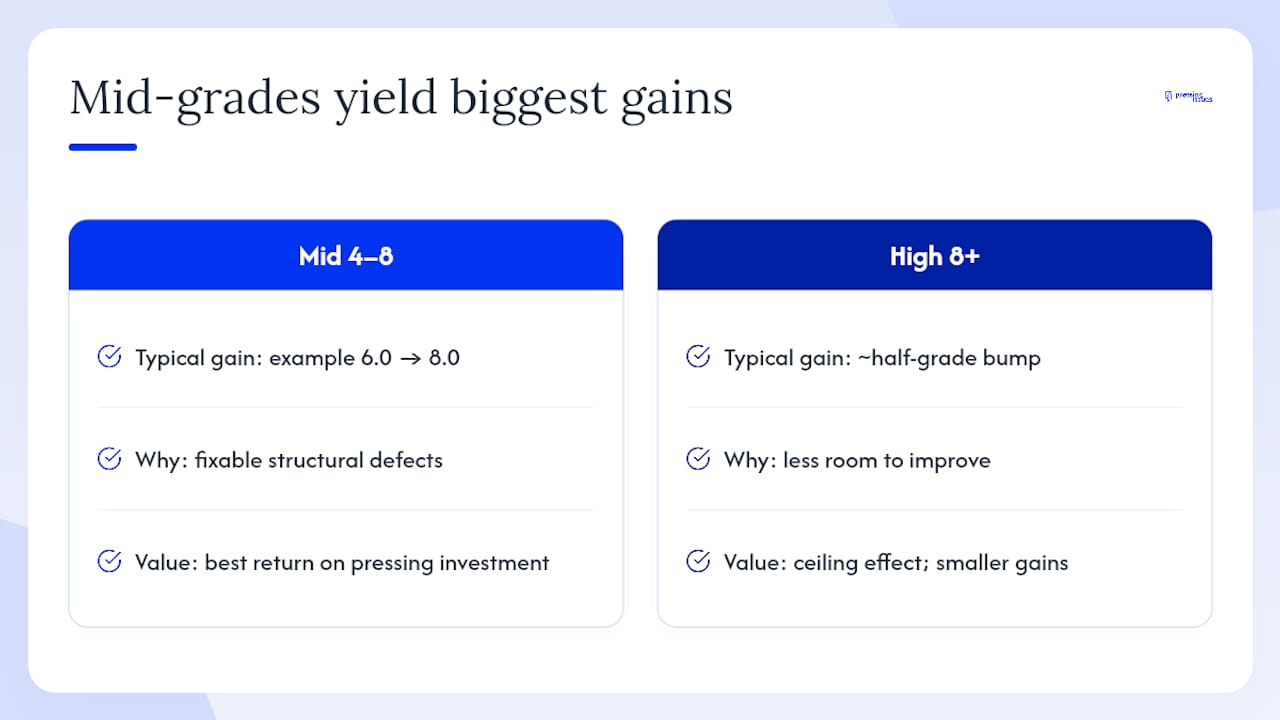
High-grade books, 8.0 and above, run into a ceiling effect. There's simply less room to improve, and the defects present at that grade tend to be smaller and harder to correct dramatically. You might see a half-grade bump. You're not going to see a book jump three points because there wasn't three points of correctable damage to begin with.
One reassurance worth stating plainly: pressing is classified as a non-restorative, conservation process, and it does not change how a book gets labeled when graded. A pressed book that grades well still receives a standard universal grade label, not a restored designation. That distinction is precisely why pressing has become accepted practice rather than something collectors need to disclose apologetically.
Mid-grade books show the clearest before-and-after value story in the hobby. A 6.0 copy with a spine roll and a couple of stacking bends is often a stronger pressing candidate, dollar for dollar, than a 9.0 copy with a single tiny corner tick, simply because there's more fixable surface area to work with.
Before requesting an estimate, gather clear photos under good light, note every defect you can see, and mention how the book has been stored. That documentation lets a presser give you a realistic answer instead of a guess. Signs your comic needs pressing walks through how to spot the defects most worth mentioning in that first conversation.
How Does the Comic Pressing Process Actually Work?
Pressing is a sequence, not a single step, and skipping or reordering steps is where amateur attempts go wrong. Here's the workflow a professional cycle typically follows, start to finish:
- Inspection and screening. The presser examines the book under strong, angled light to identify every defect, distinguish color-breaking damage from correctable bends, and flag any brittleness or prior restoration that changes how the book should be handled.
- Dry cleaning. Surface dirt and grime get lifted before any moisture is introduced. Cleaning after humidification risks pushing dirt deeper into the paper instead of removing it, which is why order of operations matters here.
- Humidification. Controlled moisture relaxes the paper fibers just enough to make them receptive to reshaping, without saturating the paper.
- Heat and pressure cycle. The book goes under calibrated heat, generally cited across the industry as staying within a 140 to 170°F range, combined with even, steady pressure. Cycle length varies with thickness, typically running 4 to 8 hours per cycle for a standard book, longer for oversized or Golden Age issues with heavier paper stock.
- Gradual cool-down. The book cools slowly under continued pressure rather than being pulled out while still warm, which prevents the fibers from snapping back into their old shape.
- Cold stabilization. The pressed book rests under weight for 24 to 48 hours at room temperature. This step is the one most often skipped by impatient DIY attempts, and skipping it is a leading cause of partial reversion.
Total turnaround for a complete cycle, including stabilization, commonly runs 36 to 72 hours depending on how complex the defects are. Shipping a book for grading immediately after pressing, before stabilization finishes, risks the paper drifting back toward its original shape en route. That's why a rushed presser is often a worse outcome than a slower, more careful one.
What Pressing Can't Fix, and Where It Can Go Wrong
Color-breaking creases, tears, missing corners or pieces, foxing, water stains, and most tape or adhesive residue are outside pressing's reach. Once ink has cracked or paper has torn away, no amount of heat and pressure restores what's physically gone. Attempting to press over these defects doesn't just fail. It can make things worse, driving a stain deeper into the paper or stressing a tear until it spreads.
The real risk profile for pressing gone wrong includes:
- Thermal shock, usually from opening a press mid-cycle or cooling a book too fast, which can cause brittle pages to crack.
- Spine pancaking, where excessive pressure flattens the spine so aggressively it loses its natural curve and structure.
- Over-pressing, since most books can safely tolerate only two to three press cycles before the paper fibers start losing elasticity and risk brittle failure.
- Improper technique on aged newsprint, since paper construction and tolerance shift with age, and what's safe on a 1990s book can damage a 1960s one.
If your book shows brittleness, missing chips, or heavy tape and glue residue, treat that as a red flag for a screening conversation before anything else happens. A reputable presser will tell you upfront if a book is a poor candidate rather than running it through the cycle anyway.
How to Choose a Comic Book Presser
Run any presser you're considering through this checklist before you ship a single book:
- Do they document a written screening or inspection step before they press anything?
- Will they provide before-and-after photos as part of the service, not just on request?
- Can they describe their temperature controls and cycle process in specific terms?
- Do they build in cold stabilization time rather than rushing books out the door?
- Is there an insurance or claims policy in case a book is damaged in transit or in process?
- Can they give you a realistic turnaround estimate rather than a vague "it depends"?
When you request a quote, ask directly how they handle fragile or brittle newsprint, and ask what happens if they determine mid-process that a book isn't a good candidate. A documented screening policy paired with before-and-after photography is one of the clearest signs you're dealing with someone who takes the craft seriously.
For the cost-benefit math: pressing tends to make financial sense once a book's potential grade jump translates into a value increase larger than the service fee and turnaround cost combined. Books worth under $30 to $40 rarely clear that bar. Anything with real key-issue or mid-grade upside usually does.
Pro Tip: Ask a prospective presser to show you a before-and-after example of a book similar in age and defect type to yours, not just their best overall transformation. A spine roll fix on a modern book tells you nothing about how they'll handle a brittle Silver Age spine roll.
A Labeled Case Study From Pressing Issues
One recent submission involved a mid-grade Bronze Age book with a pronounced spine roll, two stacking ticks, and general surface dirt across the cover. The book went through screening, dry cleaning, humidification, a full heat cycle, and 48 hours of cold stabilization before photography and return shipping.
[brand_signal]
The result: the spine roll flattened almost completely, both stacking ticks became barely visible under raking light, and the surface cleaning brightened the cover noticeably in side-by-side photos.
That timeline, screening first, humidification and heat next, stabilization last, mirrors the sequence every reputable presser follows, and it's the same order outlined in the technical process above.
A Note From Charles
Pressing rewards patience and punishes shortcuts.. The books that come out looking best are the ones where someone slowed down, screened honestly, and didn't rush the stabilization step just to hit a shipping deadline. That's the standard worth expecting from anyone handling your collection.
— Charles
Ready to See What Pressing Can Do for Your Comics?
Collectible comic pressing services give collectors what most local options can't: a documented screening step before your book ever touches heat, controlled temperature and pressure cycles, full cold stabilization, and before-and-after photos you can actually compare side by side.
Every submission starts with an honest look at whether your book is a good candidate, not a guess. If the defects are correctable, you'll get a clear estimate and a realistic timeline before anything happens to your comic. If they're not, you'll hear that too, upfront, instead of paying for a cycle that won't move the needle. Check current services, rates, and turnaround times to see what fits your book, or head straight to the comic pressing service page to submit photos and request your estimate.
Sources
- Pressing | CGC
- Comic Book and Magazine Pressing | PSA Support
- How to Press a Comic Before CGC Submission | MyComicsCollection
- How to press comic books | ComicBookCPR