
Comic pressing turnaround dealer planning is the process of organizing pressing submissions to maximize inventory liquidity and profit margins. For U.S. comic book dealers, poor planning here is the single fastest way to tie up cash in books that sit unsold for months. Effective planning means knowing your cost structures, batching submissions intelligently, and timing your inventory around realistic turnaround windows. This guide covers what pressing services actually cost, how to select the right candidates, how to manage cash flow, and how to scale your operations without losing control of your margins.
What are typical pressing turnaround times and cost structures?
Turnaround time and fee structure are the two variables that shape every dealer's pressing schedule. In-store pressing services typically deliver within one week for standard volumes, with pricing starting at $15 per book or four books for $50. That one-week window is a meaningful advantage for dealers who need to move inventory quickly rather than waiting weeks for a remote service to return their books.
Grading costs add a separate layer to your budget. Professional grading tiers range from $20–$25 for economy submissions to $30–$65 for standard, $75–$150 for vintage or express, and over $300 for premium grading tiers. These figures do not include pressing fees, insured shipping, or return shipping costs. A dealer submitting a mid-grade Silver Age book at the standard tier is already looking at $80–$100 in total costs before the book sells.
Turnaround time also varies by volume and book condition. A batch of 20 books in good condition moves faster than a batch of five books with heavy restoration needs. Dealers who submit large, well-organized batches tend to get more predictable scheduling from pressing services.

Here is a quick reference for typical cost ranges by service tier:
| Service Tier | Pressing Fee | Grading Fee | Estimated Total |
|---|---|---|---|
| Economy (modern keys) | $15 per book | $20–$25 | $35–$40 per book |
| Standard (Bronze/Copper) | $15 per book | $30–$65 | $45–$80 per book |
| Vintage/Express | $15 per book | $75–$150 | $90–$165 per book |
| Premium (high-value keys) | $15 per book | $300+ | $315+ per book |
Key cost factors to track for every submission:
- Pressing fee per book
- Grading tier fee
- Insured outbound shipping
- Insured return shipping
- Any pre-screen or handling fees
How do you select comics worth pressing and plan batches?
Selecting the right books is where most dealers either protect their margins or destroy them. The standard framework is the 3x rule: the graded sale price must exceed the raw value by at least three times the total submission cost, including pressing, grading, shipping, and insurance. That buffer absorbs grading unpredictability and still leaves a profit.
Understanding pressable versus non-pressable defects is equally critical. Pressing removes stress marks, light spine ticks, and minor bends. It does not fix color-breaking creases, tears, water damage, or missing staples. Submitting a book with non-pressable defects wastes your pressing fee and your time.
Here is a practical selection process for building a submission batch:
- Pull candidates from inventory. Focus on books where the raw-to-graded price gap is significant, particularly keys, first appearances, and high-demand titles.
- Pre-screen each book. Pre-submission defect screening identifies which books are genuinely pressable and which will waste fees. Examine spine ticks, cover gloss, and staple condition under good lighting.
- Apply the 3x rule. Calculate total submission cost. Multiply by three. The graded value at a realistic grade must clear that number.
- Use conservative grade estimates. Do not plan around a 9.8. Plan around a 9.0 or 9.2 and treat anything higher as a bonus.
- Build your batch to a minimum shipping threshold. Sending five books costs nearly the same in shipping as sending fifteen. Fill your batch before submitting.
- Set aside sentimental books. A book with personal value but marginal profit potential belongs in your personal collection, not your submission batch.
Pro Tip: Run your 3x calculation using the current market price for the realistic grade, not the highest recorded sale. GoCollect and GPAnalysis both track recent census data and sale prices, giving you a grounded number to work from.
Checking which comics are worth pressing before you commit to a batch saves more money than any volume discount will.
How do you coordinate pressing services and manage dealer cash flow?
Cash flow is the hidden pressure in every dealer's pressing program. Books in transit or at a grading service are not generating revenue. The goal is to minimize the time between submission and sale while keeping total costs predictable.
Scheduling submissions around shipping and turnaround windows is the first discipline. If your pressing service returns books within one week and grading takes four to eight weeks at the economy tier, your total cycle from submission to slab is roughly five to nine weeks. Plan your inventory so you are not submitting your last sellable copies of a title right before a convention or peak selling window.
Local shop submission programs reduce individual insured shipping costs by pooling shipments among multiple submitters. Aggregating shipments can cut individual insured return shipping fees substantially. For a dealer submitting ten books per month, that savings compounds quickly over a year.
Practical cash flow steps for dealer operations:
- Estimate total cost per book before submission. Add pressing, grading, outbound shipping, and return shipping. Never submit without a full cost picture.
- Stagger your batches. Submit one batch, wait for it to return, then submit the next. This keeps cash moving rather than locking it all up at once.
- Negotiate volume pricing. Many pressing services offer discounted rates for dealers processing multiple books regularly. Ask directly about dealer pricing structures.
- Track your submission pipeline. A simple spreadsheet with submission date, expected return date, and projected sale price keeps your cash flow visible.
Pro Tip: Set a firm monthly submission budget as a percentage of your gross inventory spend. Treating pressing as a fixed cost line rather than an ad hoc expense makes your margins far more predictable.
The grading upgrade sweet spots for pressing and cleaning are worth studying before you finalize any batch, since not every grade range benefits equally from pressing.
What are the most common mistakes in pressing turnaround planning?
Most dealer losses in pressing programs come from a small set of repeatable mistakes. Recognizing them in advance is cheaper than learning them through failed submissions.
"Dealers frequently err by using optimistic grade estimations, which skews ROI calculations and can lead to unprofitable submissions. Use a realistic, often lower, grade estimate to avoid eroding margins on common books."
The most damaging mistakes in order of frequency:
- Overestimating grade improvements. A book that looks like a 9.6 raw often grades at 9.0 or 9.2. Build your ROI model around the lower number.
- Skipping pre-screening. Sending books with non-pressable defects wastes pressing fees and delays your turnaround cycle. Pre-screen every book before it goes into a batch.
- Ignoring transit risk. Books lost or damaged in transit to a remote presser are a real cost. Using local pressing services eliminates that risk entirely.
- Failing to update your thresholds. Market prices shift. Grading fees change. A 3x calculation that worked in 2024 may not work in 2026. Recalculate before every major batch.
- Rushing batch assembly. Submitting a half-full batch to meet an arbitrary deadline costs more per book in shipping and reduces your negotiating position on volume pricing.
- Mixing high-value and low-value books in the same batch. High-value books may warrant a different grading tier, which changes your cost structure for the entire batch.
Reviewing high-ROI comic candidates before building a batch helps you focus on books where the math actually works.
How does pressing turnaround planning help you scale dealer operations?
Pressing is a liquidity tool, not just a grade-improvement service. A well-pressed comic moves faster off the shelf and commands buyer confidence even when the grade bump is modest. Dealers who understand this use pressing strategically to accelerate inventory turnover, not just to chase 9.8s.
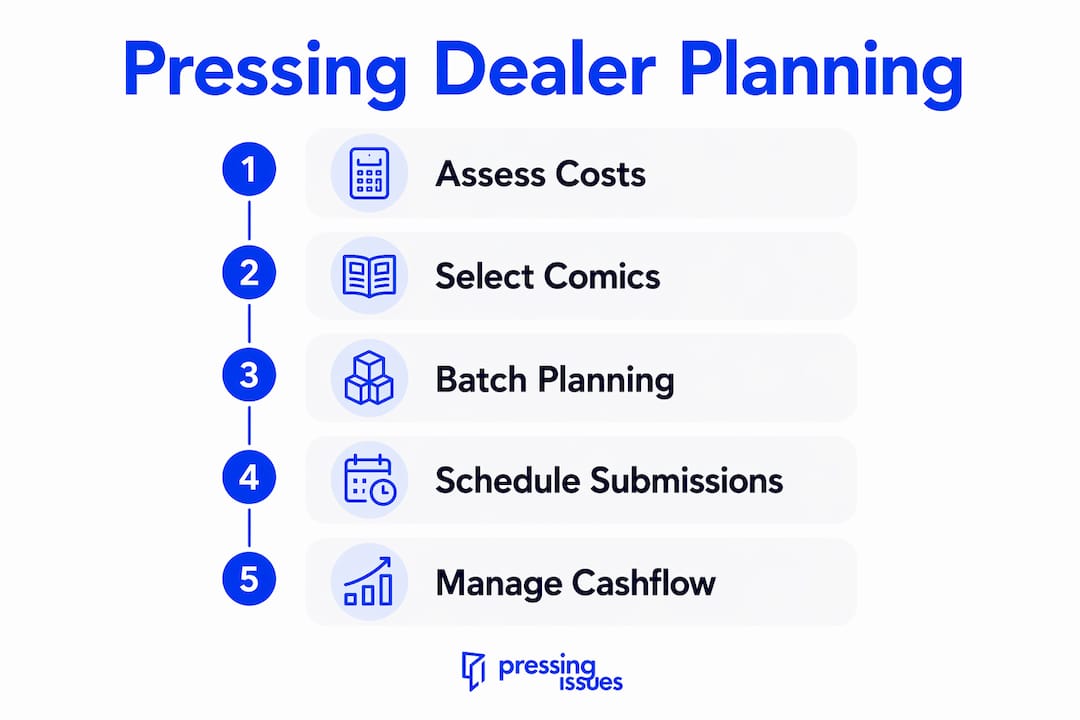
Scaling your pressing operations requires a repeatable system. Here is a four-step framework:
- Standardize your selection criteria. Use the 3x rule consistently. Document your minimum thresholds and update them quarterly as market prices and fees change.
- Build a submission calendar. Assign specific submission dates each month. This prevents ad hoc submissions that disrupt cash flow and makes turnaround times predictable.
- Coordinate pressing with your selling strategy. Time your graded book listings to coincide with peak demand windows, such as movie release dates or convention seasons, for the titles you are submitting.
- Review your results batch by batch. Track actual grade outcomes against your projections. If your realistic grade estimates are consistently off, recalibrate your pre-screening criteria.
Dealers who treat pressing as a planned operational function rather than a reactive one consistently outperform those who submit books on impulse. The comic grade impact on value is significant enough that systematic planning pays for itself within a few batches.
Key Takeaways
Effective comic pressing turnaround dealer planning requires consistent cost analysis, conservative grade estimates, and disciplined batch scheduling to protect margins and keep inventory moving.
| Point | Details |
|---|---|
| Apply the 3x rule | Graded sale price must exceed raw value by at least 3x total submission costs. |
| Pre-screen every book | Identify pressable defects before submission to avoid wasted fees and delays. |
| Use conservative grade estimates | Plan ROI around realistic grades, not best-case outcomes, to protect margins. |
| Stagger batch submissions | Submit one batch at a time to keep cash flowing rather than locking it all up. |
| Treat pressing as a liquidity tool | A pressed comic sells faster and builds buyer confidence beyond just the grade bump. |
What I've learned from watching dealers get this wrong
Charles here. After years of working with dealers through Pressing Issues, the pattern I see most often is not carelessness. It is overconfidence in the upside. A dealer pulls a book that looks pristine, runs the numbers at a 9.8, and submits it without a realistic downside scenario. When it comes back at a 9.2, the math no longer works and the book sits.
The dealers who build sustainable pressing programs do the opposite. They assume the lower grade, run the 3x calculation at that number, and only submit when the conservative case still profits. They also keep their batches tight and their submission calendar fixed. Pressing is not a lottery. It is a cost center that needs the same discipline as any other part of your inventory operation.
Local pressing services matter more than most dealers realize. Eliminating transit risk on valuable books is not a minor convenience. It is a real financial protection. When a $500 raw book goes to a remote presser and comes back damaged, no insurance claim fully compensates for the lost opportunity. Keeping pressing local, when possible, removes that variable entirely.
The dealers I respect most treat their pressing ROI calculations as living documents. They update thresholds every quarter, review their grade accuracy batch by batch, and adjust their selection criteria when the market shifts. That discipline is what separates a profitable pressing program from an expensive habit.
— Charles
Pressing Issues: built for dealer turnaround planning
Dealers who want reliable turnaround times and transparent pricing have a direct option in the Pacific Northwest.

Pressing Issues serves comic book dealers and collectors in Seattle, Washington, and Portland, Oregon, with professional pressing and cleaning services designed around dealer workflows. We offer clear per-book pricing, volume options for dealers processing multiple books, and turnaround times built to keep your inventory moving. Whether you are submitting a single key issue or a full dealer batch, our services and rates page gives you the full picture on what to expect. Reach out to discuss dealer pricing and get your next batch on the schedule.
FAQ
What is comic pressing turnaround dealer planning?
Comic pressing turnaround dealer planning is the process of organizing pressing submissions around cost analysis, batch scheduling, and inventory timing to maximize dealer profit margins and cash flow.
How long does comic pressing typically take?
In-store pressing services typically deliver within one week for standard volumes. Remote or outsourced pressing can take significantly longer depending on service load and shipping time.
What is the 3x rule for comic pressing?
The 3x rule states that the graded sale price must exceed the raw value by at least three times the total submission cost, including pressing, grading, shipping, and insurance, to justify submission.
How can dealers reduce pressing and shipping costs?
Local shop submission programs pool shipments among multiple submitters, which reduces individual insured shipping fees substantially. Volume pricing from pressing services also lowers per-book costs for dealers submitting regularly.
What defects can pressing actually fix?
Pressing removes stress marks, light spine ticks, and minor bends. It does not repair color-breaking creases, tears, water damage, or missing staples. Pre-screening every book before submission prevents wasted fees on non-pressable defects.