
Bag and board every comic first, create a rigid cardboard sandwich so it cannot flex, then add impact protection and immobilize everything inside a sturdy box or rigid mailer. That sequence, rigidity before cushioning, is the single discipline that separates a Near Mint arrival from a downgraded book. Here is your immediate checklist before we go deeper:
- Bag and board each comic in an acid-free polybag with a rigid backing board
- Build the sandwich: tape the bagged comic between two larger pieces of uncreased cardboard
- Add impact protection (bubble wrap or foam) only after the sandwich is assembled
- Choose your container: a Gemini-style rigid mailer for singles or a double-walled box for lots
- Carrier: USPS Priority Mail for most shipments; never Media Mail for comics with ads
- Insure and photograph before drop-off; mark "DO NOT BEND" only after the package is truly rigid
Table of Contents
- What materials do you need to pack comics safely?
- How to pack a single raw comic, step by step
- How to pack multiple comics and bulk shipments
- How to pack graded (slabbed) comics for shipping
- Which carrier and service should you use in the U.S.?
- How to seal and label your package correctly
- Common packing mistakes that damage comics
- When should you hire a professional for packing or submission?
- Key Takeaways
- Why we pack this way — a note from the team
- Pressing Issues handles the hard part for you
- Useful sources and further reading
What materials do you need to pack comics safely?
| Material | Function | Minimum Spec |
|---|---|---|
| Acid-free polybags | Moisture and fingerprint barrier | Polypropylene or Mylar; sized to comic era |
| Backing boards | Rigidity; prevents spine ticks and creasing | Acid-free; slightly larger than the comic |
| Outer cardboard pieces | Sandwich layers to resist flex | Two pieces per comic; uncreased, rigid |
| Gemini-style rigid mailer | Protective shell for singles/small lots | Purpose-built comic mailer; cardboard sandwich inside required |
| Double-walled box | Crush resistance for bulk or slab shipments | double-walled box; new, not reused |
| Bubble wrap / foam | Impact absorption after rigidity is established | At least 1" thickness on each side for slabs |
| High-quality packing tape | Seam sealing and sandwich assembly | Filament (strapping) tape for heavy boxes |
Buy bags and boards in bulk from dedicated comic supply retailers. Gemini-style mailers are available directly from Gemini Comic Supply and through Amazon. For high-value books, upgrading to Mylar bags and thicker boards costs a few cents per book but can protect a grade point worth hundreds of dollars.
Pro Tip: Order your bags, boards, and rigid mailers together in one bulk purchase. Mixing sizes across a shipment is one of the most common causes of shifting inside the box.
How to pack a single raw comic, step by step
- Bag and board the comic. Slide the comic spine-first into an acid-free polybag with a backing board behind it. The board should extend slightly beyond the comic on all sides.
- Build the cardboard sandwich. Place the bagged comic between two larger pieces of rigid, uncreased cardboard. The outer pieces should be bigger than the comic so the edges take any impact, not the book.
- Tape the sandwich shut. Run tape across the top and bottom edges only. Never tape the spine side — tape on the spine creates leverage points that graders will catch. Create a pull-tab on each taped edge by folding a small section of tape back on itself so the recipient can open without a knife.
- Place into a Gemini-style rigid mailer. Slide the sandwich in, seal the mailer, and confirm there is no movement inside.
- Pre-shipment inspection. Photograph the comic's condition, then photograph the sealed package. Note the declared value and purchase insurance if the book is worth more than the carrier's default coverage.
- Label and seal. Apply the shipping label directly to the mailer with clear tape. Include your return address. Write "DO NOT BEND" on the exterior.
A modern comic weighs about 2.5–3 oz bagged and boarded, so a single book ships comfortably via USPS First Class. Once you add the sandwich and mailer, weigh the finished package before selecting your service.
How to pack multiple comics and bulk shipments
For 2–12 books, bag and board each comic individually, then stack them with spines alternating (one facing left, the next facing right) so the stack stays level and even. Wrap the whole stack in bubble wrap to form a tight brick, tape it closed on all four sides, and slide it into a snug box or Gemini-style box mailer.
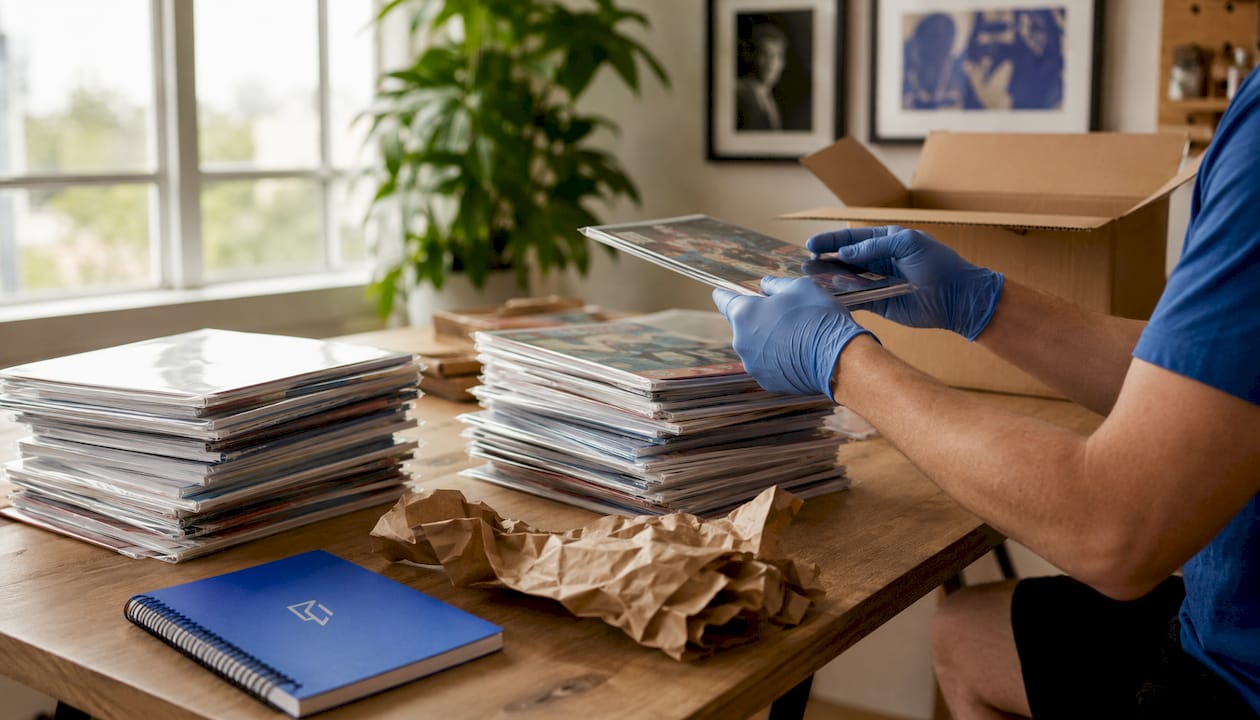
For 10–35 books, Gemini box mailers are purpose-built to minimize shifting. Fill any remaining void with crumpled kraft paper or air pillows. Avoid shipping more than roughly 35 books in a single package unless you are using heavy-duty reinforced boxes.
Pro Tip: For heavier or larger collection shipments, use filament (strapping) tape to band the box in three dimensions. Standard tape can burst under heavy loads, and shifting inside a well-packed box can still cause damage if the outer shell fails.
Keep each box under 35–40 lbs. If a collection runs heavier, split it across two boxes rather than overloading one. Reinforce all seams, not just the top flap.
How to pack graded (slabbed) comics for shipping
Slabs are the highest-risk category. A cracked CGC case can mean a full resubmission fee and a grade dispute, so the standard here is stricter than for raw books.
Wrap each slab individually in at least 1" of bubble wrap, place it in a new double-walled box, and fill every void with foam or air pillows so the slab cannot shift even a fraction of an inch. Old or previously crushed boxes are not acceptable — the structural integrity of a used box is unknown, and PSA's shipping guidelines for comics make clear that immobilization inside a new, sturdy box is non-negotiable.
Add corner protectors inside the box for extra insurance. Do not place label pouches directly on the slab case; attach all labels to the outer box with clear tape. If you are shipping multiple slabs, separate each one with foam sheets so they cannot contact each other in transit. For more on what encapsulation means for packing requirements, see our guide on comic book encapsulation.
Pro Tip: For high-value slabs, double-box: place the wrapped slab in a small inner box, then cushion that box inside a larger shipping box with at least 2" of padding on all sides. Use signature-required service for any declared value above your carrier's standard coverage limit.
Which carrier and service should you use in the U.S.?
- USPS Priority Mail is the recommended choice for most collector shipments. It includes tracking, up to $100 of built-in insurance, and reliable 1–3 day delivery windows. Priority Mail also carries less inspection risk than Media Mail.
- USPS First Class works for very light shipments (under 13 oz finished weight), typically one to three bagged-and-boarded books in a rigid mailer.
- UPS and FedEx are worth considering for higher declared values, account-based discounts, or when you need declared-value coverage above what USPS offers. Both carriers accept comics without restriction and provide robust tracking.
- Media Mail: avoid it. Comics frequently contain advertisements, which makes them ineligible for Media Mail. Packages can be opened, returned, or delayed during inspection.
For insurance, photograph the comic's condition and the sealed package before drop-off. Keep your purchase invoice or a written appraisal. Without documentation, a carrier claim is difficult to support regardless of the declared value.
Statistic: A modern comic book weighs 2.5–3 oz bagged and boarded. Use that figure to estimate service eligibility and total shipping cost before you get to the counter.
How to seal and label your package correctly
Seal every seam of the outer box with high-quality packing tape, running at least two passes over the top and bottom flaps. For heavier boxes, add a third pass across the side seams. Create pull-tabs on the tape so the recipient can open cleanly without cutting tools near the comics.
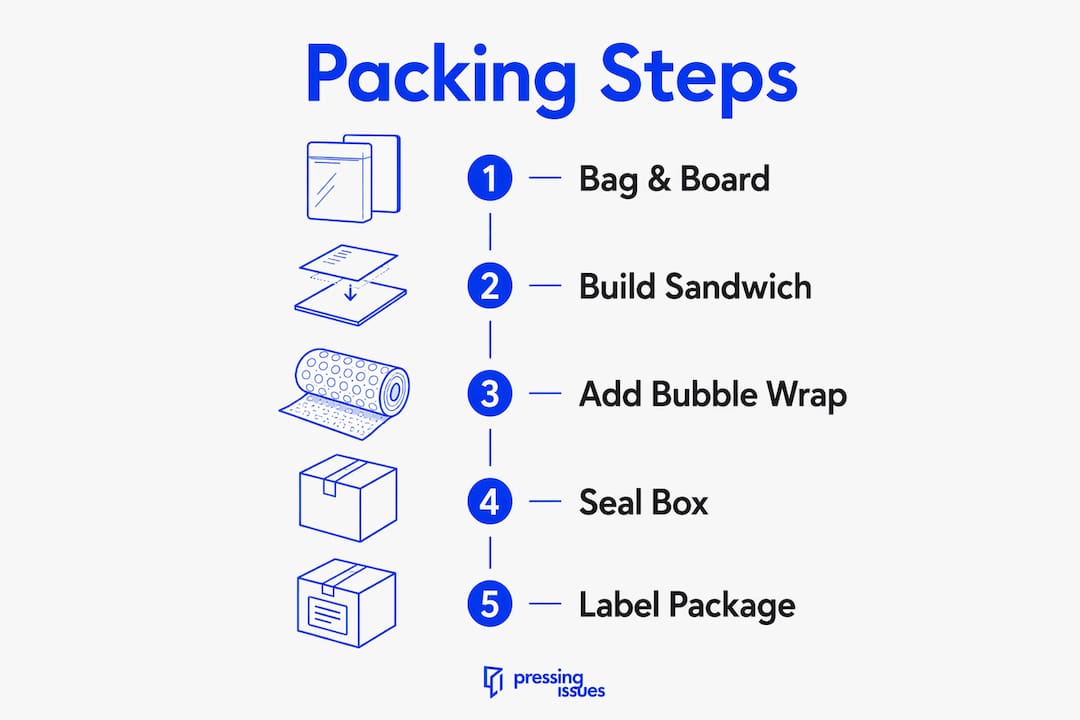
Attach the shipping label directly to the box surface with a layer of clear tape over it. Avoid label pouches on slabbed comics — they can catch on conveyor belts and peel. Always include your return address and a contact phone number on the exterior.
Pro Tip: Place a simple packing manifest inside the box listing every comic, its condition, and its estimated value. Photograph the open box showing the manifest, then photograph the sealed box on a postal scale. Those two images are your best protection in any insurance or grading dispute.
Common packing mistakes that damage comics
Knowing the most common shipping mistakes saves you from the errors that cause the most damage.
- Using bubble mailers alone. Bubble mailers flex. Without a rigid cardboard sandwich inside, the comic bends with the mailer under postal handling pressure.
- Reusing old boxes. A previously crushed box has compromised structural integrity. Damage is rarely the carrier's fault when the box was already weak before it shipped.
- Taping the spine. Tape on the spine side creates stress points that graders detect even when they look minor to the naked eye.
- Not photographing before shipment. Without pre-shipment photos, you cannot prove condition for an insurance claim or a grading dispute.
- Leaving empty space in the box. Any void allows movement. Fill gaps completely with kraft paper, air pillows, or foam before sealing.
- Ignoring weight limits. Overloaded boxes burst at the seams. Split heavy lots across multiple packages.
If you notice shifting inside a sealed box, open it, add filler, and reseal rather than shipping it as-is. A slight spine roll caught before drop-off is fixable; the same roll after transit is a grade deduction.
When should you hire a professional for packing or submission?
A few situations make professional help the smarter call:
- You have a single high-value book where one grade point represents significant money
- You are sending a lot destined for CGC grading and want to minimize selection or labeling errors
- You cannot assemble a rigid sandwich that holds without flex
- Time constraints make careful packing impractical
Professional pressing and cleaning before submission can increase a book's grade potential, and expert packing reduces transit damage risk on the way to CGC. Submission handling saves time and reduces the paperwork errors that cause delays at grading centers. Our CGC submission handling service covers the full process, from packing to paperwork.
Before you ship a book worth several hundred dollars or more, ask yourself: is the cost of professional prep less than the value of one grade point? For most collectors, the answer is yes.
Pro Tip: Not sure which books in your collection are worth pressing before grading? Our guide on choosing comics for pressing walks through the value analysis step by step.
Key Takeaways
Rigidity comes before impact protection every time: bag and board first, build the sandwich, then add bubble wrap and immobilize inside a new, sturdy box.
| Point | Details |
|---|---|
| Bag and board first | Every comic needs an acid-free polybag and rigid backing board before any other protection is added. |
| Rigid sandwich is non-negotiable | Two uncreased cardboard pieces taped around the bagged comic prevent the flex that causes spine ticks and grade loss. |
| Slabs need new double-walled boxes | Wrap each slab in at least 1" of bubble wrap, use a new box, and fill all voids to immobilize completely. |
| USPS Priority Mail for most shipments | Priority Mail includes tracking and basic insurance; Media Mail risks inspection and return for comics with ads. |
| Photograph everything | Pre-shipment photos of condition and sealed packaging are required to support insurance claims or grading disputes. |
| Pressing Issues for high-value books | Professional cleaning, pressing, and CGC submission handling reduce risk and protect grade potential on books that matter most. |
Why we pack this way — a note from the team
The bag-board-sandwich approach is not a formality. We have seen what happens when it gets skipped: a book that left a collector's hands in Fine condition arrives at a grading center with a fresh spine tick, and the grade drops a full point. That is real money lost, and it is entirely preventable.
What most guides understate is how subtle flex damage can be. A comic can bend and partially recover its shape inside a bubble mailer, and the collector never sees it. The grader does. The spine stress is there in the paper fibers even when the cover looks clean. Rigidity is not about being cautious; it is about understanding what graders actually examine.
The same logic applies to slabs. A cracked case is obvious, but a slab that shifted during transit and developed a hairline pressure mark on the label is less obvious and equally damaging to a resale. Immobilization matters as much for a graded book as for a raw one, arguably more, because the collector has already invested in the grade.
Ship like the grade depends on it, because it does.
Pressing Issues handles the hard part for you
Packing a high-value comic correctly takes the right materials, the right sequence, and zero shortcuts. Pressing Issues offers professional comic cleaning, pressing, and full CGC submission handling for collectors and dealers across the United States, so you do not have to manage the packing, paperwork, and carrier coordination yourself.

We clean and press your books to maximize grade potential before they ever reach CGC, then handle the submission from our Seattle and Portland locations. Every book gets a value analysis so you know whether pressing makes financial sense before you commit. To see rates, turnaround times, and service details, visit our pressing and cleaning services page and request a quote. Your comics deserve the care that protects what they are worth.
Useful sources and further reading
- GoCollect: How to Pack Comics for Shipping — Practical overview of supplies and preparation steps for raw and graded comics.
- ShippingLabel: How to Ship Comic Books Safely — Core guidance on bag-and-board standards, weight estimates, and pre-shipment documentation.
- Gemini Comic Supply: Shipping Ungraded Comics — Authoritative source on rigid mailer use, cardboard sandwich assembly, and bulk shipment limits.
- PSA Shipping Guide for Comics — Official grading-service guidance on slab packing, new box requirements, and immobilization standards.
- ComicBookInvest: How to Properly Pack and Ship Comics — Explains the order of protections (rigidity first) and the spine-tape warning.
- Porgstar: Best Way to Ship Comics — Carrier comparison and Media Mail risk explanation for comics with advertisements.
- CovrPrice: How to Ship Comics — Pull-tab technique and practical sealing tips for protecting comics at opening.
- MyComicShop: How to Ship Comic Books — Emphasizes that most damage comes from improper preparation, not carrier mishandling.
- SimplyParcel: Parcel Packaging Best Practices — General packaging and parcel-protection principles applicable to collector shipments.
Recommended
- CGC Submission Do's and Don'ts: How to Save Money and Avoid Shipping Headaches — Pressing Issues
- Comic Book Consignment Best Practices for Collectors — Pressing Issues
- How to Choose Which Comics to Send for Pressing — Pressing Issues
- Comic Book Encapsulation: What It Is and Why It Matters — Pressing Issues