
What are the best pbs.org alternatives right now?
There is no single PBS alternative. That is the honest answer, and understanding why changes how you search. PBS distributes programming to nearly 350 local public television stations across the country, each independently operated and funded. No commercial platform or streaming service replicates that non-commercial, community-rooted structure.
That said, viewers looking for similar cultural, documentary, and educational content have real options:
- Local PBS member stations with their own apps and livestreams
- NPR and its 1,000+ member stations for public radio and news
- American Public Television (APT), the leading syndicator of programming to public TV stations
- American Public Media, operating 49 public radio stations and distributing content nationwide
- Local Public, a cloud-based streaming platform built specifically for PBS stations
- Free Speech TV, available on Roku, Amazon Fire, and streaming online for independent progressive news
- PBS Passport, the member-supported tier offering extended on-demand access through your local station
- Niche documentary streaming services covering science, history, and arts programming
None of these is a drop-in PBS substitute. Together, they cover much of the same ground.
Table of Contents
- How the US public media system actually works
- Emerging digital models reshaping public media
- Common misconceptions about PBS and what a real alternative looks like
- Pressing Issues' perspective on media, community, and collector culture
- Key Takeaways
How the US public media system actually works
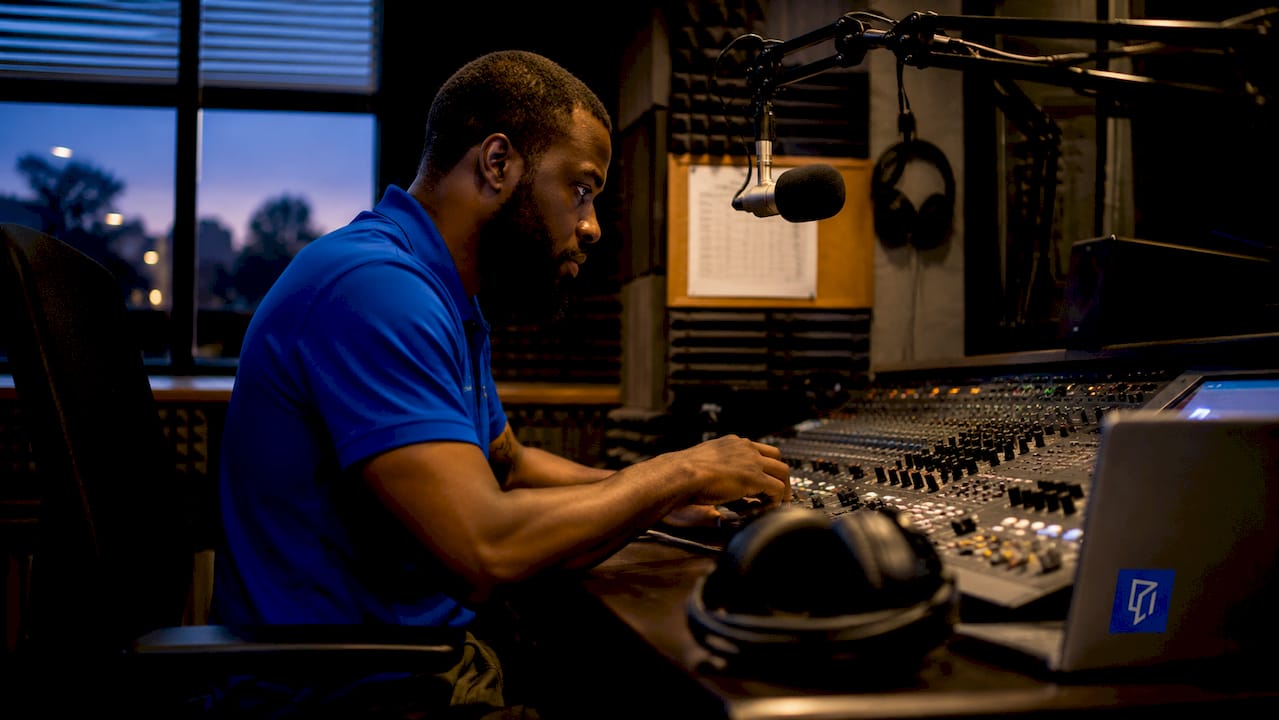
The US public media system is deliberately decentralized, and that structure is the reason no single alternative exists. PBS does not produce most of its programming. It aggregates funding, acquires content, and distributes it via satellite to local stations. Those stations make their own programming decisions, carry their own underwriters, and answer to their own communities.
Contrast that with the BBC in the United Kingdom, funded by a national licensing fee and operating unified television and radio networks, or the Canadian Broadcasting Corporation, which holds a federal mandate to produce Canadian content across two languages. The US built something fundamentally different: roughly 400 independent non-profits holding non-commercial broadcast licenses, loosely connected through PBS and NPR but never centrally controlled.
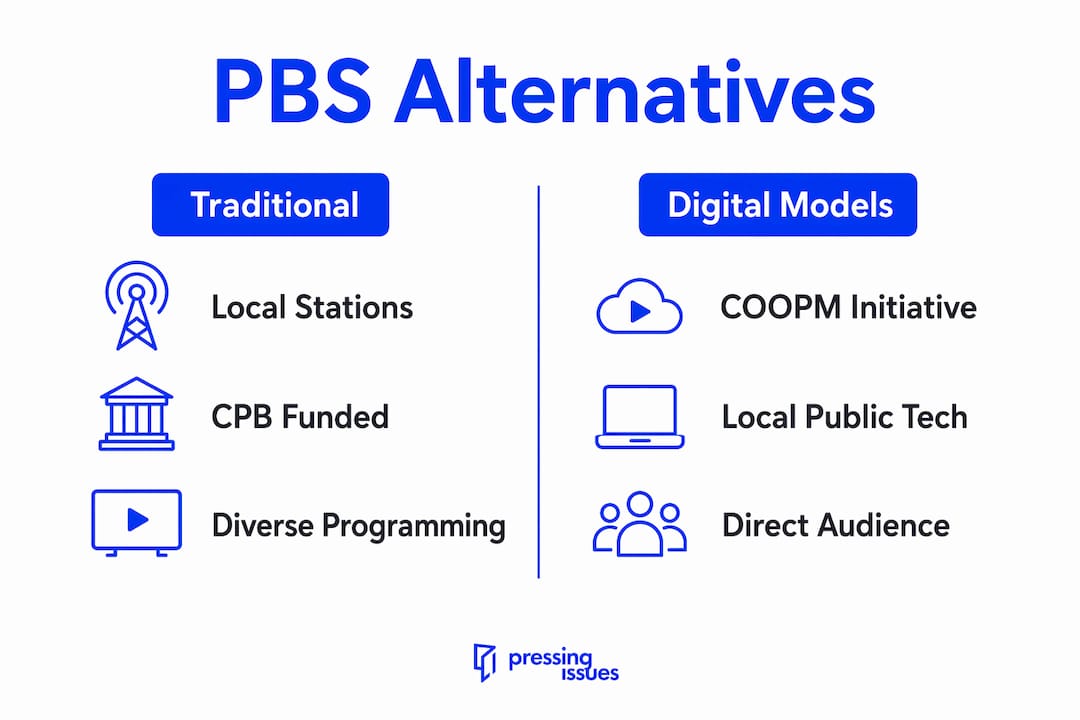
Funding reflects that independence. Most stations draw from viewer contributions, state agencies, private grants, and institutional support. Federal support through the Corporation for Public Broadcasting (CPB) historically made up only a portion of any station's budget, and that support is now ending, with the CPB announcing plans to cease operations.
Programming across this network spans documentary, science, history, arts, children's education, and public affairs. Access varies by region. A viewer in Oregon has different local content than one in Texas, and streaming availability depends on which platforms a given station has built out.
Emerging digital models reshaping public media
The CPB's wind-down has accelerated something that was already underway: local stations building their own digital infrastructure rather than depending on federal coordination.
The Cooperation for Public Media (COOPM) is the clearest example. It describes itself as "a field-led initiative designed to support local stations, journalism, and civic storytelling in the absence of federal infrastructure." COOPM is not a replacement for PBS or NPR. It pools shared technology, journalism resources, and public advocacy across stations that previously relied on CPB as a connective backbone.
Local Public takes a technology-first approach. Originally a service of Cascade PBS, it now operates as an independent Public Benefit Corporation, offering a cloud-based content management system built specifically for PBS station workflows. Oregon Public Broadcasting and Arizona PBS have both signed on. The platform integrates with PBS Passport, single sign-on systems, and donation platforms, letting smaller station teams benefit from shared automation while larger teams customize their content presentation.
NPR Chief Digital Officer Thomas Hjelm has noted that audiences now reach NPR.org directly in nearly every market more than they reach local station websites, a shift that inverts the old broadcast model. The future of public media is distributed streaming, not centralized broadcast.
Common misconceptions about PBS and what a real alternative looks like
Most searches for PBS substitute websites start from a misunderstanding of what PBS actually is. Here are the misconceptions worth clearing up:
- PBS is not a national broadcaster. It is a content distributor. It does not own or operate local stations.
- There is no PBS equivalent in the US. Platforms often cited as alternatives are either commercial services or public-media-adjacent without the non-commercial mandate.
- Paywalls are not the same as alternatives. If you hit a paywall on PBS.org, the fix is supporting your local station for Passport access, not finding a different platform.
- Specific shows have specific homes. PBS content is modular; the best path to a specific program is often finding the producer's own licensing platform or streaming deal.
- Funding shapes content. Stations with stronger viewer support produce more original programming. Stations hit hardest by CPB cuts have announced staffing reductions and programming changes.
- Searching for "alternatives" usually means seeking access, not replacement. Most viewers want the same type of content through a different delivery method, not a structurally different media organization.
The PBS app itself is free, available on Roku, Apple TV, Amazon Fire, Android TV, and Samsung Smart TVs, and requires no account for basic streaming. That is often the simplest answer to the access question.
Pressing Issues' perspective on media, community, and collector culture
At Pressing Issues, we spend a lot of time thinking about trusted sources and community-driven services. That is what we do for comic book collectors in Seattle and Portland: provide professional pressing and cleaning that collectors can rely on when a book's grade and market value are on the line. The parallel to public media is real. Both fields depend on expertise you can trust, not just content you can access.
The shift in public media toward field-led, cooperative models mirrors what the best collector services have always done: build local expertise, share resources, and serve the community rather than a corporate bottom line. When Oregon Public Broadcasting partners with Local Public to build its own streaming infrastructure, that is the same instinct that drives a collector to seek out a specialist rather than a generalist.
Pro Tip: Local PBS stations and niche documentary streaming services often carry programming on comics history, pop culture preservation, and American art that is directly relevant to collectors. Check your local station's on-demand library before assuming that content does not exist.
If you are a collector in the Pacific Northwest looking for professional comic book pressing and cleaning, Pressing Issues brings that same community-first approach to every book we handle. We also keep a running blog on collector resources, including our breakdown of alternative comic book pressers for those who want to understand the full landscape before making a decision.
Key Takeaways
No single platform replaces PBS; the US public media system is a decentralized network of local stations, and finding alternatives means understanding that structure first.
| Point | Details |
|---|---|
| PBS is a distributor, not a broadcaster | It sends content to nearly 400 local stations; it does not produce or own them. |
| No true PBS equivalent exists | Alternatives are either commercial or public-media-adjacent, lacking the non-commercial mandate. |
| COOPM and Local Public are the new backbone | Field-led cooperatives now replace federal CPB infrastructure for many local stations. |
| Specific shows need specific searches | Finding a program means tracing its producer's licensing deals, not finding a PBS clone. |
| Local station support beats platform-hunting | PBS Passport through your local station gives the deepest on-demand access available. |
Recommended
- Top 3 Youtube Alternative Comic Book Pressers 2026 — Pressing Issues
- Comic Dealer Heritage Auction Preparation: 2026 Guide — Pressing Issues
- The Grading Upgrade Game: Where Are the Sweet Spots for Pressing and Cleaning? — Pressing Issues
- CGC Submission Do's and Don'ts: How to Save Money and Avoid Shipping Headaches — Pressing Issues