
Pressing ROI on comic inventory is profitable when professional pressing lifts a comic's grade enough to cover all costs and produce a resale value that raw selling cannot match. At Pressing Issues, we see collectors and dealers make this calculation every day. The standard cost structure runs $15–$30 for pressing, $30–$65 for grading, and $30–$60 for round-trip shipping and insurance, putting total costs near $80–$100 per comic. That means a raw book valued at $50 rarely justifies the investment. The math only works when the right book gets pressed at the right time.
What costs and time investments affect pressing ROI on comics?
The full cost of pressing a comic goes well beyond the pressing fee itself. Every submission carries four distinct expense layers, and ignoring any one of them will distort your ROI calculation.
- Pressing fees: $15–$30 per book, depending on the service tier and turnaround option you choose.
- Grading fees: $30–$65 per book at standard CGC tiers. Express and walkthrough tiers cost significantly more.
- Shipping and insurance: Round-trip costs typically run $30–$60. Insuring a high-value book adds to that figure.
- Opportunity cost: Capital tied up for 10–14 weeks during standard grading turnaround is money you cannot reinvest elsewhere.
That last point is the one most collectors underestimate. Professional pressing fees look modest on paper. The real cost is the cash sitting idle while your books wait in a grading queue. For dealers running active inventory, that capital lock-up limits how many deals you can pursue in parallel.
The combined cost floor of roughly $80–$100 per comic sets a clear minimum threshold. A book must realistically sell for well above that figure after grading to produce any meaningful return. Factor in marketplace fees of 10–15% on platforms like eBay, and the break-even point climbs further. Every expense must appear in your model before you submit a single book.

Pro Tip: Build a simple spreadsheet with columns for pressing fee, grading tier, shipping estimate, marketplace fee, and projected sale price. Run the numbers before you bag and board anything for submission.
Which comics are the best candidates for pressing?
The 3x rule is the clearest filter in the business: the expected graded sale price must be at least three times your total submission cost. A book costing $100 to press and grade needs a realistic post-press sale price of $300 or more to justify the risk. That rule eliminates most modern mass-produced comics immediately.
The strongest pressing candidates share a specific profile. Focus your submissions on books that meet these criteria:
- Key issues and first appearances: First appearances of major characters, origin issues, and landmark story arcs hold the deepest price gaps between grade tiers.
- Near-NM or better raw condition: Pressing improves spine roll, corner bends, and minor creases but cannot fix color breaks, tears, missing pages, or structural damage. A book already showing color-breaking defects is not a pressing candidate.
- Pressable defects only: Spine roll, light bends, and non-color-breaking creases respond well to heat and pressure. Stains, water damage, and writing do not.
- Blue Chip keys from 1940–1970: Market analysts recommend focusing on Golden and Silver Age first appearances in high grade rather than short-term variant speculation.
- Population report support: Low-population books in the 9.2–9.4 range often command dramatic premiums over the same book at 9.0. Check CGC census data before committing.
Avoid pressing low-value books, heavily damaged copies, and modern print-run variants with no secondary market depth. Pressing those books turns a modest loss into a guaranteed one.
Pro Tip: Use recent eBay sold listings filtered by CGC grade to build a realistic price ladder for your target book. Compare the 9.0, 9.2, and 9.4 sale prices. If the gap between grades is small, pressing ROI shrinks fast.
For a deeper look at how to evaluate specific books, the Pressing Issues guide on choosing comics for pressing walks through the selection process in detail.
How does timing affect ROI when pressing comic inventory?
Timing a grading submission correctly can be the difference between selling at peak demand and selling into a flat or declining market. The 10–14 week grading window means you are always selling into the future, not the present. Plan accordingly.
- Identify upcoming media events. MCU and DCU character announcements, film release dates, and streaming premiere windows drive short-term price spikes on key issues. Submitting 10–14 weeks before an expected announcement positions your book to sell at peak hype.
- Use scenario planning, not single-point projections. Model three outcomes: the grade improves as expected, the grade stays the same, and the grade comes back lower. Know your loss exposure before you submit.
- Avoid submitting during speculative bubbles. When a character's key issue spikes 300% on rumor alone, the price is often unsustainable. Pressing into that spike means your book returns after the bubble deflates.
- Decide between holding and flipping before you submit. Dealers flipping for short-term profit need tighter timing than collectors building long-term holdings. A long-term comic investment strategy tolerates more timing variance because you are not dependent on a single sale window.
- Account for seasonal demand. Convention season and holiday buying windows create real secondary market lift. A book returning from grading in october or november hits a stronger retail environment than one returning in january.
The most common timing mistake is submitting speculatively priced modern books with no confirmed media catalyst. Those books often return graded into a market that has already moved on.
Best practices in inventory management for maximizing pressing ROI
Disciplined inventory management separates profitable pressing programs from expensive hobbies. The goal is a system that tells you, at any moment, which books are worth pressing, which are already submitted, and which have returned and are ready to sell.
Build a detailed inventory record
Every book in your collection needs a record that includes raw condition photos, known defects, estimated raw grade, and current market value at each CGC grade tier. Documenting grading reports and sales histories improves valuation accuracy and gives you a defensible basis for pricing decisions. Without photos taken before pressing, you have no baseline to evaluate whether the press delivered the expected improvement.
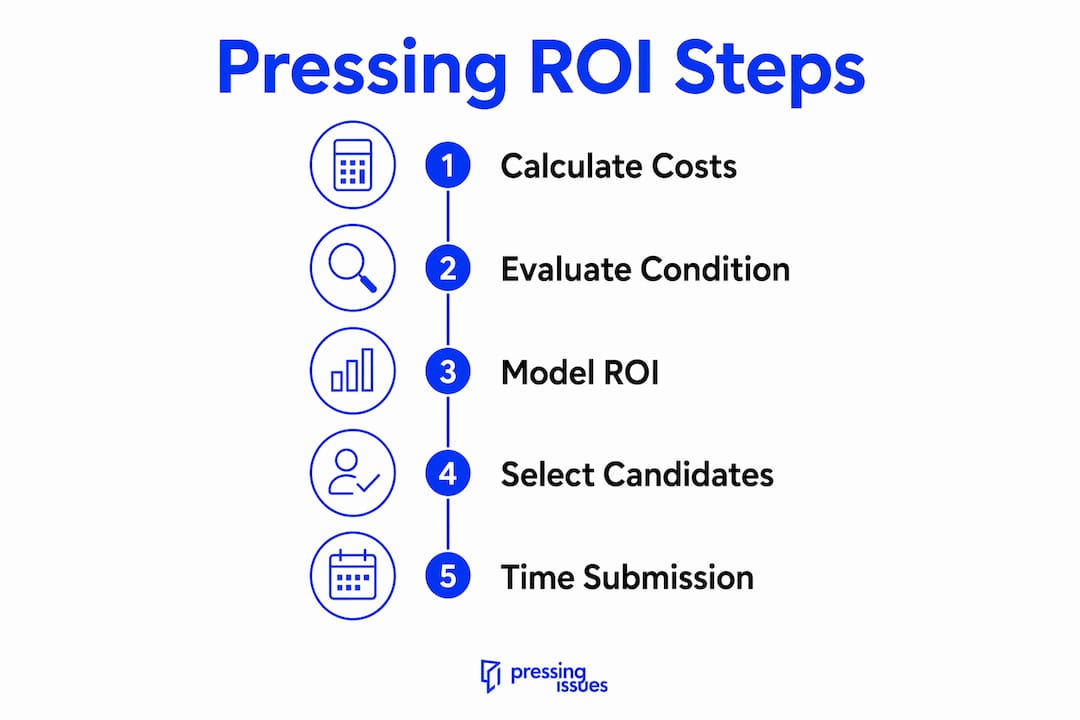
Model ROI before every submission
Conservative ROI modeling must include pressing fees, grading fees, shipping, insurance, marketplace fees, and the risk of no grade improvement. That last variable is the one most collectors skip. A book that returns at the same grade it went in at has just cost you $80–$100 with zero upside. Build that scenario into every model and know the loss before you commit.
Segment your inventory by pressing suitability
Divide your inventory into three buckets: strong pressing candidates, marginal candidates, and books to sell raw. Strong candidates meet the 3x rule with a realistic grade bump. Marginal candidates require a larger-than-expected grade improvement to break even. Books in the third bucket should move as raw copies rather than wait in a submission queue.
Reevaluate regularly as market prices shift
The comic market moves. A book that failed the 3x test six months ago may pass it today after a media announcement. Pressing ROI on comic inventory is not a one-time calculation. Revisit your marginal candidates quarterly and update your price ladders with fresh sold-listing data. The grading upgrade sweet spots guide from Pressing Issues breaks down exactly where grade bumps produce the largest value jumps.
Pro Tip: Track your actual results against your pre-submission models. If your projected grade bumps consistently outperform reality, your raw grading eye needs calibration. Honest tracking is the fastest way to improve your selection process.
Key Takeaways
Pressing ROI on comic inventory requires selecting the right books, modeling all costs honestly, and timing submissions to match market demand rather than current prices.
| Point | Details |
|---|---|
| Know your cost floor | Total pressing, grading, and shipping costs run $80–$100 per book before marketplace fees. |
| Apply the 3x rule | The expected graded sale price must be at least three times total submission costs to justify pressing. |
| Press only pressable defects | Spine roll and minor bends respond to pressing; color breaks, tears, and stains do not. |
| Time submissions strategically | Submit 10–14 weeks before media events to sell into peak demand rather than a flat market. |
| Track and reevaluate inventory | Update ROI models quarterly with fresh sold-listing data and honest post-submission grade tracking. |
What I've learned pressing comics for real profit
The biggest mistake I see collectors make is pressing too many books. The logic feels sound: pressing is relatively cheap, so why not press everything with a decent grade? The problem is that "relatively cheap" still means $80–$100 per book when you count everything. Press 20 marginal books and you have $1,600–$2,000 tied up for three months in books that may return with no grade improvement at all.
The discipline that actually moves the needle is conservative estimation. When I evaluate a book, I assume the press delivers one grade point, not two. I assume the market is flat, not rising. If the math still works under those conservative assumptions, the book goes in. If it only works under an optimistic scenario, it stays raw or gets sold as is.
The other thing collectors consistently underestimate is how much their own condition grading is biased. We all want our books to be better than they are. A book you call a raw 8.5 is often a 7.5 or 8.0 in a grader's hands. That gap destroys ROI projections built on wishful raw grades. Get a second opinion from someone who has no stake in the outcome before you build your model.
Pressing can also serve as a protection mechanism, not just a profit tool. A near-mint book with a minor spine roll that you plan to hold long-term is worth pressing simply to preserve its grade potential. Pressing protects assets by improving presentation and preventing minor defects from worsening over time. That is a different calculation than pressing for immediate resale, and both are valid strategies.
— Charles
How Pressing Issues can help you get more from your collection
Pressing Issues serves collectors and dealers in Seattle, Washington, and Portland, Oregon with professional pressing and cleaning services built around one goal: getting your books back in the best possible condition before grading.

We handle the evaluation, pressing, and cleaning so you can focus on the selection and submission strategy. Our comic pressing services include transparent pricing, clear turnaround timelines, and honest assessments of which books are worth pressing and which are better sold raw. If you want to see our full rates and turnaround times before committing, everything is listed on our services page. We are here to help you protect what you have and get the most out of every submission.
FAQ
What is a good rule of thumb for pressing ROI?
The expected graded sale price should be at least three times your total submission cost. A book costing $100 to press and grade needs a realistic sale price of $300 or more to justify the risk.
How long does the pressing and grading process take?
Standard grading turnaround runs 10–14 weeks from submission. That window locks up your capital and must factor into any ROI calculation.
Which defects can pressing actually fix?
Pressing corrects spine roll, corner bends, and minor non-color-breaking creases. It cannot fix color breaks, tears, missing pages, stains, or water damage.
Should I press modern comics?
Pressing modern mass-produced comics rarely produces profitable ROI. The price gap between grade tiers is too small to cover $80–$100 in submission costs. Focus pressing on key issues and high-demand Silver or Golden Age books.
Does timing my submission really affect sale price?
Yes. Submitting 10–14 weeks before a confirmed media event positions your book to sell at peak demand. Submitting after a price spike means your book returns into a market that has already moved past the hype.