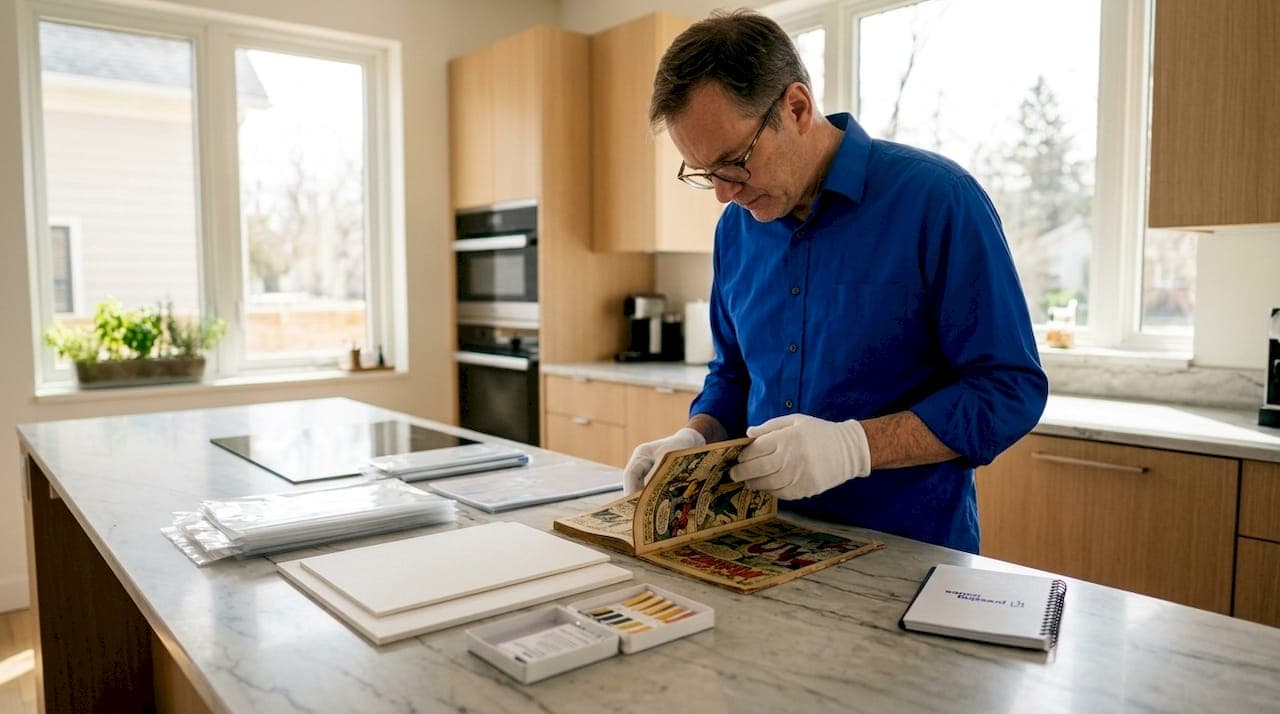
pH is the single most important chemical factor determining how long your comic books survive in storage. Modern comic paper carries a residual acidity between pH 4.5 and 5.5, and that acidic environment triggers visible yellowing within 5–7 years in unprotected conditions. The role of pH in comic preservation goes beyond surface discoloration. Acidity breaks down paper fibers, weakens ink adhesion, and destroys structural integrity over time. Archival standards define neutral to slightly alkaline pH (7.0–8.5) as the target range for all storage materials. Getting there requires the right bags, boards, boxes, and environment.
How does acidity chemically affect comic book paper and inks?
Acid degrades comic paper through a process called hydrolytic and oxidative chain scission. In plain terms, acid molecules attack the cellulose chains that give paper its strength, breaking them apart until the paper becomes brittle and discolored.
The primary culprit is lignin, a natural binding compound found in wood pulp paper. Lignin oxidizes in the presence of acid and moisture, producing chromophores — colored chemical compounds that turn paper yellow and brown. Most comics printed before the 1990s used high-lignin newsprint, which is why Golden Age and Silver Age books degrade so aggressively. Even modern comics printed on glossy stock carry acidic residues and volatile organic compounds that catalyze ongoing oxidation.
The chemical process accelerates with every environmental stress:
- Moisture acts as a catalyst, speeding up acid-driven hydrolysis of cellulose fibers
- Heat increases the rate of oxidative reactions, compounding acid damage
- Light exposure generates free radicals that react with lignin and acidic compounds
- Oxygen combines with lignin breakdown products to form additional organic acids
- Adjacent acidic materials (like non-archival cardboard) migrate acid directly into comic paper
Inks are not immune. Certain pigments and dyes used in comic printing are sensitive to pH shifts. Alkaline treatments applied incorrectly can cause color bleeding, while highly acidic environments dull and crack ink layers over time. This is why the impact of acidity on preservation extends to cover art, not just the paper beneath it.
The long-term result is a comic that loses both structural integrity and visual quality. A book that grades 9.2 today can drop to an 8.0 or lower within a decade if stored in acidic conditions. That grade loss translates directly to market value loss, which is the real cost collectors pay for ignoring paper chemistry.
Pro Tip: Smell your older comics. A sharp, vinegary odor signals advanced acid degradation. That "old book smell" is acetic acid off-gassing from deteriorating paper, and it means the process is already well underway.
What pH levels define acid-free, archival-quality storage materials?
Acid-free is not a marketing term. It is a measurable standard. Archival backing boards must meet a pH of 7.0–8.5 and be lignin-free to qualify as truly protective storage materials.
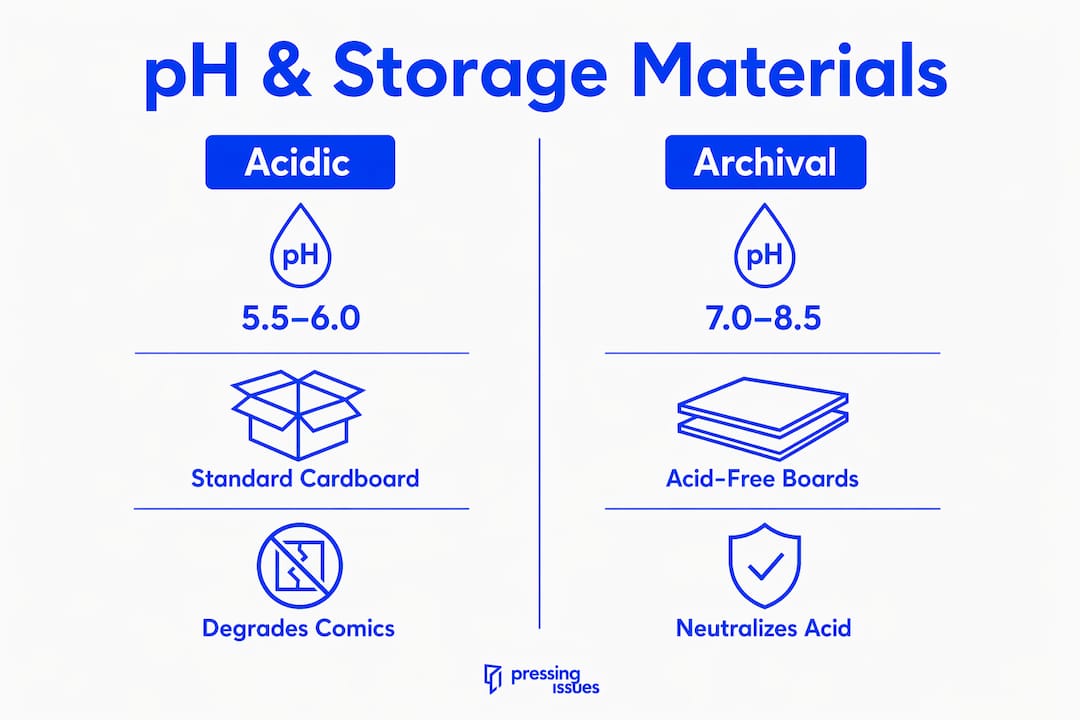
Standard corrugated cardboard sits at pH 5.5–6.0. That range sounds close to neutral, but it is acidic enough to bleed damaging compounds into your comics over time. The difference between standard cardboard and an archival board is not just chemistry. Non-archival cardboard actively bleeds acid into comics, causing a full grade loss within 10 years. The few cents saved per board cost far more in collection value.
The table below shows how pH ranges translate to real-world protection outcomes:
| Material type | Typical pH range | Effect on comics |
|---|---|---|
| Standard corrugated cardboard | 5.5–6.0 | Bleeds acid, causes grade loss within 10 years |
| Entry-level backing boards | 6.0–7.0 | Minimal buffering, limited long-term protection |
| Acid-free archival boards | 7.0–8.5 | Neutral to alkaline, slows acid migration |
| Alkaline-buffered boards | 8.0–8.5 | Active neutralization via calcium carbonate |
Alkaline buffering is the most important feature to look for beyond basic acid-free certification. Calcium carbonate in backing boards acts as a sacrificial neutralizer, absorbing acids that migrate from the comic paper and from environmental pollutants. Think of it as a slow-release antacid for your collection.
That buffering capacity is not permanent. Alkaline backing boards saturate with absorbed acids over 5–10 years and must be replaced to maintain their protective effect. A board that tested at pH 8.0 when new may test at pH 6.5 after a decade of use. Replacing boards on a regular schedule is one of the most cost-effective maintenance practices in comic preservation.
Pro Tip: When buying backing boards, look for the term "alkaline-buffered" in addition to "acid-free." Acid-free simply means the board starts at neutral pH. Alkaline-buffered means it actively fights incoming acid.
How to apply pH knowledge to your comic storage environment
Controlling the storage environment is the second half of the pH equation. Even archival-grade materials cannot fully compensate for a storage space with unstable temperature and humidity.
The recommended conditions for long-term comic storage are a stable temperature of 64–68°F and relative humidity of 45–55%. Humidity above 65% triggers mold growth and staple rust within 6–12 months. Mold produces organic acids as a metabolic byproduct, directly lowering the pH of paper it contacts.
Temperature swings are equally damaging. A 9°F daily temperature swing creates micro-condensation inside bags and boxes, accelerating acid-catalyzed oxidation. Attics and garages are the worst storage locations for this reason. Basements are risky due to humidity. A climate-controlled interior room or a dedicated storage cabinet is the practical standard.
Follow these steps to build a pH-stable storage environment:
- Measure before you store. Place a digital hygrometer in your storage area for 48 hours to establish baseline humidity and temperature readings.
- Control humidity actively. Use silica gel packets or a small dehumidifier to keep relative humidity in the 45–55% range. Replace silica gel when it changes color.
- Choose chemically inert bags. Polypropylene (PP) bags are chemically neutral and effective for 10–15 years. Mylar bags offer superior protection and last over 100 years with strong UV and moisture resistance. Avoid PVC bags entirely. PVC off-gasses plasticizers that accelerate paper degradation.
- Store boxes away from exterior walls. Exterior walls conduct temperature swings from outside. Interior placement keeps conditions more stable.
- Keep comics upright in boxes. Flat stacking creates pressure on lower books and traps moisture. Upright storage with a snug fit prevents slumping and allows air circulation.
For collectors who want expert guidance on archival storage techniques, the principles of chemical inertness and pH neutrality apply across every material choice you make.
Pro Tip: Avoid storing comics in plastic totes with tight-fitting lids. Sealed plastic traps humidity and off-gasses from the plastic itself. Acid-free cardboard boxes with lids allow minimal air exchange while keeping conditions stable.
What are common mistakes and myths about pH and comic preservation?
Most collectors understand that acid is bad. Fewer understand how many common storage choices actively introduce acid into their collections.
The most widespread mistake is using non-archival backing boards. Standard cardboard from office supply stores or repurposed packaging material carries a pH that actively harms comics. The cost savings are real but short-lived. A single grade point lost on a key issue can represent hundreds or thousands of dollars in value, far exceeding the cost of proper boards.
Chemical interventions are the second major risk area. Deacidification sprays exist and they do work in professional hands. Sprays use magnesium carbonate to raise paper pH, but improper application causes ink smearing and color bleeding. The risk is highest on covers with heavy ink coverage or metallic finishes. Professional conservation is the right call for any high-value book that needs chemical treatment.
Common myths worth correcting:
- "Acid-free bags are enough on their own." Bags prevent external contamination but do nothing about the acid already in the paper. You need alkaline-buffered boards to address internal acid migration.
- "Newer comics don't need archival storage." Modern comics still carry residual acidity. Glossy covers off-gas compounds that affect adjacent paper. Archival storage benefits every book regardless of age.
- "Storing comics flat is safer." Flat storage under weight creates pressure damage and traps moisture. Upright storage in properly fitted bags and boards is the correct method.
- "A sealed plastic bin protects against humidity." Sealed containers trap humidity and off-gas from the plastic itself, creating a worse chemical environment than open shelving.
The primary threat to comics is inherent vice, the chemical instability built into wood pulp paper from the moment it was manufactured. Storage can slow that process significantly, but only if every material in the storage system is pH-neutral or alkaline-buffered.
How to choose pH-appropriate materials for long-term maintenance
Selecting the right materials is straightforward once you know what to look for. The goal is chemical inertness throughout the entire storage system, from the bag touching the cover to the box holding everything together.
For bags, the hierarchy runs from polypropylene at the entry level to Mylar at the archival standard. Polypropylene is affordable and chemically neutral, making it a solid choice for most collections. Mylar (biaxially oriented polyethylene terephthalate) offers superior barrier properties against moisture and oxygen, and it does not yellow or become brittle over time. For key issues, first appearances, and grading submissions, Mylar is the correct choice.
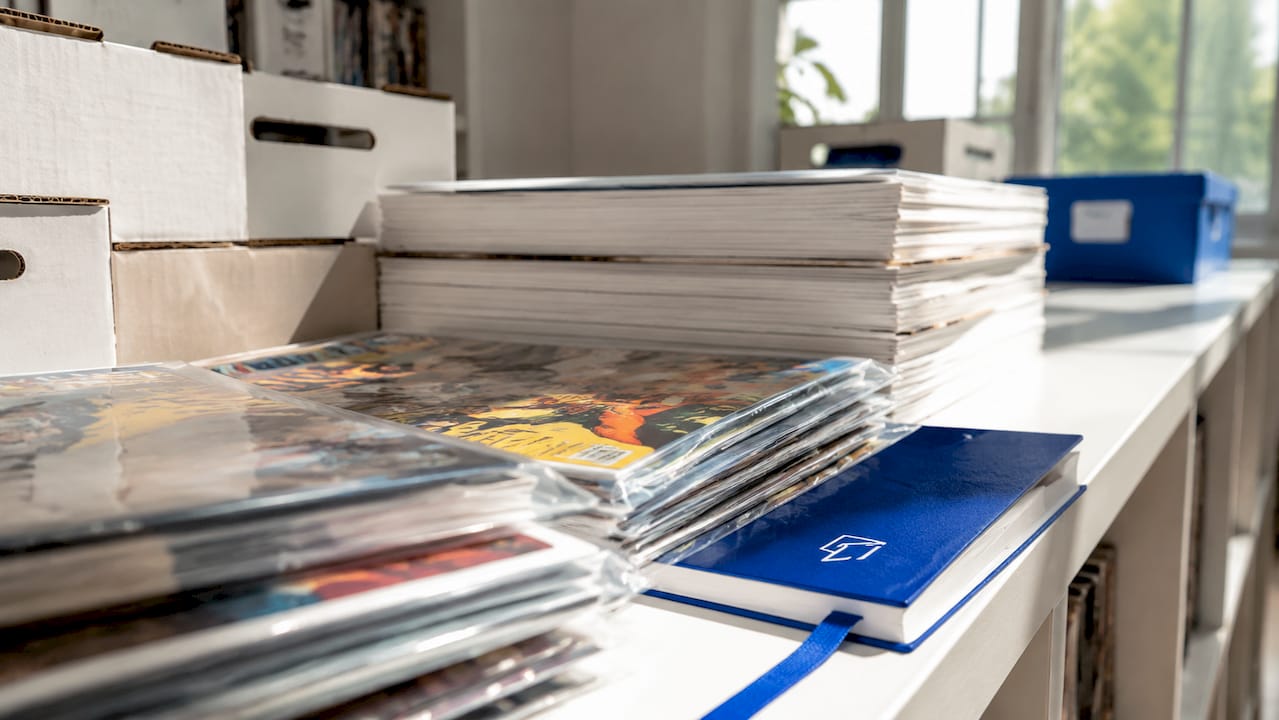
For boards, alkaline-buffered and lignin-free are the two non-negotiable specifications. Replace boards every 5–10 years regardless of visible condition. A board that looks fine may have exhausted its buffering capacity years earlier.
For boxes, acid-free corrugated cardboard boxes designed for archival storage are the standard. Avoid repurposed shipping boxes, which carry unknown pH levels and may contain adhesives that off-gas harmful compounds.
Monitoring your collection does not require laboratory equipment. A digital hygrometer costs under $20 and gives you real-time humidity and temperature data. Pair it with a visual inspection schedule, checking books twice a year for yellowing, brittleness, or odor changes. For collectors considering comic book encapsulation through professional grading services, proper pH-neutral pre-storage significantly improves the condition a book presents at submission.
Professional comic cleaning services also play a role here. Cleaning removes surface contaminants, mold spores, and oxidation products that lower the effective pH of a book's surface before storage. A clean book stored in archival conditions degrades far more slowly than a contaminated book in the same environment.
Key takeaways
Controlling pH through archival-grade materials and stable environmental conditions is the most effective strategy for preserving comic book quality and value over decades.
| Point | Details |
|---|---|
| Comic paper is inherently acidic | Most comics carry a pH of 4.5–5.5, causing yellowing within 5–7 years without protection. |
| Archival boards must be alkaline-buffered | Boards rated pH 7.0–8.5 with calcium carbonate actively neutralize acid migration from paper. |
| Replace boards every 5–10 years | Buffering capacity depletes over time; a saturated board no longer protects against acid. |
| Environment controls pH stability | Keep storage at 64–68°F and 45–55% humidity to prevent moisture-driven acid acceleration. |
| Mylar outperforms all bag materials | Mylar bags last over 100 years and provide the strongest barrier against moisture and oxidation. |
pH is the foundation, not a footnote
I have handled thousands of comics at Pressing Issues, and the pattern is always the same. Collectors spend real money on key issues, then store them in whatever cardboard and plastic bags came with a bulk order. The books that come to us in the worst shape almost always share one thing: they were stored in non-archival materials for years, sometimes decades.
What surprises most collectors is how fast acidity works. A book that looks fine today can show significant yellowing and brittleness within a few years if the storage environment is wrong. The chemistry does not wait for you to notice. Acid is working on your paper right now, and the only question is whether your storage system is slowing it down or speeding it up.
The good news is that pH management is not expensive. Switching to alkaline-buffered boards and Mylar bags adds a small cost per book. Replacing boards on a 5–10 year schedule is a minor maintenance task. A digital hygrometer costs less than a single mid-grade key issue. The investment is small relative to what collectors spend on the books themselves.
Where I see collectors go wrong most often is in treating preservation as a one-time setup rather than an ongoing practice. They buy the right materials once, then never replace boards, never check humidity, and never revisit their storage conditions as their collection grows. pH management works only if you maintain it. Check your storage twice a year. Replace boards on schedule. And when a book matters enough to grade, get it cleaned professionally before submission.
— Charles
Pressing Issues: professional preservation for your collection
Your comics deserve more than a bag and board from a bulk order. At Pressing Issues, we work with collectors in Seattle and Portland who want their books preserved and prepared to the highest archival standard.
Our comic book pressing and cleaning services remove surface contaminants, address oxidation, and prepare books for grading submissions in pH-neutral conditions. We handle everything from Silver Age keys to modern variants, treating every book with the care it deserves. Whether you are preparing a submission or simply want your collection in the best possible condition, we are here to help. Visit Pressing Issues to learn more about our services and get your books the treatment they deserve.
FAQ
What pH level is considered safe for comic storage materials?
Archival storage materials should carry a pH of 7.0–8.5. Alkaline-buffered boards in this range actively neutralize acid migration from comic paper and environmental pollutants.
How quickly does acidity damage unprotected comics?
Comics stored without archival protection show visible yellowing within 5–7 years. Paper with a pH of 4.5–5.5 begins degrading immediately, with brittleness following as cellulose chains break down.
Are polypropylene bags good enough for long-term storage?
Polypropylene bags are chemically neutral and effective for 10–15 years, making them a solid choice for most collections. For high-value books or long-term archival storage, Mylar bags offer superior protection lasting over 100 years.
Can deacidification sprays fix an acidic comic?
Deacidification sprays can raise paper pH but carry real risks including ink smearing and color bleeding. Professional conservation is the right approach for valuable books. Always test any chemical treatment on an inconspicuous area first.
How often should backing boards be replaced?
Replace alkaline-buffered backing boards every 5–10 years. Their calcium carbonate buffering capacity depletes as it absorbs acids, and a saturated board provides no more protection than standard cardboard.