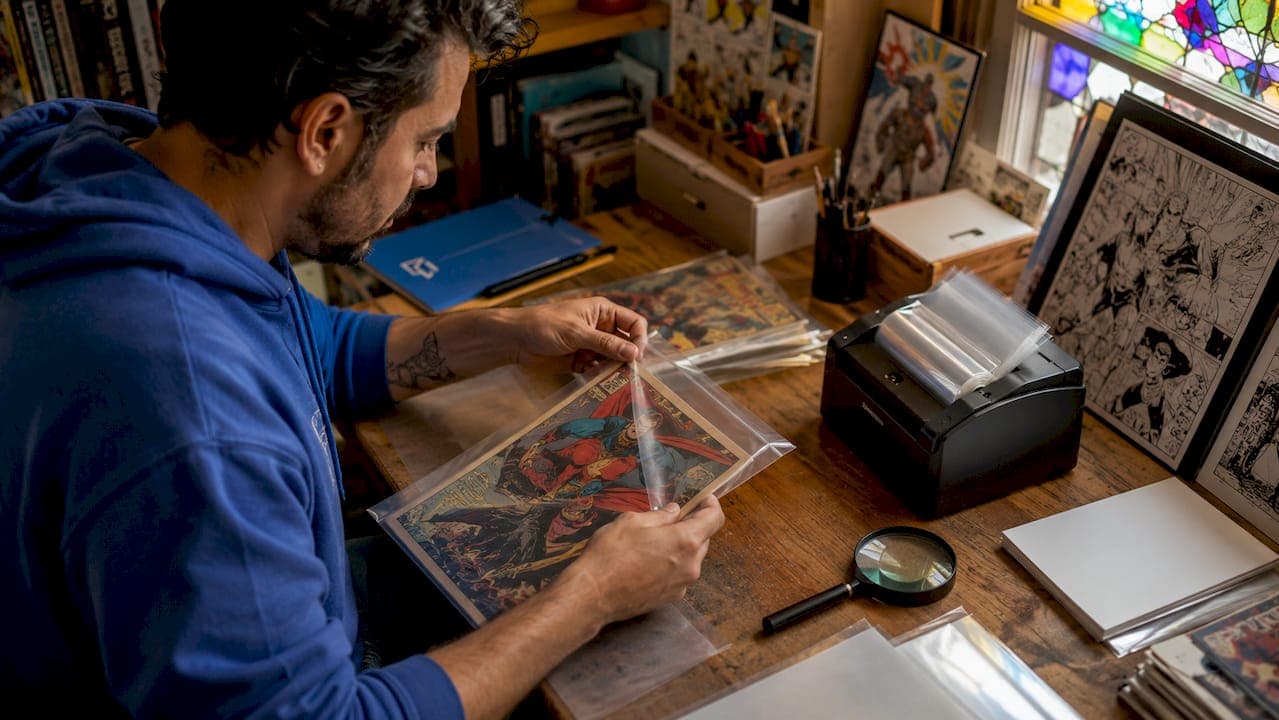
For grading submissions and long-term preservation, use 4 mil Mylar (BoPET) with an acid-free, lignin-free buffered backing board, the correct size bag for your comic's era, and a top-entry insertion method. The Library of Congress recognizes polyester film as the only plastic suitable for heritage preservation, and that same chemical inertness is exactly what protects a high-value key issue in transit to a grader. At Pressing Issues, we see the difference proper bagging makes every time a book arrives for cleaning and pressing. For budget or short-term storage, archival polypropylene with an acid-free board is a workable alternative, though it carries a shorter useful life.
Table of Contents
- What are the main types of comic book bags?
- Does bag thickness actually change how well your comic is protected?
- Why the backing board matters as much as the bag
- Choosing the right bag size and sealing method
- How to pack comics for grading submissions
- When should you upgrade to better bags and boards?
- Common mistakes that damage comics during bagging
- What is the best bagging system for grading submissions?
- Key Takeaways
- Bagging is the floor, not the ceiling
- Pressing Issues handles the whole submission process for you
- Useful sources
What are the main types of comic book bags?
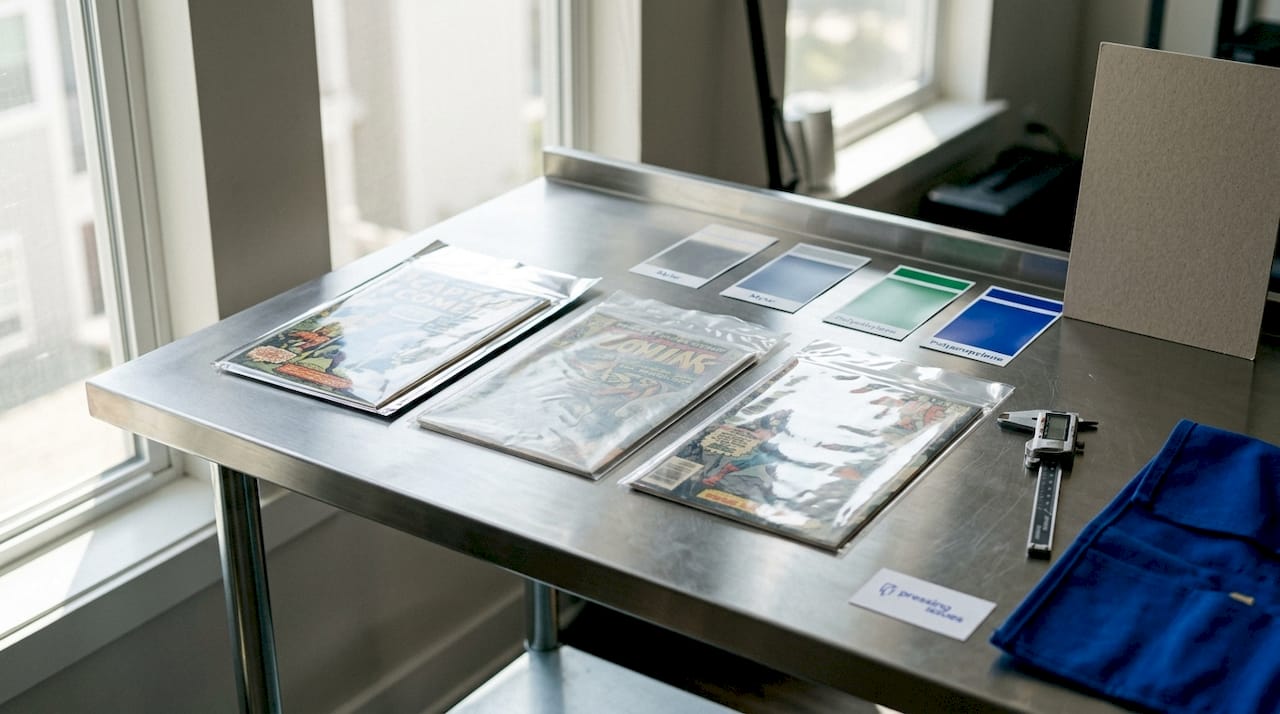
Three polymer families cover the entire market: Mylar (BoPET), polypropylene (PP), and polyethylene (PE). Each behaves differently chemically and physically, and choosing the wrong one for a high-value book is a mistake that compounds over time.
| Material | Archival Rating | Typical Useful Life | Yellowing / Off-Gassing Risk | Rigidity | Best For | Cost |
|---|---|---|---|---|---|---|
| Mylar (BoPET) | Highest — Library of Congress approved | Decades (effectively lifetime) | Very low | High (especially 4 mil) | Grading submissions, high-value keys, long-term preservation | Highest |
| Polypropylene (PP) | Moderate | 2 years | Moderate — can yellow | Low–moderate | Reading copies, low-to-mid value storage | Lowest |
| Polyethylene (PE) | Low–moderate | 2–10 years | Higher — can release residues into paper | Low | Short-term or budget storage only | Low–moderate |
Mylar (BoPET) is the gold standard. It is chemically inert, resists oxygen and moisture, and will not yellow or off-gas onto your paper. The trade-off is cost: Mylar bags can run up to four times the price of poly options.
Polypropylene accounts for roughly 70% of bags sold. It is clear, inexpensive, and fine for modern reading copies. The problem is longevity: in suboptimal conditions, PP bags can begin yellowing within a few years, and that yellowing is a warning sign of chemical breakdown near your paper.
Polyethylene sits between the two in price but closer to PP in archival performance. It has a slightly milky appearance and lasts longer than the cheapest PP bags, but PE can degrade and release residues that migrate into paper. For anything you plan to hold more than a few years, it is not the right choice.
Does bag thickness actually change how well your comic is protected?
Yes, and the difference between 2 mil and 4 mil Mylar is not trivial for a book heading to CGC or CBCS.
| Thickness | Material | Rigidity | Puncture Resistance | Recommended Use | Value Threshold |
|---|---|---|---|---|---|
| 2 mil | Mylar (BoPET) | Moderate | Good | Long-term storage, mid-value books | Under ~$200 |
| 4 mil | Mylar (BoPET) | High | Excellent | Grading submissions, high-value keys | Over ~$200–$500 |
| 1–2 mil | PP or PE | Low | Fair | Short-term, reading copies | Under ~$20 |
A "mil" is one-thousandth of an inch. That extra thickness in 4 mil Mylar translates directly into a stiffer sleeve that resists bending and accidental creasing during handling and shipping. Professional practice recommends upgrading to 4 mil for books worth over $200–$500, and we agree. When a book is making a round trip to a grading house, the rigidity of 4 mil is what keeps a borderline 9.4 from picking up a new spine tick in transit.
Pro Tip: For batch grading submissions, use 4 mil Mylar on every key issue regardless of current estimated value. A book you think is worth $150 today may grade higher than expected and be worth multiples of that after slabbing.
Why the backing board matters as much as the bag
The bag handles chemical isolation. The board handles structural support. Skip one, and you have half a system.
Professional archivists are clear that an acid-free, buffered backing board is non-negotiable alongside any archival sleeve. Older newsprint is acidic, and without a buffered board, that acidity migrates into the paper over time, causing brittleness and discoloration no bag can prevent.
Key specs to look for on every board you buy:
- Acid-free and lignin-free: both labels must appear; lignin is the compound in wood pulp that drives long-term yellowing
- Buffered (alkaline reserve): a calcium carbonate buffer neutralizes ongoing acid migration from the comic's own paper
- 700 micron thickness: the standard spec for modern comics; provides firm support without adding excessive bulk
- 1000 micron thickness: recommended for fragile Golden Age books or any high-value issue going to a grader; the extra rigidity prevents spine flex during handling
For insertion, slide the board in first, printed side facing the back cover of the comic. Then lower the comic and board together into the bag, spine down, so the staples do not catch on the bag's opening. This orientation protects the spine and keeps the cover flat against the board.
Pro Tip: If a board is labeled "buffered on one side only," orient the coated side toward the back cover of your comic. The coating is what does the acid-neutralizing work.
Choosing the right bag size and sealing method
Fit is where collectors lose grades they should have kept. A bag that is too small creates edge friction damage; one that is too loose lets the comic shift and develop spine rolls or edge wear during transit.
The four standard sizes and their eras:
- Current/Modern (6 7/8" × 10 1/2"): comics from roughly 1990 to present
- Silver Age (7 1/8" × 10 1/2"): approximately 1956–1969, plus some late Golden Age
- Golden Age (7 5/8"–7 3/4" × 10 1/2"): pre-1956 books; measure your copy before buying
- Magazine (8 1/2" × 11"): Warren titles, black-and-white Marvel adaptations, Mad Magazine
When in doubt, measure the comic horizontally before ordering. There is meaningful overlap between eras, and a book that is even slightly too wide for a Current bag will suffer edge damage over time.
For sealing, open-top bags work well for active storage where you access books regularly. Resealable flap bags offer a middle ground for long-term storage. Permanently sealed bags are best avoided for grading submissions because graders need to open the sleeve, and a forced opening can damage the book. For shipping to a presser or grader, a snug open-top or resealable flap bag is the right call.
How to pack comics for grading submissions
Getting the bag and board right is step one. Getting the book to the grader in the same condition it left your hands is step two.
Before bagging:
- Photograph every comic front and back, noting any existing defects.
- Gently remove any loose debris from the cover with a soft, dry brush. Do not use liquids.
- Handle Golden Age books with extra care: Mylar can generate static that lifts loose paper fragments and ink from embrittled pages.
Packing a single comic:
- Slide the acid-free board into the bag first.
- Lower the comic onto the board, cover facing forward.
- For keys, use 4 mil Mylar; for supporting books, 2 mil Mylar or archival PP.
- Fold the flap or leave the top open per your bag type.
Packing multiple comics for shipment:
- Stack bagged-and-boarded books flat, not upright, for transit.
- Wrap the stack in acid-free tissue or bubble wrap.
- Place in a snug-fitting, rigid box with void fill on all sides.
- Keep humidity in mind: target storage and transit conditions of 64–68°F and 35%–55% relative humidity to prevent moisture-driven yellowing and value loss.
- Insure the declared value and include your condition photographs with the shipment documentation.
When should you upgrade to better bags and boards?
A simple value-based framework keeps spending rational across a large collection.
- Under $20 per book: archival PP with a 700-micron acid-free board covers the need.
- $20–$200 per book: PP or PE with an acid-free, buffered board; consider 2 mil Mylar if you plan to hold medium-to-long term (PP typically lasts 2–15 years depending on quality and conditions).
- Over $200–$500 per book: upgrade to 4 mil Mylar with a 1000-micron buffered board. The cost difference per book is small relative to the value at risk.
Replace bags when you see any yellowing, rippling, or brittleness at the seams. Replace boards when they show any waviness, staining, or compression. A good maintenance schedule is to inspect your collection annually and swap out any supplies showing visible wear. Buying Mylar in bulk packs of 25–50 reduces the per-unit cost significantly, and high-quality undamaged boards can be reused when you upgrade bags.
Pro Tip: Reserve your 4 mil Mylar for key issues and first appearances. Use archival PP for the rest of the run. That selective approach cuts supply costs without compromising the books that actually drive your collection's value.
Common mistakes that damage comics during bagging
A few errors show up repeatedly, and most are easy to fix once you know what to look for.
- "All clear plastic is archival" is false. Standard PP and PE are not archival materials. Only Mylar (BoPET) carries the chemical inertness the Library of Congress endorses for long-term preservation.
- Inserting without a board is the single fastest way to create a spine roll. The board is structural, not optional.
- Oversized bags feel safe but allow lateral movement that causes edge wear and spine rolls over time. Snug fit is the goal.
- Static from Mylar on fragile books: for Golden Age or embrittled comics, use anti-static precautions and handle slowly to avoid lifting ink or paper fragments.
- Red flags in cheap bags: a yellow tint, rippling film, or brittle seams mean the bag is already degrading. Stop using it immediately and transfer the book.
Understanding types of comic book damage before you bag helps you document pre-existing defects accurately, which matters when a grader's notes come back.
What is the best bagging system for grading submissions?
For any book worth grading, the answer is 4 mil Mylar with a 1000-micron acid-free, lignin-free buffered board, the correct era size, and a top-entry insertion. For the rest of your collection, archival PP with a 700-micron board is solid protection at a fraction of the cost.
If you are preparing a submission for CGC or CBCS, photograph every book first, pack flat with void fill, insure the declared value, and keep humidity in range. For choosing which comics to send for pressing before grading, a value analysis step before you bag saves time and money. When you would rather have a professional handle the cleaning, pressing, and submission paperwork, that is exactly what Pressing Issues does.
Key Takeaways
For grading submissions, 4 mil Mylar with a 1000-micron acid-free board is the only bagging system that protects both the chemistry and the structure of a high-value comic in transit.
| Point | Details |
|---|---|
| Material choice | Use 4 mil Mylar (BoPET) for grading submissions and high-value keys; archival PP is acceptable for lower-value storage. |
| Backing board specs | Acid-free, lignin-free, buffered boards are required; 700 micron for modern comics, 1000 micron for fragile or high-value books. |
| Fit and size | Match the bag size to the comic's era (Current, Silver, Golden, Magazine) and aim for a snug, non-constrictive fit. |
| Photograph before shipping | Document condition front and back before every grading submission to support any transit damage claim. |
| Pressing Issues | Professional cleaning and pressing before submission materially improves grade outcomes for borderline books. |
Bagging is the floor, not the ceiling
Here is what most bagging guides miss: the bag and board protect what is already there. They do not improve it. For a book sitting at a borderline grade, the difference between a 9.2 and a 9.6 is not the Mylar sleeve. It is whether the book was professionally cleaned and pressed before it went into that sleeve.
We see this constantly at Pressing Issues. A collector bags a key issue correctly in 4 mil Mylar, sends it to CGC, and gets back a grade that is one or two points lower than the book's potential because surface grime, a light crease, or a spine tick was never addressed. Proper bagging preserves the grade the book already has. Professional cleaning and pressing raises the ceiling on what that grade can be.
The other thing worth saying: not every book needs professional prep. A reading copy in a PP bag is fine. But if you are investing in Mylar, a 1000-micron board, and grading fees, the cost of a professional press is a small fraction of the value you are protecting. Do the math before you skip it.
Pressing Issues handles the whole submission process for you
Proper bagging is the foundation, but the full submission process includes cleaning, pressing, value analysis, packaging, and managing the paperwork with CGC. At Pressing Issues, we handle every step for collectors and dealers across the United States. Our comic book pressing and cleaning service removes surface defects and non-restorative creases before your book ever reaches a grader, and our CGC submission handling covers the shipping, insurance, and documentation so you do not have to. High-value books receive a complimentary value analysis so you know the grade improvement potential before you commit. Ready to get started? Submit your books to Pressing Issues and let us take it from there.
Useful sources
- Library of Congress: Care, Handling, and Storage of Comic Books — primary authority on Mylar/BoPET as the archival standard for heritage preservation; also covers static handling cautions for embrittled books.
- Comic Bags & Backing Boards: The Complete Guide — detailed breakdown of PP market share, board specs (700 and 1000 micron), and fit guidance.
- Comic Book Preservation Guide: Bags, Boards & Storage — covers 4 mil Mylar recommendations, PE degradation risks, and storage environment targets (temperature and humidity).
- BCW Supplies: Comic Bags & Boards Size Guide — practical size chart for Current, Silver, Golden, and magazine formats with exact dimensions.
- Preservation Equipment: How to Store Comic Books — handling and fit guidance; source for bag-size consequences (too small vs. too loose).
- Consult CGC and CBCS submission guidelines directly before each submission, as packaging requirements and accepted materials are updated periodically.
Recommended
- Types of Comic Book Damage: A Collector's Guide — Pressing Issues
- What Is Comic Book Slabbing? A Collector's Guide — Pressing Issues
- The Grading Upgrade Game: Where Are the Sweet Spots for Pressing and Cleaning? — Pressing Issues
- Pressing Modern vs Vintage Comics: A Collector's Guide — Pressing Issues