
What does an unrestored comic book actually mean?
An unrestored comic book is one that has never been altered, repaired, or enhanced beyond its original published state. No color touch, no piece replacement, no re-glossing. Whatever the publisher printed and shipped is exactly what you hold in your hands today, wear and all.
The industry standard for identifying an unrestored comic is the CGC Universal blue label. Certified Guaranty Company (CGC) assigns this blue label to books with no qualifying defects and no restoration detected. For most collectors, a high-grade blue label is the most desirable and liquid combination on the market.
What the blue label does NOT require is perfection. Natural wear from age, manufacturing defects like off-center staples, and printing flaws do not disqualify a comic from unrestored status. The key distinction is intent and intervention: if no foreign material was added and no technique was applied to improve appearance, the comic remains unrestored.
- No color touch, ink fills, or marker work
- No piece replacement or paper additions
- No re-glossing or whitening treatments
- No staple replacement for cosmetic purposes
- No trimming of edges to appear sharper
How restoration and conservation differ in comic collecting
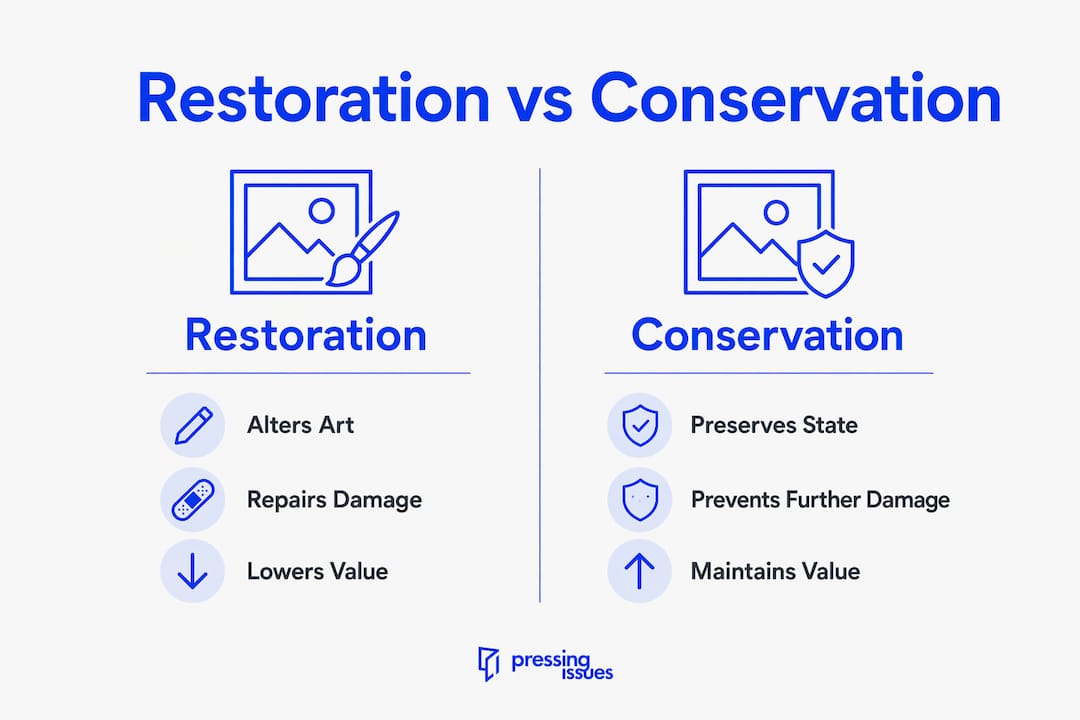
Restoration and conservation are not the same thing, and confusing them costs collectors real money.
Restoration is the act of adding foreign material to a comic to improve its appearance. Techniques include color touch, piece fill, re-glossing, whitening, and trimming. The goal is aesthetic: make the book look better than its current condition warrants. CGC flags restored comics with a purple label, and that label carries a market penalty.
Conservation is different in both intent and outcome. Recognized by CGC in 2016 as a distinct category, conservation focuses on preserving structural integrity without altering the comic's original appearance. It includes tear seals, spine split seals, spine stabilization, and staple replacement when structurally necessary. Critically, conservation excludes color touch and piece fill entirely. Only professionally applied, archival-quality techniques qualify.
- Restoration (purple label): color touch, piece fill, re-glossing, trimming, whitening
- Conservation (conserved designation): tear seals, spine stabilization, piece re-attachment, professional cleaning
- Unrestored (blue label): no treatments of any kind applied
Pro Tip: If a seller describes a book as "professionally conserved," ask for the CGC label color before buying. A conserved book carries a blue/purple hybrid designation, not a standard blue Universal label.
How collector attitudes toward restoration have shifted over time
Before 2000, restoration was common and largely accepted. Collectors routinely repaired books with tape, markers, and glue, and those treatments rarely affected sale prices. The hobby simply lacked the tools to detect most work.
CGC's founding in 2000 changed everything. Their thorough restoration checks exposed hidden enhancements on books that had been circulating as raw copies for years. Suddenly, restoration became taboo for any comic that already qualified for a Universal grade. The logic was straightforward: why risk a purple label on a book that could earn a clean blue?
Today, the collector community strongly favors originality. Restoring a Universal-grade comic is widely considered a mistake, both ethically and financially. A few collectors do seek out lightly restored books with the intent to have the work professionally removed, though this strategy carries real risk and only works on minor treatments like small color touch.
- Pre-2000: restoration widespread, undetected, and value-neutral
- Post-2000: CGC transparency made restoration detectable and stigmatized
- Today: restoring a Universal-grade book is considered a collector error
Why unrestored comics command higher market value
The market consistently rewards originality. Collectors pay a premium for blue label unrestored comics over purple label restored copies, driven by concerns about long-term integrity and the simple fact that originality cannot be replicated.
A real example illustrates the gap. A restored Batman #23 CGC 5.0 sold for $635 versus $1,201 for an unrestored copy of the same book. The restoration on that book was described as slight, covering only small color touch, a tear seal, and re-glossing. Even minor work cut the value nearly in half.
Professional restoration generally lowers market value compared to an equivalent unrestored copy, even when the aesthetics improve. The exception is when unrestored versions are essentially unobtainable, as with some extremely scarce Golden Age keys where a restored copy may be the only option available at any price.
Professional care methods that keep your comic unrestored
Pressing and cleaning are the two professional methods collectors use to improve a comic's condition without triggering a restoration classification. Both are widely accepted in the hobby and will not affect a book's blue label eligibility.
Comic pressing uses controlled heat and pressure to flatten stress lines, reading creases, and spine ticks. Cleaning removes surface dirt, oils, and debris that accumulate over decades of handling and storage. Neither method adds foreign material to the book, which is the line CGC draws between acceptable care and restoration.
What you should avoid is DIY repairs. Tape is never acceptable on a comic book for any reason. CGC does not classify tape as restoration but downgrades the book significantly when tape is present, and the damage tape causes to paper fibers over time is irreversible. Similarly, household glues, markers, and any attempt to recolor art at home will result in a restoration flag or permanent damage.
- Do: professional pressing, professional cleaning, archival bags and boards, acid-free storage boxes
- Avoid: tape of any kind, household glue, markers or pens on cover art, DIY spine repairs
For collectors interested in how pressing and cleaning can affect grading upgrade potential, the sweet spots are books sitting just below a grade threshold where a crease or stress line is the primary defect.
How to tell if a comic has been restored
The most reliable method is CGC certification. A purple label confirms restoration; a blue label confirms none was detected. For raw, uncertified books, you need to look more carefully.
Hold the book at an angle under a bright light and examine the cover surface. Restored areas often show a slightly different sheen or texture than the surrounding paper. Color touch can appear as a subtle color mismatch, especially along spine stress lines or corner tips where wear typically shows. Piece fills may feel slightly raised or show a faint seam at the edge.
Check the staples. Original staples on most Silver Age and Bronze Age books have a specific oxidation pattern. Replaced staples are often brighter or show a different metal finish than the surrounding cover. Interior pages that seem unusually white for a book of its age may have been chemically whitened.
Common signs and tests for detecting restoration
Detecting restoration on a raw book takes practice, but these are the most consistent indicators collectors rely on.
- UV light test: Restored areas often fluoresce differently under ultraviolet light, revealing color touch and piece fills invisible to the naked eye
- Cover sheen inconsistency: Glossy patches on a matte cover, or dull patches on a glossy one, suggest re-glossing or localized treatment
- Color mismatch: Slight tonal differences along spine stress lines, corners, or staple holes often indicate color touch
- Staple condition: Bright, rust-free staples on a book from the 1960s or earlier are a red flag for staple replacement
- Paper texture variation: Areas that feel slightly thicker, smoother, or stiffer than surrounding paper may contain piece fill
- Edge irregularity: Covers that appear unusually sharp and even on all four sides may have been trimmed
A UV lamp is the single most useful tool for home inspection. Many restoration techniques that are invisible under normal light show clearly under UV. For books with significant value, professional grading and authentication through a third-party service like CGC remains the only definitive answer. The same principle applies across collectibles: authentication protects both buyer and seller.
Pressing Issues keeps your comics collection in original condition
Collectors in Seattle and Portland trust Pressing Issues for professional comic pressing and cleaning that improves condition without crossing into restoration territory. We work specifically to preserve your book's blue label eligibility, flattening stress lines and removing surface debris so your comic grades as well as it possibly can without any foreign material added.
Whether you're prepping a key issue for CGC submission or protecting a long-held collection, our team understands exactly where the line between acceptable care and restoration sits. We've seen what tape, amateur glue, and DIY pressing attempts do to a book's value, and we're here to make sure that doesn't happen to yours. Reach out to Pressing Issues to discuss your collection and get a professional assessment before your next grading submission.
Key Takeaways
An unrestored comic retains its original published state with no foreign material added, and the CGC Universal blue label is the industry standard that confirms this status.
| Point | Details |
|---|---|
| Blue label = unrestored | CGC's Universal blue label confirms no restoration and no qualifying defects on a comic. |
| Restoration cuts value | A restored Batman #23 CGC 5.0 sold for $635 versus $1,201 for an unrestored copy of the same book. |
| Conservation is not restoration | CGC recognized conservation in 2016 as structural preservation only, with no color touch or piece fill allowed. |
| Tape is never safe | CGC downgrades comics with tape rather than labeling them restored; the damage to paper fibers is permanent. |
| Pressing Issues preserves blue label status | Professional pressing and cleaning by Pressing Issues improves condition without triggering a restoration classification. |