
A key issue comic is a collectible milestone that commands a premium because it marks a durable, historically significant moment: a character's first appearance, an origin story, a death, a pivotal plot change, or an iconic cover. Collectors and graders at CGC recognize these books as standing apart from the rest of a print run. If you think you're holding one, do three things right now:
- Identify the reason it's key. First full appearance, cameo, origin, death, or creator milestone — the distinction matters for pricing and grading.
- Photograph key details. Cover, spine, barcode, indicia, and staples before anything else touches the book.
- Note the printing and variant. Direct edition, newsstand, or variant copy — these details change market value significantly.
When you're ready to move forward, Pressing Issues provides professional pressing and cleaning in Seattle, WA and Portland, OR, and sold comps from platforms like GoCollect give you the market evidence you need.
Table of Contents
- What counts as a key issue comic?
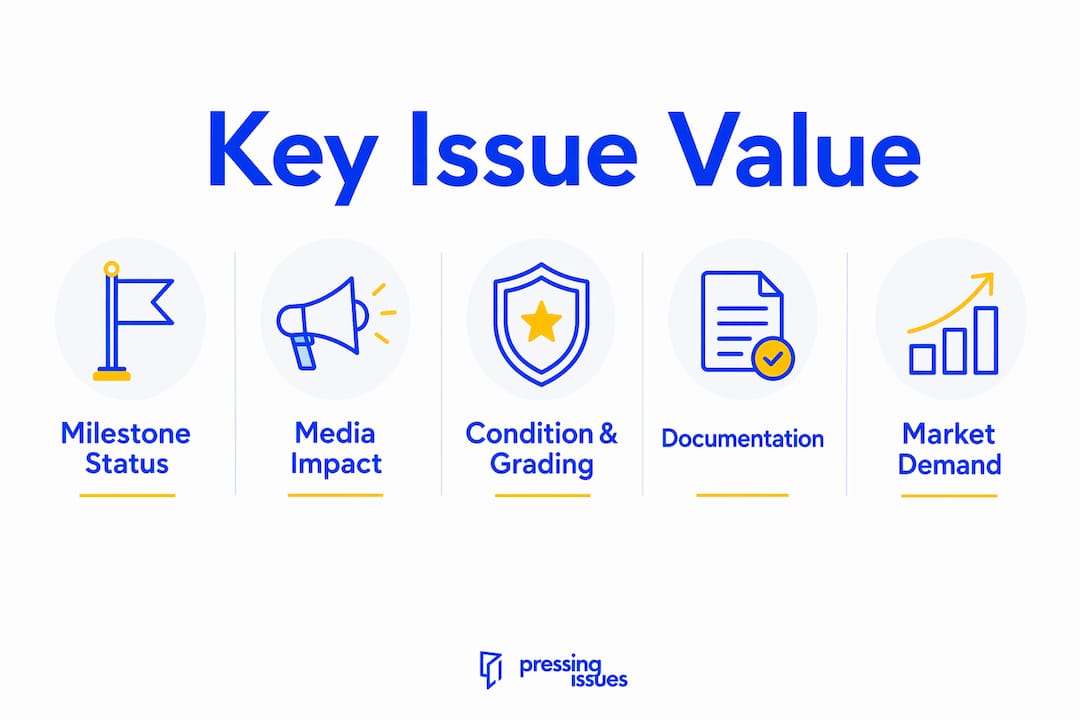
- Why do key issues matter and what drives their value?
- How to document that a book is a key issue
- How condition, pressing, cleaning, and CGC grading interact
- Should you press or clean your key issue?
- How to store and preserve key issues after pressing
- Key Takeaways
- The part most collectors skip
- Ready to have your key issues professionally assessed?
- Useful sources for further research
What counts as a key issue comic?
There is no single fixed definition across the hobby. Collectors typically divide keys into two tiers: major keys and minor keys.
Major keys carry large-scale impact on a character, series, or the industry itself. Think first appearances of flagship characters, origin stories, landmark deaths, and industry-defining publications. A subset of major keys earns the label "holy grail" — books like Action Comics #1 or Amazing Fantasy #15 that are universally desired but owned by very few. These books come with significant milestones attached: debuts of characters with massive followings, moments that reshaped entire universes, or the first comic from a publisher that would go on to define the medium.
Minor keys mark notable moments with narrower impact:
- A superhero's first new costume
- A celebrated artist's first published work on a defining series
- A first team-up between two supporting characters
- An early appearance of a villain before they became widely popular
Marvel Super-Heroes Secret Wars #8 is a textbook minor key: it introduced Spider-Man's black suit, a notable moment, but the suit's evolution into Venom (debuting fully in Amazing Spider-Man #300) is the major key. The distinction matters because major keys carry far greater price sensitivity, making professional preservation and documentation a higher priority.
Why do key issues matter and what drives their value?

Market value for a key issue depends on scarcity, character popularity, and the physical copy's condition. A book can be historically significant and still sell below what you paid if any one of those three factors works against you. Understanding which drivers you can control — and which you can't — shapes every decision you make about preservation and sale timing.
The core value drivers:
- First appearance or milestone importance. The more culturally durable the character or moment, the stronger the floor on demand.
- Scarcity. Newsstand editions had smaller distribution than direct editions, and lower print runs produce genuine rarity. Two books with identical covers can be entirely different market products depending on printing and variant details.
- Condition and grade. A CGC 9.8 of the same key can sell for multiples of a CGC 6.0. Condition is the one driver you can directly influence before sale.
- Media tie-ins. A character's debut in a film or streaming series can spike demand overnight. That same spike can fade just as fast.
- Provenance and sold comps. Matched sold comps — same issue, same printing, same grade band — are the only defensible evidence of market value. Asking prices are not comps.
Key status is also dynamic. A book the hobby considers minor today can become a major key after a media adaptation, and the reverse happens too. Treat key status as fluid and always verify with recent sold data, not wishful thinking. If you're weighing a key issue as a speculative investment, our guide on comic book flipping covers the risk side of that decision in detail.
How to document that a book is a key issue
Documentation is what separates a claim from a defensible valuation. Whether you're filing an insurance claim, negotiating a sale, or submitting to CGC, you need a repeatable record. Identifying the exact technical reason a book is key — first full appearance vs. cameo, printing, variant — is the foundation of that record.
Documentation checklist:
- Series name, volume number, and exact issue number
- Publication date and publisher
- Printing, variant, and edition (newsstand vs. direct, first print vs. reprint)
- The specific reason it's key (first appearance, origin, death, iconic cover, creator milestone)
- Grade band estimate (raw visual assessment before submission)
- 2–5 sold comps matched to the same printing and grade band, with dates
Photographic checklist:
- Full front cover and back cover
- Spine (look for ticks, stress marks, and color breaks)
- Interior splash page and key story pages
- Staples (condition and rust)
- Barcode and indicia (confirms printing and edition)
- Any printing codes on the cover or inside front cover
Pro Tip: Photograph under diffuse daylight or a daylight-balanced LED panel — direct flash washes out spine ticks and cover gloss. Name files systematically: "SeriesTitle_IssueNumber_PrintingEdition_Date" so the record is self-explanatory to an insurer, buyer, or grader.
For consignment-specific documentation practices, Pressing Issues has a dedicated guide on comic book consignment that walks through provenance records in detail.
How condition, pressing, cleaning, and CGC grading interact
Condition is the one value driver you can act on before a sale or grading submission. Professional pressing and cleaning can improve eye appeal and, in some cases, a book's grade — but the process carries real risks if approached carelessly.
CGC graders are trained to detect signs of restoration. A pressed book that passes as unrestored receives a standard grade. A book with evidence of improper work, adhesive residue, or color touch may receive a "Restored" or "Qualified" label, which typically reduces market value. Disclosure matters: always be transparent with your presser and, through them, with CGC.
Common problems pressing can address:
- Spine roll and slight cover warp
- Surface creases that haven't broken color
- Light dirt and handling grime (via dry or wet cleaning)
Problems pressing cannot fix:
- Staple rust (a red flag — moisture damage and rust are structural issues)
- Tears, missing pieces, or brittleness
- Chemical deterioration or foxing at an advanced stage
Pro Tip: Before any pressing or cleaning, request a pre-press assessment with dated before photos. Ask your presser explicitly whether the book shows any signs of prior restoration — a professional can often detect this before CGC does, saving you a surprise qualifier on your slab.
Our post on eye appeal and market value explains why a well-pressed book at a given grade often outsells a technically equivalent slab with poor presentation.
Should you press or clean your key issue?
Not every key issue is a pressing candidate. Use this decision checklist before committing:
- Is the defect surface-only and reversible (crease, roll, light grime)? If yes, pressing or cleaning may help.
- Does the book have realistic potential for a high grade that justifies the cost?
- Do you have sold comps showing a meaningful price difference between grade bands for this specific key?
- Does the book show staple rust, moisture staining, or brittleness? If yes, stop — pressing will not help and may cause damage.
- Have you documented the book's current condition with photos before anything is done?
Typical professional workflow: intake assessment and quote, pre-press photos, pressing and/or cleaning, post-press photos, final written report. That report is your provenance document for CGC and future buyers.
| Service | Typical cost range | Typical turnaround |
|---|---|---|
| Standard pressing | $15 per book | 2–6 weeks |
| Pressing + cleaning | $25 per book | several weeks |
| Expedited service | Varies by presser | 1–2 weeks |
Ranges are general market estimates. Actual quotes depend on book condition, tier, and presser workload. Always request a written estimate.
Pro Tip: Ask for a written estimate that includes a documented risk statement, before/after photos, explicit turnaround, and disclosure language you can share with CGC and future buyers. A presser who won't provide this in writing is a presser to avoid.
For a deeper look at what the pressing process actually involves, our pressing secrets guide covers the workflow from the inside.
How to store and preserve key issues after pressing
Once a book has been professionally pressed and cleaned, storage is what protects that work.
- Use Mylar or archival-grade polypropylene bags with acid-free backing boards.
- Store flat, not upright, to prevent spine stress over time.
- Keep books in a stable environment: cool, low humidity, away from direct sunlight and temperature swings.
- Handle with clean cotton gloves or freshly washed hands.
- Never use tape, adhesive labels, or lamination on or near the book.
- Avoid basements and attics — both are high-risk for humidity fluctuations and pests.
Keep the presser's before/after photos and written report with the book's provenance file. If you ever sell, submit to CGC, or file an insurance claim, that documentation is part of the book's story and its value.
Key Takeaways
A key issue comic's value rests on three pillars you must address before grading or sale: confirmed milestone status, exact printing identification, and documented condition with matched sold comps.
| Point | Details |
|---|---|
| Define the key reason precisely | Record first full appearance vs. cameo, printing, and variant — vague descriptions won't hold up to grader or buyer scrutiny. |
| Use sold comps, not asking prices | Match issue, printing, variant, and grade band; unmatched comps are weak evidence for insurance or sale. |
| Condition is the one driver you control | Pressing and cleaning can improve eye appeal and grade, but staple rust and moisture damage are beyond what pressing can fix. |
| Key status changes over time | Media adaptations and generational demand shift values; verify with recent sold data before making preservation or sale decisions. |
| Contact Pressing Issues before DIY | Professional assessment from Pressing Issues (Seattle, WA and Portland, OR) prevents irreversible damage to books that deserve careful handling. |
The part most collectors skip
Here's what I see consistently: collectors do the hard work of identifying a key issue and then skip the documentation step entirely. They press forward with a grading submission or a sale without a single sold comp matched to their exact printing, without a photo of the indicia, and without a written record of why the book is key. Then they're surprised when a buyer disputes the price or CGC returns a qualifier they didn't expect.
The hobby has a tendency to treat key-issue status as self-evident — as if the book's importance speaks for itself. It doesn't, not to an insurer, not to a grader, and not to a serious buyer. The documentation is the argument. A well-documented key issue with before/after photos, a presser's report, and matched sold comps is a fundamentally different asset than the same book with none of that.
My honest view: the collectors who get the most out of their key issues are the ones who treat documentation as part of the preservation process, not an afterthought. The book's physical condition and its paper trail are both part of what you're protecting.
Ready to have your key issues professionally assessed?
Collectors in Seattle and Portland trust Pressing Issues for exactly this kind of work: a careful pre-press assessment, honest risk disclosure, and before/after documentation that holds up to CGC scrutiny and buyer questions. We don't press books that shouldn't be pressed, and we don't skip the paperwork that protects your investment.
When you reach out, ask for a written estimate that includes pre-press photos, a documented risk statement, itemized cost, turnaround time, and disclosure language for graders and buyers. That's the standard we hold ourselves to on every submission.
Visit our comic pressing and cleaning services page to get started, or browse our full services and rates to compare options before you reach out.
Useful sources for further research
- CGC — The primary grading authority. Their standards define what "restored," "qualified," and "universal" labels mean for your book's market value.
- GoCollect — Sold comp data and editorial guides on major vs. minor key distinctions. Use their sales database to pull matched comps by grade band.
- Appraisily — Practical workflow for researching, grading, and pricing key issue series, including guidance on building a defensible comp range.
- Key Collector Comics — A searchable database of key issue criteria, useful for confirming whether a book qualifies and why.
- Pressing Issues blog — Practical guides on pressing, cleaning, damage types, CGC submission, and eye appeal written for collectors at every level.
This article is general information for educational purposes. For insurance valuations, CGC submission decisions, or legal questions about your collection, consult a qualified professional or the relevant primary source directly.