
Cream pages are interior comic pages whose paper has aged to a uniform warm, cream-toned color — stable and supple, but less bright than white or off-white. The label matters because it directly affects eye appeal and, by extension, resale value. On a CGC or CBCS slab, you'll see it printed right below the title and date as "Cream pages" or "Cream to Off-White pages," and the Overstreet Price Guide treats page quality as a meaningful factor when collectors compare otherwise identical copies. Two books graded 9.0 can sell at noticeably different prices if one has white pages and the other has cream.
Table of Contents
- What does "cream pages" mean on the page-color scale?
- Why do pages turn cream in the first place?
- Which eras and titles most often show cream pages?
- How do cream pages affect grading, eye appeal, and market value?
- Can cream pages be fixed? Pressing, cleaning, and restoration explained
- How to evaluate page color when buying a comic
- How sellers should describe page color accurately
- Key Takeaways
- The case for accepting cream pages — and knowing when not to
- Pressing Issues can help you prepare your books the right way
- Useful sources and further reading
What does "cream pages" mean on the page-color scale?
Page color runs along a spectrum from the brightest to the most degraded, and cream sits in the middle of that range. Here's how the standard scale breaks down:
| Page Color | What It Means |
|---|---|
| White | Bright, no visible aging; typical of well-stored modern books |
| Off-White | Slight warmth or dulling; still bright, minimal oxidation |
| Off-White to White | Combined label; center brighter than edges |
| Cream to Off-White | Combined label; edges have warmed more than center |
| Cream | Uniform warm tone; stable but clearly aged |
| Tan | Noticeably brown; aging is advanced |
| Brittle | Structurally compromised; pages crack or flake |
CGC records page quality directly on the slab label alongside the numeric grade, using phrasing like "Cream to Off-White pages" to capture variation between a book's center and its edges. CBCS follows the same color hierarchy with slightly different wording conventions. The combined labels — "Cream to Off-White" or "Off-White to White" — are common because graders assess center and edge variation separately, and a book's interior often ages differently than its outer pages. Grader-to-grader wording can vary slightly, but the underlying color hierarchy is consistent across both services.
Pro Tip: When reading a slab label, the first color listed in a combined designation (e.g., "Cream to Off-White") typically reflects the dominant or most prevalent tone — the second term describes where the pages are brighter.
Why do pages turn cream in the first place?
The short answer is chemistry and time. Most comic books printed before the mid-1980s used acidic wood-pulp paper, which contains lignin and other compounds that break down and yellow as they oxidize. Light, heat, humidity, and oxidation all accelerate this process, which is why two copies of the same issue can look completely different depending on where they spent the last 60 years.

Environmental factors are the biggest variable. A book stored in a hot attic or a damp basement will warm faster than one kept in a cool, dark, climate-controlled space. Ultraviolet light from windows or fluorescent bulbs degrades paper quickly, even through a bag and board. Pollutants in the air — including off-gassing from certain plastics — can also contribute to yellowing over time.
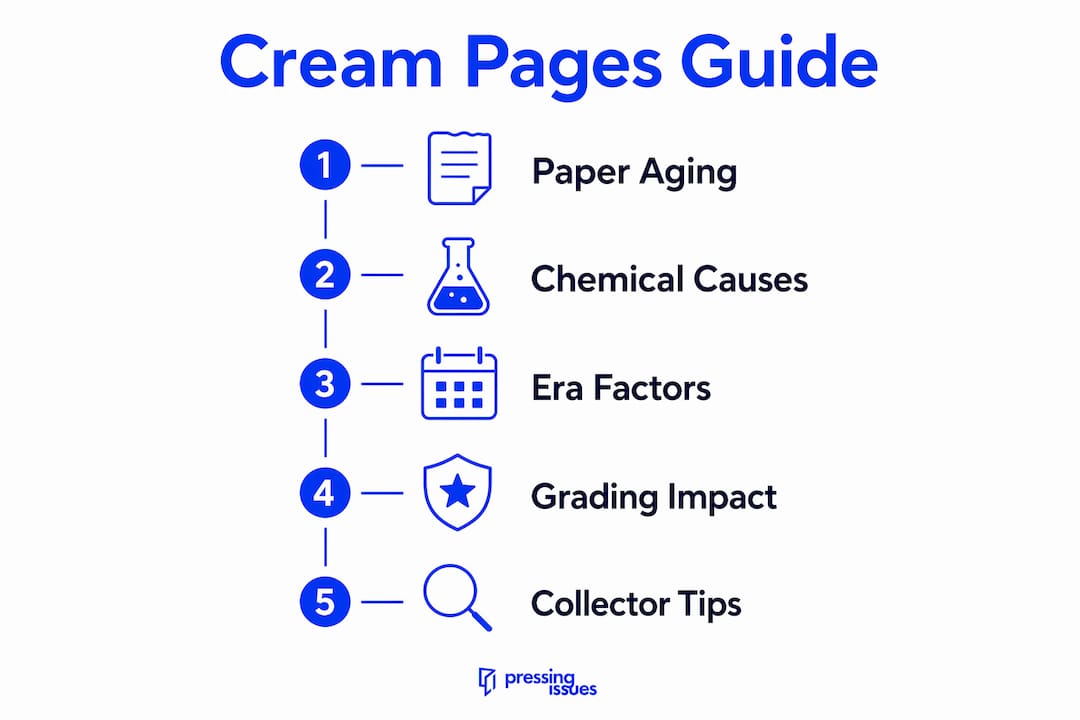
Production variables matter too. Publishers in the Golden Age and early Silver Age used cheaper, more acidic paper stocks to keep costs low. The inks and manufacturing processes of those eras introduced additional acids into the paper. Books printed on newsprint-grade stock are particularly vulnerable. By contrast, comics printed after the direct market shifted to higher-quality paper in the late 1980s tend to hold their brightness much longer.
One useful diagnostic: uniform cream across all pages suggests even, natural oxidation over time. If the edges are darker than the center, that points to uneven exposure, possibly from storage with covers open or in a poorly sealed environment. Center-preserved cream (the "Cream to Off-White" pattern) often indicates the book was stored with its covers closed, limiting edge exposure.
Which eras and titles most often show cream pages?
Cream pages are the norm, not the exception, for vintage books. If you're buying Golden Age or early Silver Age material, you should expect them.
- Golden Age (1930s–1950s): Cream pages are most prevalent in books from this era. The wood-pulp paper used by virtually every publisher of the period was highly acidic, and 70–90 years of aging has warmed nearly all surviving copies.
- Early Silver Age (mid-1950s to early 1960s): DC titles from this period frequently show cream to off-white pages. Marvel's early Silver Age books are similar, though some runs show more variation depending on print run and distribution region.
- Mid-to-late Silver Age and Bronze Age: Page quality improves on average, but cream pages still appear regularly, especially in books that weren't stored carefully.
- Modern Age exceptions: Even books from the 1990s and 2000s can show cream pages if they were stored in heat or humidity. Poor storage overrides good paper stock.
The practical takeaway: cream pages on a 1940s book are expected and don't signal neglect. Cream pages on a 1995 book are a red flag worth investigating.
How do cream pages affect grading, eye appeal, and market value?
Page color is recorded as a separate quality note and does not directly change the numeric grade — unless pages reach the brittle range. Brittleness causes a drastic grade drop because it signals structural failure. Cream pages, by contrast, are stable. A 9.4 with cream pages is still a 9.4.

Where cream pages hit hardest is eye appeal and the price that eye appeal commands. A white-page copy of a key issue will consistently sell at a premium over a cream-page copy at the same grade. For high-grade keys — first appearances, origin issues, major crossover books — that gap can be substantial. Buyers competing at auction know this, and so do dealers pricing private-sale inventory.
Overstreet provides baseline values, but those figures don't fully capture the page-quality premium in the current market. Recent auction results from Heritage Auctions and ComicLink are more reliable for understanding what white versus cream actually costs you on a specific book. When comparing listings, always match grade AND page quality — a 9.6 with cream pages is not a fair comparison to a 9.6 with white pages, even if both slabs show the same number.
For collectors focused on comic book flipping or investment-grade keys, white pages should be the priority. For readers, casual collectors, or anyone building a run on a budget, cream pages on a structurally solid book are entirely acceptable. The price differential can actually work in your favor: cream-page copies of high-grade keys sometimes trade slightly under white-page equivalents, and if you store them properly going forward, you're preserving what you have.
Can cream pages be fixed? Pressing, cleaning, and restoration explained
This is where realistic expectations matter most. Here's what each type of service actually does:
- Pressing: Removes physical defects — creases, rolls, spine stress, and light bends. Pressing does not change page color. A cream-page book that's been pressed will have better structural presentation, but the pages will still be cream.
- Cleaning: Removes surface dirt, oils, and some staining from covers and pages. Cleaning can improve overall presentation and occasionally brightens pages slightly, but it cannot reliably convert cream pages to white.
- Bleaching/chemical restoration: Can lighten pages, but bleaching is expensive, frowned upon, and often destabilizes the paper long-term. More critically, any restoration must be disclosed when selling, and CGC and CBCS both flag restored books with a purple label, which typically reduces market value compared to an unrestored copy.
The market consequence of restoration is real. A restored book in a purple label holder often sells for less than an unrestored copy at a lower grade. Buyers discount restoration because they can't verify the long-term stability of the treatment. Pressing and cleaning are considered non-restorative when done correctly and don't require disclosure, but bleaching crosses into restoration territory.
When is professional treatment worth considering? Only for extremely high-value keys where the cost of service is a small fraction of the potential value gain. For most books, pressing and cleaning to improve structural presentation makes sense before a grading submission. Bleaching almost never does.
Pro Tip: Before sending any book for treatment, ask the service provider specifically what they can and cannot do for page color. A reputable presser will tell you upfront that pressing won't change cream pages to white. If someone promises otherwise, that's a red flag.
For guidance on choosing which comics to send for pressing, the decision usually comes down to whether the structural improvements justify the cost relative to the book's market value.
How to evaluate page color when buying a comic
Whether you're browsing online listings or handling a book in person, a consistent inspection process protects you from overpaying.
- Request a centerfold shot. The centerfold is the most protected part of the book and shows the truest interior page color. Compare it to the edge pages to check for variation.
- Check the lighting in photos. Warm or yellow-tinted lighting makes cream pages look worse than they are; cool white light is more accurate. Ask for a photo under neutral lighting if the listing shots look heavily filtered.
- Look at the edges. Edge darkening beyond the general cream tone can indicate tan pages developing, which is a more serious condition.
- Ask for a staple close-up. Rust or corrosion around staples often accompanies moisture damage, which accelerates page darkening.
- Test suppleness on unslabbed books. Gently flex a staple-adjacent fold to feel whether pages are supple or stiff. Supple means cream; stiff or cracking means brittle. This is the single most important physical check for unslabbed vintage books.
- Smell the book. A musty or mildew smell signals moisture damage that often accompanies foxing and accelerated browning.
- Verify the slab label. For slabbed books, confirm the page-quality designation on the label matches what you see through the case. If the label says "Off-White to White" but the pages look clearly cream, ask questions.
Red flags that go beyond acceptable cream: localized foxing (brown spots), edge brittleness or flaking, and any pages that feel stiff or papery rather than flexible. These indicate conditions that affect both grade and long-term stability, not just appearance.
How sellers should describe page color accurately
Accurate descriptions protect you from disputes and attract buyers who are genuinely right for your book. Vague or optimistic descriptions lead to returns, negative feedback, and damaged reputation.
- Use standard terminology. "Cream pages," "Cream to Off-White pages," and "Off-White pages" are the terms buyers recognize. Don't substitute "slightly yellowed" or "a little aged" — those phrases signal that you're not fluent in grading language.
- Be specific about variation. If edges are darker than the center, say so: "Cream pages, edges trending toward tan." That one phrase sets accurate expectations and demonstrates honesty.
- Provide the right photos. Every listing for an unslabbed vintage book should include: a centerfold shot, an edge-to-edge spread, a staple close-up, and at least one interior page under neutral lighting.
- Use a short disclosure template. Something like: "Pages are cream throughout, supple and flat. No foxing, no brittleness. Photos taken under natural light — centerfold and edge shots included." That's enough to set expectations and show you know what you're talking about.
- Price accordingly. Cream-page copies should be priced below white-page equivalents at the same grade. Check recent auction results for the same book at the same grade with the same page quality. Overpricing a cream-page copy relative to white-page comps is the fastest way to sit on inventory.
For slabbed books, the label does the heavy lifting. Still, noting the page quality in your listing text saves buyers from having to zoom in on the slab photo.
Key Takeaways
Cream pages are a stable, expected condition in vintage comics — the label affects eye appeal and price, not structural grade, unless pages have progressed to brittle.
| Point | Details |
|---|---|
| Cream pages defined | Uniform warm-toned paper that is stable and supple, distinct from tan or brittle pages. |
| Grade vs. eye appeal | Page color doesn't change the numeric grade unless brittle; white pages command a market premium over cream at the same grade. |
| Era expectations | Golden Age and early Silver Age books almost always show cream pages — it's normal, not a defect. |
| Restoration limits | Pressing and cleaning improve presentation but won't reliably turn cream pages white; bleaching requires disclosure and usually hurts resale value. |
| Pressing Issues | For professional pressing and cleaning before a grading submission, Pressing Issues provides transparent rates and turnaround for collectors in Seattle and Portland. |
The case for accepting cream pages — and knowing when not to
Cream pages get a bad reputation they don't always deserve. For most vintage collecting, cream is simply what 70 years of existence looks like on paper. The collectors who dismiss every cream-page book are often leaving real value on the table, especially on Golden Age material where white pages are genuinely rare and priced accordingly.
That said, the calculus changes when you're buying investment-grade keys. A high-grade first appearance with cream pages will always carry a ceiling that a white-page equivalent doesn't. If you're buying to hold and eventually sell at a premium, page quality is a factor you can't ignore. The price differential between white and cream on a key issue at 9.4 or above can be significant enough to matter at resale, even years down the road.
The smarter approach is to match your page-quality standards to your collecting goals. Building a reading collection or completing a run? Cream pages on a structurally solid book are a perfectly reasonable choice, and the lower price point is a genuine advantage. Chasing investment-grade keys for long-term appreciation? Prioritize white or off-white pages and treat the premium as part of the cost of doing it right.
What we'd caution against is spending money on bleaching or chemical restoration to "fix" cream pages. The disclosure requirements, the purple label, and the market discount for restored books almost always make that a losing proposition. Pressing and cleaning to improve structural presentation before submission? Absolutely worth considering. Trying to chemically alter page color? Rarely, if ever.
Pressing Issues can help you prepare your books the right way
If you've got a vintage book with cream pages and you're wondering whether pressing or cleaning could improve its presentation before a grading submission, Pressing Issues offers exactly that kind of honest evaluation. Based in Seattle, Washington and Portland, Oregon, we work with collectors who want to know what's realistic before they spend money on treatment.
Pressing and cleaning can remove surface dirt, reduce minor rolls and creases, and improve overall eye appeal — all without crossing into restoration territory. We won't tell you we can turn cream pages white, because we can't, and neither can anyone else without bleaching. What we can do is make sure your book looks its best structurally before it goes to CGC or CBCS. Check our comic pressing services for current rates and turnaround times, or visit our full services page to see everything we offer. Send us your book details and we'll give you a straight answer on what treatment makes sense.
Useful sources and further reading
These are the primary references worth bookmarking for page-color grading and comic condition standards:
- CGC Grading Scales: The authoritative source for slab-label wording, page-quality designations, and how CGC records combined labels like "Cream to Off-White." Start here when you need to decode a label.
- Heritage Auctions Grading Guide: Covers restoration definitions, bleaching risks, and grading terminology from one of the largest comic auction houses in the country. Especially useful for understanding restoration disclosure requirements.
- Overstreet Price Guide: The industry standard for baseline valuations and condition definitions. Use it as a floor for pricing, then check recent auction results for page-quality premiums on specific books.
- CBCS: The second major grading service; follows the same page-color hierarchy as CGC with its own label conventions. Worth checking when comparing slabbed copies from both services.
- Pressing Issues Services: For collectors considering pressing or cleaning before submission, this page covers what each service does, realistic outcomes, and current turnaround times.
When making any value judgment on a cream-page book, always cross-reference the slab label with recent sales records for the same title, grade, and page quality. Overstreet gives you a baseline; the market gives you the real number.
Recommended
- Comic Book Pressing Secrets Revealed: What Experts Don't Want You to Know — Pressing Issues
- Comic Book Consignment Best Practices for Collectors — Pressing Issues
- Comic Book Double Cover: What Collectors Need to Know — Pressing Issues
- Comic Book Pedigree Explained: What Collectors Need to Know — Pressing Issues