
GPAnalysis (GPA) is a live sales database that records completed transactions for CGC-graded comics, linking each sale to grade, venue, date, and CGC certification number where available. If you are buying, selling, or deciding whether to press and submit a book, GPA gives you the real prices collectors paid, not what sellers are asking.
- For collectors: Use GPA to verify whether a dealer's asking price reflects actual market activity before you commit.
- For dealers: Use it to set competitive prices grounded in completed sales, not wishful thinking.
GPA is close to essential for any CGC-graded book above raw value. For low-grade common issues where the spread between raw and slabbed is thin, it becomes optional. Value is a range, not a single number, and GPA is the most direct tool for defining that range from real transaction history.
Table of Contents
- What data GPA records and the features collectors rely on
- How GPA collects data and which venues it covers
- What a GPA subscription costs
- How to use GPA data to set a fair market value
- What GPA does not capture and how to avoid common mistakes
- Should you press and submit? A cost-benefit checklist using GPA data
- Alternatives and complementary tools to GPA
- Headline GPA stats and notable top sales
- Key Takeaways
- Why GPA data only tells part of the story
- Pressing Issues can handle the submission workflow for you
- Useful sources and further reading
What data GPA records and the features collectors rely on
GPAnalysis markets itself as the world's first and most comprehensive analysis and valuation service for CGC-graded comics and magazines, with multi-million transaction coverage. Each record in the database captures a specific set of fields that matter for grading decisions.
Fields recorded per transaction:
- Grade (numeric CGC grade)
- Sale price and sale date
- Venue (auction house, dealer, marketplace)
- CGC certification number (where available)
- Label type (Universal, Restored, Signature Series, Qualified)
- Variant, printing, and edition
- Pedigree designation where applicable
- Page quality (PQ) notes where disclosed
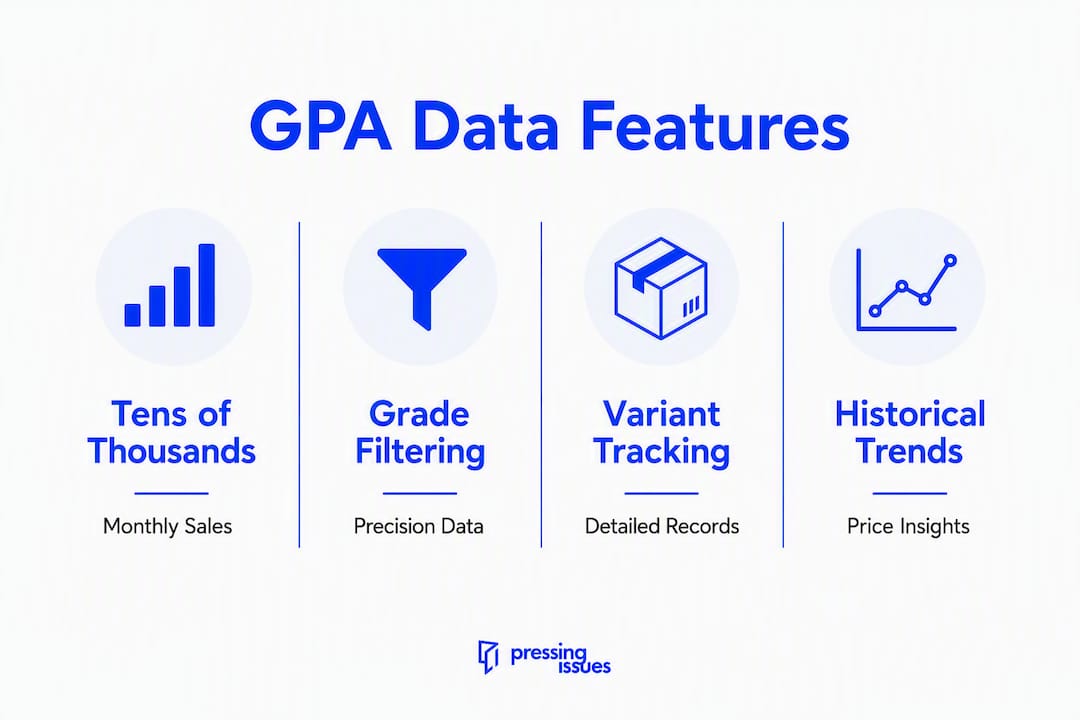
Beyond raw records, GPA's feature set includes filters by grade, variant, pedigree, and label type; historical price charts broken out by grade; live active listings alongside completed sales; watchlists for titles you are tracking; and a portfolio tracker. These tools map directly to valuation tasks. Grade-specific filters let you build true comps for a 9.8 versus a 9.6 of the same issue. Historical charts reveal whether a book is trending up, cooling off, or holding flat over a 12-month window.
Pro Tip: Filter by label type before reading any chart. A Restored label copy selling at half the Universal price is not a comp for your unrestored book, even at the same numeric grade.
How GPA collects data and which venues it covers
GPA ingests sales continuously as auction and dealer results are recorded. The platform covers major auction houses, dealer archives, and marketplace sold listings, building a record that reflects where CGC-graded comics actually change hands. Data updates are ongoing rather than batched monthly, so a sale that closes today typically appears in the database within a short window rather than weeks later.

Trust signals matter here. GPAnalysis was founded in 2001 by collector enthusiasts who identified the need for timely pricing data in the collectibles space. GPA for CGC Comics was the first pricing and analysis tool of its kind for CGC-graded material, and it now reports on tens of thousands of transactions every month. Each transaction is tied to a CGC certification number where one exists, and GPA links directly to CGC census entries so you can verify the cert, check the population at that grade, and confirm the book's grading history without leaving the platform.
Pro Tip: When a sale looks like an outlier, pull the CGC cert number from that GPA record and run it against the CGC census directly. You will immediately see whether the book was regraded, pressed between submissions, or has a restoration note that the listing did not disclose.
What a GPA subscription costs
GPA operates on a subscription model. The monthly subscription tier is typically $10.95 and the annual tier $119, according to recent feature page listings from GPAnalysis. Always confirm live pricing on the GPA features page before subscribing in case of updates.
What the subscription unlocks:
- Full access to individual completed transaction records (not just aggregates)
- Historical price charts broken out by grade
- Live active listing data alongside sold comps
- Watchlists and portfolio tracking tools
- Direct links to CGC census entries from individual sale records
The free tier, where one exists, typically shows limited data. The paywall sits in front of the granular per-transaction detail that makes GPA genuinely useful for pricing decisions. For a dealer moving volume or a collector building a serious collection, the annual cost is modest relative to the value of avoiding a single mispriced purchase.
Pro Tip: Start with the annual plan if you plan to use GPA regularly. The per-month cost drops meaningfully, and the tools you need for ROI modeling require full access to transaction history.
How to use GPA data to set a fair market value
Pricing a CGC-graded comic with GPA is a five-step process. Done correctly, it produces a low/fair/high range grounded in completed sales rather than asking prices.
-
Confirm the exact edition, variant, and printing. Before touching GPA, verify the book's details against the CGC label. A Type 1A versus Type 1B variant can have a dramatically different sales history. Check the CGC census population at the exact grade to understand scarcity context.
-
Filter GPA to the precise grade or nearest grade band and set a time window. For liquid books with frequent sales, a 90-day window gives you current market sentiment. For scarcer grades with low transaction volume, extend to 12 months to gather enough records for a meaningful range.
-
Prioritize completed transactions over active listings. Active listings are asking prices. Completed sales are evidence. Sold listings reflect true market value; active listings reflect seller optimism. If GPA shows 12 completed sales and 3 active listings at 30% above the sales average, the active listings are noise.
-
Compute your low/fair/high using the median and recent volume. Trim obvious outliers (a single record 3x the median is almost always a condition anomaly or a relist error). The median of your filtered set is your fair value. The lower quartile is your floor; the upper quartile is your ceiling.
-
Adjust for page quality, Signature Series status, pedigree, and unique notes. A 9.4 with white pages and a pedigree designation will consistently land at the top of the 9.4 range. A 9.4 with off-white/white pages and no pedigree sits at fair. These adjustments are not guesswork; they are visible in the transaction records themselves if you filter by PQ where GPA captures it.
Pro Tip: When a grade lane has fewer than five completed sales in your time window, widen the band by one grade in each direction and note the price differential. Use that differential to interpolate rather than relying on a statistically thin average.
What GPA does not capture and how to avoid common mistakes
GPA is powerful, but it has real gaps. Private sales between collectors never enter the database. Restoration status is not always disclosed in the original listing, so a Restored book occasionally appears in Universal-label data until the cert is checked. Physical defects invisible in auction photos, such as spine stress or micro-tears, can make a realized price misleading for a book you are trying to comp.
Common valuation mistakes:
- Treating a single headline sale as the market price. One record at 3x the median is a ceiling data point, not a comp.
- Using active listings as proof of value. A book listed at $500 that has not sold is not worth $500.
- Relying on low-volume grade lanes without widening the band. Five or fewer sales in a grade lane is statistically thin; treat those averages with wider uncertainty.
- Ignoring label type when filtering. Signature Series and Restored copies require separate comp sets.
Do's and don'ts:
- Always cross-check the CGC cert number for any record that looks anomalous.
- Use multi-month windows for scarce grades; use tighter windows for high-volume modern keys.
- Set a minimum volume threshold (at least five to eight completed sales) before trusting an average for ROI math.
Pro Tip: GPA averages are a starting point, not a final answer. For high-value copies, a hands-on physical exam for spine stress, micro-tears, and page quality should accompany any GPA comp before you price or purchase.
Should you press and submit? A cost-benefit checklist using GPA data
GPA gives you the expected slabbed price. The question is whether that price justifies the cost of getting there. Professional dealers recommend grading only when the expected value increase comfortably exceeds total processing costs, and for many non-key or low-grade books, the fees outweigh potential returns.
Here is the calculation framework:
| Cost or Value Item | Example Amount | Notes |
|---|---|---|
| Expected slabbed price (GPA median for target grade) | — | Use 90-day median for liquid books |
| Current raw value | — | Use sold eBay comps for raw copies |
| Raw-to-slabbed spread | — | This is your gross opportunity |
| Pressing and cleaning fee | — | Varies by book complexity |
| CGC submission fee | Varies by tier | CGC fees scale by declared value and service tier |
| Shipping and insurance (round trip) | — | Estimate conservatively |
| Net expected gain | — | Spread minus all costs |
Checklist before submitting:
- Is the raw-to-slabbed spread at least 2x total costs? If not, reconsider.
- Does the book have PQ, pedigree, or Signature Series potential that pushes it toward the high end of the grade range?
- Is the CGC population at the target grade low enough that scarcity supports the GPA median?
Raw comics typically trade for 30–50% less than comparable CGC-graded copies, so the spread exists on most mid-grade keys. The question is always whether it survives the cost stack.
Pro Tip: Pedigree and Signature Series status can move a copy to the very top of its grade curve. If your book has either, model the slabbed price against the top-quartile GPA records for that grade, not the median. The difference in expected return often justifies pressing even when the median spread looks marginal.
Alternatives and complementary tools to GPA
GPA is not the only data source, and the strongest valuations use it alongside other tools.
- eBay sold listings: Free and updated in real time. Best for raw comic comps and for cross-checking GPA on high-volume modern books. Weaker for scarce keys where CGC-specific filters matter.
- CGC population report: Free from CGC directly. Tells you how many copies exist at each grade, which is the scarcity context GPA prices need to be meaningful. Use it alongside GPA, not instead of it.
- Auction-house archives: Heritage Auctions and Goldin publish realized prices for major sales. For trophy books, these archives capture the high end of the market that GPA may underrepresent if those sales are not fully ingested.
- PriceCharting and similar aggregators: Broad price references are useful for initial triage, especially for raw books or inherited collections. They lack the CGC-grade specificity and cert-level detail that GPA provides.
The practical stack: start with GPA for CGC-specific comps, cross-reference the CGC population report for scarcity, and check auction-house archives for any book where a single trophy sale might define the ceiling.
Headline GPA stats and notable top sales
GPAnalysis covers multi-million transactions across its database, reporting tens of thousands of new sales every month from auction houses, dealers, and marketplaces. That volume is what makes the platform's averages statistically meaningful for liquid titles.
GPA's "chart busters" feature highlights top realized prices for individual issues and grades. These headline sales, often record-setting copies of Action Comics #1, Amazing Fantasy #15, or Detective Comics #27 in high grade, serve a specific purpose in valuation: they define the ceiling for a grade, not the floor or the fair value.
How to use headline sales correctly:
- Treat them as ceiling checks. A single 9.8 sale at $500,000 does not mean your 9.8 is worth $500,000 if that record is one of two sales in five years.
- Note the date. A record set in a peak market year may not reflect current demand.
- Check population. A headline price on a book with a census population of three is a different signal than the same price on a book with a population of 300.
Key Takeaways
GPA (GPAnalysis) is the most direct tool for building a CGC-grade-specific price range from completed sales, but its value depends entirely on how you filter and interpret the data.
| Point | Details |
|---|---|
| Sold beats asked | Always use completed GPA transactions, not active listings, for true market value. |
| Verify every cert | Cross-check CGC certification numbers in GPA against the CGC census to catch restoration or regrading history. |
| Volume thresholds matter | Require at least five to eight completed sales in a grade lane before trusting an average for ROI math. |
| Model the full cost stack | Subtract pressing, CGC fees, and shipping from the raw-to-slabbed spread before deciding to submit. |
| Pressing Issues fits the workflow | When GPA shows a spread that covers costs, professional pressing and cleaning can move a book toward the top of its grade range. |
Why GPA data only tells part of the story
Most collectors treat GPA as the final word on a book's value. It is not. GPA tells you what similar copies sold for. It does not tell you whether your specific copy will grade the same way, hold the same PQ designation, or survive the submission process without a surprise.
The books where this gap matters most are mid-to-high-grade copies with visible but non-restorative defects: a light spine tick, a small corner crease, surface grime that photographs well but reads poorly under grader lighting. GPA shows you the 9.4 median. It does not show you that your copy, unaddressed, might grade 8.5 and land well below that median.
Pedigree and page quality are the two variables most commonly underweighted by collectors reading GPA charts. A 9.2 with white pages from a recognized pedigree collection will consistently outperform a generic 9.2 in the same grade lane. That difference is visible in GPA's transaction records if you filter carefully, but most collectors read the grade average and stop there.
The practical takeaway: use GPA to define the range, then use a physical assessment to determine where your specific copy sits within it. For books where the spread justifies the investment, professional pressing and cleaning can move a copy from the middle of that range toward the top before it ever reaches a grader.
*— Charles
Pressing Issues can handle the submission workflow for you

When your GPA research shows a raw-to-slabbed spread that covers costs, the next question is execution. Pressing Issues provides professional comic book pressing, cleaning, and CGC submission handling for collectors and dealers in Seattle and Portland. We assess each book for non-restorative defects, surface grime, and structural issues before pressing, with the goal of positioning your copy toward the high end of its grade curve rather than the middle.
Our appraisal and value analysis service is complimentary and helps you confirm whether the GPA spread on your book justifies the full cost stack before you commit. We manage pressing, cleaning, packaging, and CGC paperwork so you are not navigating submission logistics alone. Grade outcome is never guaranteed, but reducing defect risk before submission is the most direct way to improve your odds of landing at the top of a grade band.
Request an estimate at pressing-issues.com/services/comic-book-pressing to get started.
Useful sources and further reading
- GPAnalysis — About: Background on GPA's founding, scope, and transaction coverage. Start here to understand the platform's history and positioning.
- GPAnalysis — Features: Full list of subscription features, filter options, and current pricing. Confirm live pricing here before subscribing.
- GPAnalysis — FAQ / Help: Workflow guidance for using GPA filters, reading charts, and linking to CGC census entries.
- CGC Census: Verify certification numbers, check population by grade, and confirm label type for any book you are pricing or purchasing.
- Comic book price tracking — expert note: Guidance on building price ranges from completed sales and using GPA alongside other tools.
- Estimate comic collection value: Practical overview of raw versus graded pricing differentials and why sold listings outperform active listings for valuation.
- Comic book values guide: Tool-stack recommendations and CGC fee context for modeling grading ROI.
- Dealer guidance on comic book value: Professional perspective on when grading fees outweigh potential returns.
- Pressing Issues — Services and Rates: Pressing, cleaning, and CGC submission rates for building the cost side of your ROI calculation.
- How to choose which comics to send for pressing: Practical criteria for prioritizing books before submission.
Recommended
- GoCollect vs. CovrPrice vs. GPA (GPAnalysis): Which Tracking Tool Fits Your Collecting Style? — Pressing Issues
- Beyond the Number: Why Eye Appeal is the Secret to Winning in the Comic Market — Pressing Issues
- CGC Submission Do's and Don'ts: How to Save Money and Avoid Shipping Headaches — Pressing Issues
- Comic Dealer Population Report Strategy: 2026 Guide — Pressing Issues