
Modern age comic pressing is the process of using controlled heat, humidity, and pressure to remove non-color-breaking defects from comic books printed roughly from 1975 to the present, and yes, most collectors should do it before submitting to a professional grader. It is a non-restorative conservation step, meaning it does not add or alter material, and CGC treats it accordingly — pressed books receive a standard blue label, not the purple restored label that tanks resale value.
- The core benefit: Pressing can move a modern book up by a half or full grade by correcting factory waves, spine rolls, and light indentations that graders penalize.
- The main limit: It only works on non-color-breaking defects. Tears, stains, and creases where the ink has already fractured will not respond, and pressing them incorrectly can make things worse.
Table of Contents
- What does "Modern Age" mean for pressing decisions?
- What does a competent presser actually do with your comic?
- What pressing will and will not fix, and why that distinction matters
- When should you press a modern comic?
- What does pressing cost, and how long does it take?
- How do you choose a reputable presser?
- Pressing Issues: professional pressing and cleaning in Seattle and Portland
- How to prepare and package your comics before sending them
- Key Takeaways
- Why press-before-grade is the right call for modern books
- Get your modern comics pressed the right way
- Useful sources for collectors who want to go deeper
What does "Modern Age" mean for pressing decisions?
The Modern Age of comics is generally considered by collectors to begin around 1975 and continue to the present day, though the exact start date is debated. What matters for pressing is what that era's production methods actually produced: higher-volume offset printing, thinner paper stocks, and mass-market distribution that introduced a specific set of cosmetic defects you rarely see on Golden or Silver Age books.
Factory waves are the most common culprit. Modern books often arrive from the distributor with a slight bow or ripple caused by humidity fluctuations during shipping and storage, not by mishandling. Light finger rippling along the cover, minor spine ticks from shelf storage, and subtle indentations from binding pressure are all characteristic of this era. Because these defects come from environmental stress rather than structural damage, they tend to respond well to a controlled press.

Older books present different challenges. Pre-1970s paper is more brittle, more chemically unstable, and far less forgiving of heat and humidity. Modern books, by contrast, have paper that is still pliable enough to relax under the right conditions. That physical difference is exactly why pressing is so commonly discussed in the context of modern comics specifically.
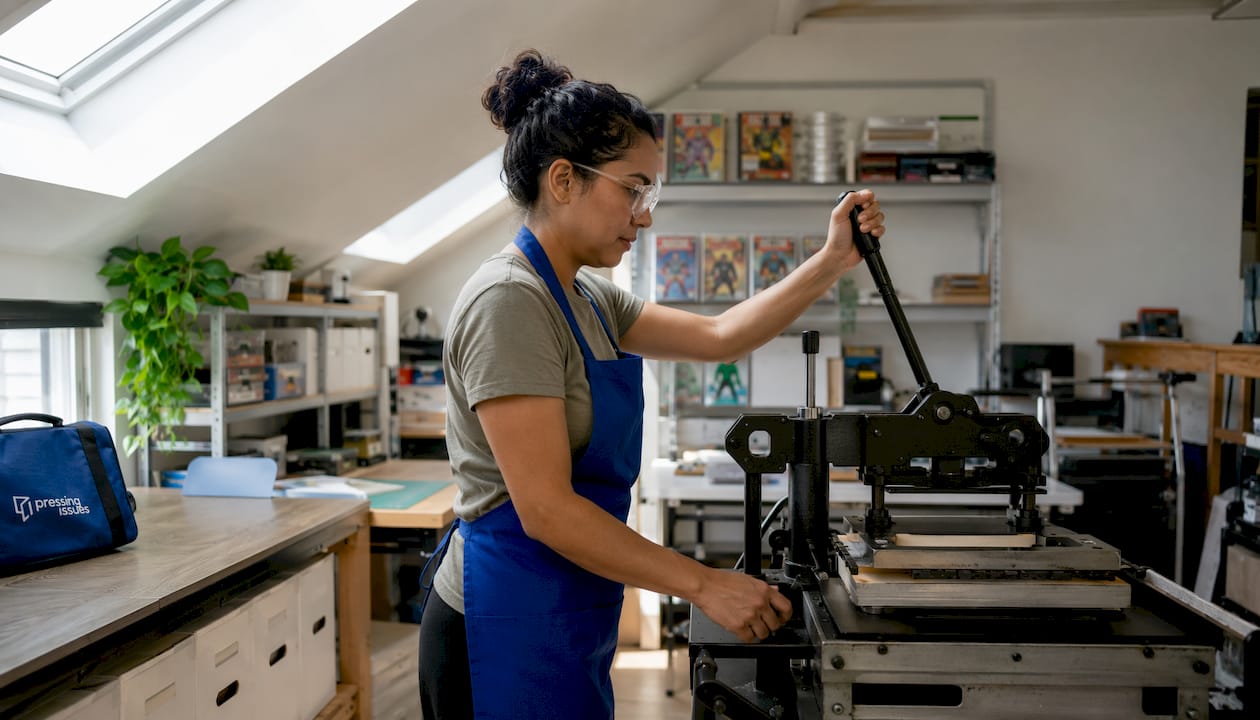
What does a competent presser actually do with your comic?
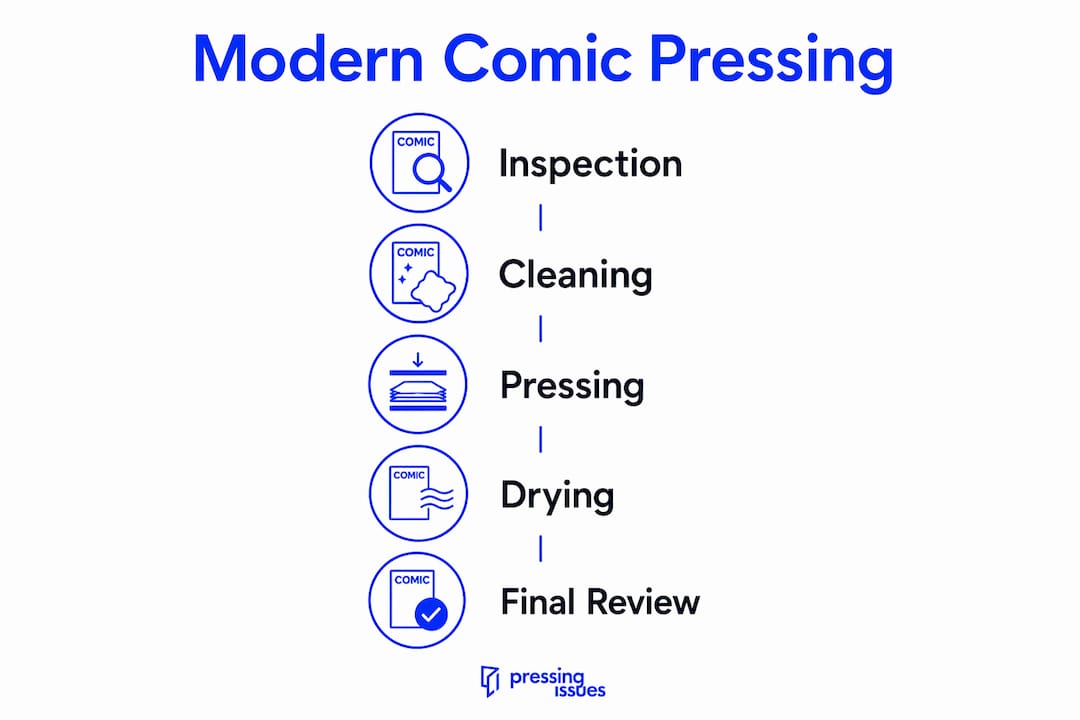
A professional pressing service follows a deliberate sequence, and understanding it helps you evaluate whether a presser knows what they are doing:
- Intake inspection: The book is examined under bright light to catalog existing defects, note any color-breaking creases, and confirm the book is a candidate for pressing.
- Dry cleaning (if needed): Surface dirt, fingerprints, and oxidation are removed before pressing. Skipping this step traps contaminants under pressure, which can cause permanent marks.
- Divot and indent care: Localized dents or indentations may be addressed with targeted moisture and gentle manipulation before the full press cycle begins.
- Humidity conditioning: The book is exposed to controlled humidity to relax the paper fibers, making them receptive to flattening without cracking.
- Controlled heat press: The book is pressed under calibrated temperature and pressure using specialized equipment, not household irons. This is a gradual process, not a single heavy press.
- Cold set: After the heat cycle, the book is held flat under weight at room temperature to lock in the corrected shape.
- Final inspection and packaging: The book is re-examined, documented, and packaged securely for return or grading submission.
The goal of each step is to coax the paper back to its original flat state without stressing the ink or fibers. Cover rippling, non-color-breaking creases, spine rolls, and light waves are the primary targets.
Pro Tip: When reviewing before/after photos from a presser, look specifically at the spine under raking light. A well-pressed book should show a smooth, consistent spine with no new stress lines introduced by the press itself. If the after photo is taken straight-on with flat lighting, ask for a raking-light shot — that is where quality shows.
What pressing will and will not fix, and why that distinction matters
This is where collectors most often get burned by misplaced expectations. Pressing is not a cure-all, and the line between what it can and cannot fix is firm.
| Defect Type | Pressable? | Notes |
|---|---|---|
| Factory waves / bowing | Yes | Common on modern books; responds well to conditioning |
| Non-color-breaking creases | Yes | Crease flattens; no ink fracture present |
| Spine rolls and ticks | Often | Depends on severity; light ticks usually respond |
| Cover rippling / finger waves | Yes | Primary target for modern book pressing |
| Color-breaking creases | No | Ink already fractured; pressing cannot restore color |
| Tears and missing pieces | No | Structural damage; requires restoration, not pressing |
| Water damage / staining | No | Stains are set into the paper; pressing may worsen them |
| Mold or foxing | No | Biological damage; pressing spreads rather than fixes |
| Previous restoration | No | Graders will still flag it; pressing does not hide fills |
The industry distinction here is critical. CGC defines restoration as any process that adds or replaces material, including color touch, piece fill, and tape. Pressing does neither. It removes or flattens, but introduces nothing. That is why pressed books grade normally while restored books receive a separate label that collectors and buyers treat as a significant value reduction.
Pressing is widely accepted as a standard pre-grading conservation step because it does not introduce foreign material. A pressed book is still an unrestored book. A restored book — no matter how skillfully done — carries that designation permanently on its CGC label.
DIY attempts with household irons are where things go wrong most often. Uncontrolled heat causes ink stress and can permanently set a crease deeper than it was before. Reversion — where a book returns to its defective shape after an amateur press — is also common when the conditioning and cold-set steps are skipped.
When should you press a modern comic?
Not every book is worth pressing, and the decision comes down to a straightforward value calculation. The best candidates are modern books in the 8.5–9.4 grade range carrying non-color-breaking defects.
- Strong candidates: Books with factory waves, light spine ticks, or non-color-breaking cover creases where a half-grade bump would meaningfully increase market value.
- Weak candidates: Books with structural damage, color-breaking creases, or staining — pressing costs money and time without improving the grade.
- Timing: Always press before professional grading submission. Submitting an unpressed book and then pressing after grading means paying for grading twice.
- Value check: Estimate the likely post-press grade ceiling, look up the price difference between that grade and the current grade on recent sales, and compare that gap to the pressing fee. The grade-bump economics favor pressing most strongly in the mid-to-high grade range on keys and first appearances.
Modern books with factory waves and distribution-induced bends can improve noticeably in grade when the defects are purely cosmetic. That kind of jump on a key modern issue can represent a substantial dollar difference.
Pro Tip: To check whether a crease is color-breaking before you send a book, tilt it under a bright lamp at a low angle. A non-color-breaking crease shows a smooth indentation. A color-breaking crease shows a white or jagged line where the ink and paper fibers have separated. That five-second test tells you whether pressing is worth pursuing.
What does pressing cost, and how long does it take?
Pricing for professional pressing in the United States varies based on several factors, and no single flat rate applies universally.
What affects the price: The level of defect remediation needed, whether dry cleaning is required before pressing, the volume of books submitted (bulk rates are common), and whether pressing is bundled with a grading submission all influence the final cost. CGC's pressing service is offered as a bundled add-on to grading, which is one common route collectors take.
Turnaround time depends on the service's current backlog, whether you are using a third-party presser or submitting directly through a grading house, and the time of year. Peak convention season typically extends wait times across the industry.
When comparing quotes, ask specifically about: insured return shipping, photo documentation of the book before and after pressing, whether the presser offers any assessment of non-pressable defects before they begin work, and their written policy on the pressing-versus-restoration distinction. A presser who cannot answer those questions clearly is a presser worth avoiding.
How do you choose a reputable presser?
The right presser protects your book and your investment. Here is what to ask before you send anything:
- Does your process include dry cleaning, and is it bundled or priced separately?
- Can you provide before/after photos for my specific book?
- What is your policy on books that turn out to have non-pressable defects?
- Do you carry insurance on books in your possession, and how is return shipping handled?
- Can you share sample results or references from previous customers?
- How do you define the line between pressing and restoration, and what happens if a book needs restoration?
Red flags include vague process descriptions ("we press it flat"), guaranteed grade increases (no presser can promise a specific CGC grade), use of household tools, no photo documentation policy, and any suggestion that they can "fix" color-breaking creases or tears through pressing alone. A reputable presser will tell you honestly when a book is not a good candidate.
Pressing Issues: professional pressing and cleaning in Seattle and Portland
Pressing Issues is a dedicated comic book pressing and cleaning service based in Seattle, Washington and Portland, Oregon. The service covers the full workflow collectors need before grading submission: inspection, dry cleaning when required, and controlled pressing using professional equipment, with a firm commitment to non-restorative practice. Every book that comes through is treated as an unrestored book, and that standard does not change.
The team publishes process guides, before/after documentation, and transparent service policies so collectors know exactly what they are getting.
For collectors comparing modern versus vintage pressing considerations, Pressing Issues covers both, with particular depth on the factory defects common to modern books.
How to prepare and package your comics before sending them
How you pack a book matters as much as who presses it. Damage in transit is irreversible, and a poorly packed submission can arrive in worse shape than it left.
Use a properly sized current or mylite bag with a backing board that fits snugly without bending the book. For shipping, place bagged and boarded books between two pieces of rigid cardboard cut slightly larger than the book, then wrap the stack in bubble wrap before placing it in a box. The book should not shift inside the box at all. Double-boxing is worth the extra cost for high-value submissions.
Before sealing the package, photograph every book from the front and back under raking light. Those photos are your record of the book's condition at the time of shipping. Include a printed packing slip listing each book by title, issue number, and your contact information. Never use rubber bands directly on a comic, and avoid packing tape anywhere near the book itself.
Key Takeaways
Pressing modern age comics before grading is one of the highest-return steps a collector can take on books with cosmetic, non-color-breaking defects.
| Point | Details |
|---|---|
| Pressing targets cosmetic defects | Factory waves, spine rolls, and non-color-breaking creases are the primary candidates for modern books. |
| Restoration is a different category | Pressing adds no material; restored books receive a separate CGC label that reduces resale value. |
| Best ROI is in the 8.5–9.4 range | Mid-to-high grade modern books with pressable defects see the largest value jumps from a half- or full-grade bump. |
| Always press before grading | Submitting an unpressed book and pressing afterward means paying grading fees twice. |
| Pressing Issues handles the full workflow | Seattle and Portland-based Pressing Issues offers inspection, cleaning, and pressing with non-restorative practice and photo documentation. |
Why press-before-grade is the right call for modern books
The conventional wisdom in collector circles used to be that pressing was optional, something you did for high-value keys but skipped on regular modern issues. We disagree with that framing, and the grade economics back us up. Modern books are uniquely susceptible to factory defects that graders penalize and pressers can fix. Leaving those defects on the table before a grading submission is leaving money on the table, plain and simple.
What we care about most at Pressing Issues is that collectors understand the limits as clearly as the benefits. We will tell you when a book is not a good candidate, because a press that does not improve a grade is a cost with no return. That honesty is what we think separates a real pressing service from one that just takes your books and your money. Balancing value uplift against cost and risk for each submission is how we approach every book that comes through our door.
Get your modern comics pressed the right way
Collectors who want a managed, documented pressing service without the guesswork have a straightforward option. Pressing Issues handles the full process from intake inspection through final packaging, with dry cleaning available when needed and photo documentation at every stage. Books are returned ready for grading submission or can be routed directly to a grading house.
Every submission is treated as non-restorative by default. No material is added, no color touch, no fills. Just careful, professional pressing that gives your modern books the best shot at the grade they deserve. Ready to get started? Visit the comic pressing service page to review the process and submit your books, or head to pressing-issues.com to learn more about what Pressing Issues offers collectors in Seattle, Portland, and beyond.
Useful sources for collectors who want to go deeper
- CGC Pressing — CGC's official explanation of what pressing is, how it differs from restoration, and how pressed books are labeled. The authoritative industry reference.
- CGC Restoration — CGC's resource on what counts as restoration and why it affects grading labels and market value.
- CGC Services & Fees: Pressing — Detailed service and fee information for collectors who want to bundle pressing with a CGC grading submission.
- Comic Book Pressing Guide, The Comic Locker — A thorough practitioner guide covering technique, defect types, and value calculus for pressing decisions.
- ComicMintAI: Comic Book Pressing — Analysis of pressable versus non-pressable defects with practical guidance for collectors evaluating their books.
- Modern Age of Comic Books, Wikipedia — Background on the collector-defined Modern Age timeframe and its publishing context.
Recommended
- Pressing Modern vs Vintage Comics: A Collector's Guide — Pressing Issues
- Comic Book Pressing Secrets Revealed: What Experts Don't Want You to Know — Pressing Issues
- How to Choose Which Comics to Send for Pressing — Pressing Issues
- Comic Book Consignment Best Practices for Collectors — Pressing Issues