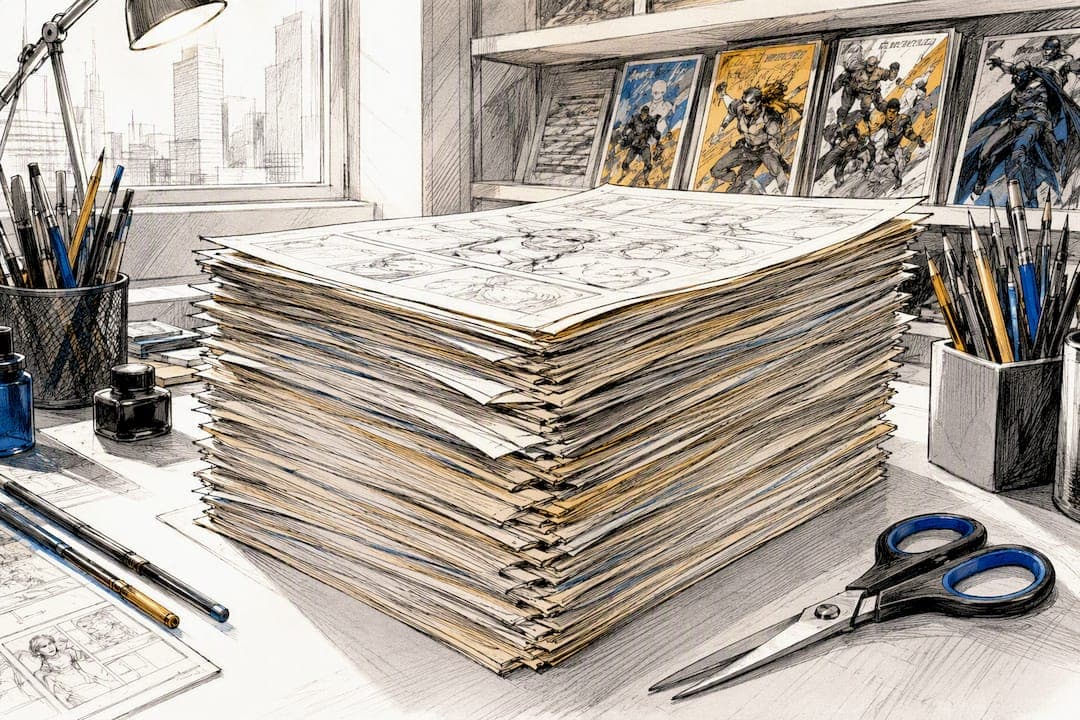
Newsprint comic paper is a low-cost, uncoated stock made from mechanically ground wood pulp, the same material used in daily newspapers, and it typically weighs around 45 g/m² (roughly 30 lb). It's thin, absorbent, and off-white, with a soft tactile quality that a lot of vintage comic fans love.
Here's the verdict: newsprint works well for black-and-white interiors, indie zines, and anyone chasing that authentic Golden Age look on a tight budget. It's a poor fit for color interiors, comics meant to survive decades on a shelf, or any project going into wide retail distribution.
- Good fit: B&W minicomics, art zines, vintage-style one-shots, large-format experimental print runs
- Bad fit: color comics, archival collector editions, retail-distributed books needing consistent print quality
- Quick take: if you want the look without the fragility, a warm-toned uncoated stock often gets you 80% of the aesthetic, without the yellowing timeline
Key Takeaways
Newsprint works well for low-budget, black-and-white comic interiors chasing a vintage look, but its acidic groundwood pulp guarantees yellowing and poor color reproduction over time.
| Point | Details |
|---|---|
| Best use case | Choose newsprint for B&W minicomics, zines, and vintage-style projects, not color or archival editions. |
| Watch the weight | Standard newsprint runs about 45 g/m² (30 lb), far lighter than the 60 to 70 lb stocks used in modern interiors. |
| Expect dot gain | High absorbency spreads ink and dulls color, so printers use coarser halftone screens around 85 lpi. |
| Consider alternatives | Warm-toned uncoated stocks from brands like Strathmore or Canson mimic the look without the yellowing timeline. |
| Preserve fragile books | Pressing Issues offers non-restorative cleaning and pressing for newsprint-era comics that need careful, condition-safe handling. |
Table of Contents
- What Is Newsprint Made Of and How Is It Specced?
- How Does Newsprint Behave on a Printing Press?
- What Are the Pros and Cons of Newsprint for Comics?
- What's a Good Alternative to Newsprint for the Vintage Look?
- Where Can You Buy Newsprint or Get Comics Printed on It?
- How Should You Prep Files for a Newsprint Print Run?
- How Do You Handle and Preserve Newsprint Comics?
- Should You Choose Newsprint for Your Project?
- Get Newsprint Comics Professionally Pressed and Cleaned
- Frequently Asked Questions
- Sources
What Is Newsprint Made Of and How Is It Specced?
Newsprint is a groundwood paper, meaning the wood pulp is mechanically ground rather than chemically treated to strip out lignin. That lignin is the whole story here. It's the compound responsible for newsprint's tendency to yellow and turn brittle within a few years of exposure to light and air, and no amount of careful storage will stop that chemistry once it starts.
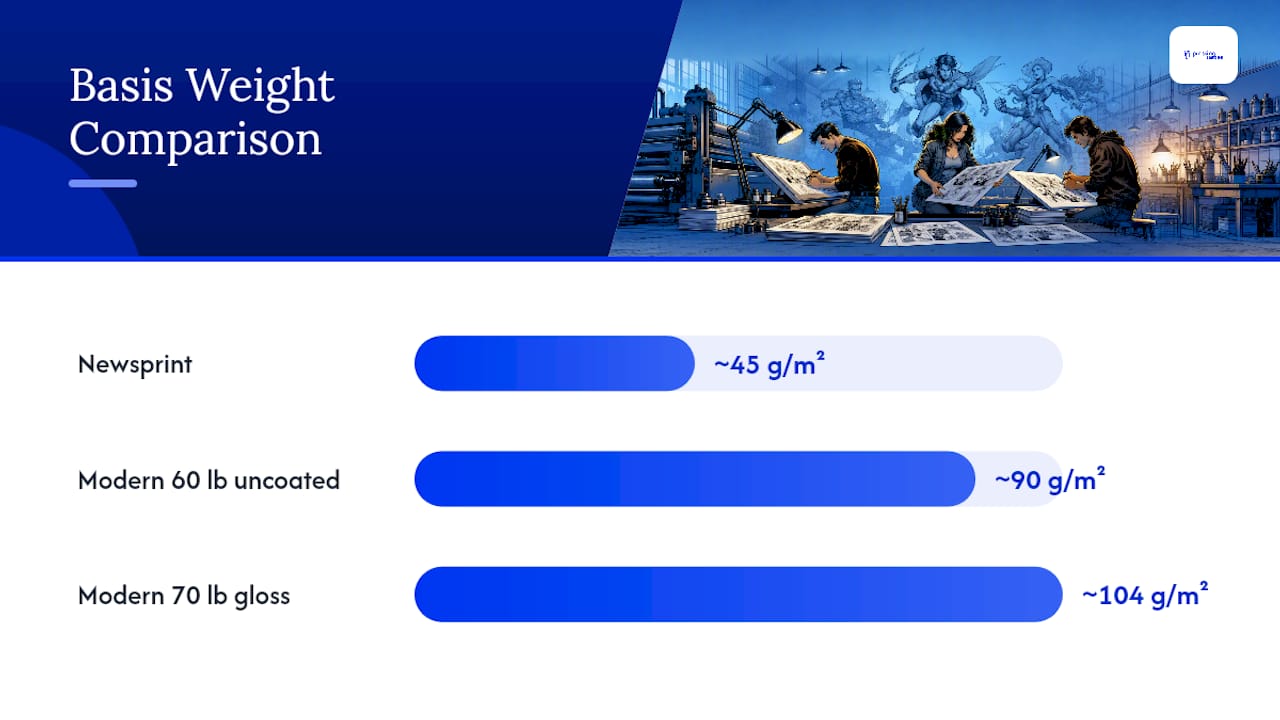
Standard newsprint runs at a basis weight of about 45 g/m² (approximately 30 lb in U.S. paper terms), with a caliper (thickness) typically between 70 and 80 microns. Compare that to a modern comic interior, which commonly runs 60 lb uncoated text for black-and-white work or a heavier gloss text suitable for color work, and you can feel the difference between a thin, springy newsprint page and a denser, more substantial modern sheet.
| Property | Newsprint | Modern 60 lb Uncoated | Modern 70 lb Gloss |
|---|---|---|---|
| Basis weight | ~45 g/m² (~30 lb) | ~90 g/m² (~60 lb) | ~104 g/m² (~70 lb) |
| Finish | Uncoated, matte | Uncoated | Coated, glossy |
| Acidity | High (lignin present) | Low to neutral | Low to neutral |
| Best use | B&W vintage look | B&W interiors | Color interiors |
A handful of terms come up constantly once you're specifying paper for a print run, and each one has real consequences on the page:
- Lignin: the wood compound that causes yellowing and long-term brittleness in groundwood papers like newsprint
- pH: a measure of acidity; newsprint runs acidic, which accelerates degradation over time
- Absorbency: how much ink the paper soaks up, directly affecting color saturation and sharpness
- Caliper: the thickness of a single sheet, measured in microns or points
- Dot gain: how much a printed halftone dot spreads beyond its intended size once ink hits the paper
If archival life matters to your project even a little, understanding pH's role in paper preservation will change how you think about every stock choice going forward, not just newsprint.
How Does Newsprint Behave on a Printing Press?
Newsprint's defining trait on press is absorbency, and it cuts both ways. That same softness that gives newsprint its warm, worn look also causes ink to spread the moment it contacts the sheet, which printers call dot gain. Higher absorbency correlates directly with increased dot gain and lower print contrast, which is why colors on newsprint always look a little duller and softer than the same file printed on coated stock.
Bleed-through and strike-through are the other headache. Because the sheet is thin and porous, ink from one side can show through on the reverse, especially with dense blacks or heavy halftone work. Any letterer packing a page with spot blacks needs to plan around this, not discover it after the print run lands.
Press type matters more than most first-time creators realize. Newsprint is engineered for non-heatset web presses, the high-speed roll-fed systems that print newspapers. Sheet-fed presses, which most short-run comic printers use, can struggle with newsprint's thinness and inconsistent stretch, leading to feed jams and registration drift.
Printers who work regularly with newsprint will flag a few recurring production issues before they ever touch your file:
- Web breaks during high-speed runs, especially with older or lower-grade newsprint stock
- Linting, where loose fiber dust builds up on plates and blankets over a long run
- Batch-to-batch variability, since one mill's newsprint can print noticeably differently from another's
- The need for coarser halftone screens, often around 85 lines per inch instead of the 150 to 200 lpi used on coated stock, to prevent dots from plugging up entirely
Lab studies back this up with hard numbers. Testing across multiple newsprint mill samples found that roughness, water absorbency, and moisture content are the strongest predictors of print density and dot gain, and that these properties vary enough between mills to meaningfully change how a job runs.
Pro Tip: Ask your printer for a physical proof on the exact newsprint batch they'll be using, not a generic sample. Mill-to-mill variation is real, and a proof from last year's stock won't tell you how this year's roll will behave.
Minimum run sizes are where newsprint's cost advantage can quietly evaporate. Web presses are built for volume, so a printer running true newsprint often needs a large enough job to justify the setup, which pushes against the short, flexible runs most indie creators want. Print professionals note that inconsistent properties between mill batches increase web breaks and waste, and that waste gets baked into your quote whether you see it itemized or not.
What Are the Pros and Cons of Newsprint for Comics?
The appeal is immediate and visceral. Newsprint gives a comic that unmistakable vintage texture, the kind readers associate with 1960s and 1970s pamphlets, and it does it at a fraction of the material cost of coated stock. Indie publishers who work in large-format or experimental layouts also lean on newsprint because its low price per sheet makes oversized print runs financially possible in ways a heavier stock simply isn't.
The tradeoffs are just as real. Color reproduction is the biggest one. That same absorbency that creates the soft, warm look also dulls saturation and increases dot gain enough that vibrant color work often looks muddy rather than intentional. Add in the yellowing timeline (many newsprint interiors show visible discoloration within two to three years) and you've got a material that ages fast, sometimes before the first print run even sells out.
- Pros: authentic vintage aesthetic, very low material cost, supports large-format and oversized projects, distinctive tactile feel that readers notice immediately
- Cons: poor color fidelity, high dot gain, visible strike-through on dense pages, rapid yellowing, short handling life before the paper becomes brittle
Where does newsprint actually make sense? Black-and-white minicomics and art zines are the sweet spot, since you're not fighting color reproduction and the low cost supports small print runs. Limited-run art projects built around the aesthetic itself, where yellowing is part of the intended look rather than a flaw, are another strong fit. Indie publishers continue to use newsprint deliberately for exactly these reasons, accepting the archival compromise because the format and price point aren't achievable any other way.
Archival editions and anything you plan to collect, grade, or resell down the road are the opposite case. If long-term condition matters to the value of the book, newsprint works against you from the day it comes off the press.
What's a Good Alternative to Newsprint for the Vintage Look?
You can get most of newsprint's visual character without its fragility by choosing a warm-toned, uncoated text stock instead. These sheets mimic the off-white tone and matte surface of newsprint while using a chemical pulping process that removes lignin, which means the paper resists yellowing far better over time.
For weight, look at uncoated text stocks in the 60 to 70 lb range if you want something closer to a standard modern comic interior with a vintage tint, or seek out lighter uncoated options if you're specifically trying to match newsprint's thin, springy feel. Artist-grade papers from brands like Strathmore and Canson are worth knowing even if you're not drawing traditionally, since many comic artists still use these sheets for original art, inked pages, and proofing before a print run, and their tonal ranges are a useful reference point when you're specifying a warm interior stock to a printer.
A few production tricks can push a modern print job closer to the newsprint aesthetic without ever touching an actual roll of it:
- Build a subtle warm tint directly into your file rather than relying on paper tone alone
- Simulate light yellowing or aging texture in your art files, especially on cover treatments
- Use slightly coarser halftones deliberately, even on coated stock, to echo the softer dot pattern newsprint produces naturally
Pro Tip: Simulate the newsprint look in your files when the project needs to last on a shelf or go into wide distribution. Print on actual newsprint only when the physical object itself, not just the look, is part of the creative statement, like a one-off art zine meant to feel disposable.
Where Can You Buy Newsprint or Get Comics Printed on It?
Newsprint comes in two basic supply formats: rolls, which feed web presses and are the standard for anyone running true newsprint at volume, and sheets, which some specialty print houses stock for smaller or hybrid jobs. Roll supply locks you into web-press production, while sheet-fed newsprint (less common, and often pricier per unit) opens the door to smaller print houses that don't run full web operations.
Finding a printer who still runs newsprint takes a bit more digging than finding one for standard comic stock, since fewer shops keep it in regular rotation. PrintNinja, a print house frequently used by indie comic creators for offset and specialty runs, is a reasonable starting point for creators exploring non-standard stock options, alongside any regional web-offset printer that handles newspaper or tabloid work, since those shops already run the press type newsprint needs.
When you reach out, come prepared with a specific request-for-quote checklist:
- What mill supplies your newsprint, and can you provide a spec sheet (basis weight, caliper, pH, brightness)?
- What's your minimum run length for a newsprint job, and how does that compare to your standard comic stock minimums?
- Can I get a physical proof on the actual newsprint batch you'll be using, not a generic sample?
- What halftone screening do you recommend, and how do you compensate for dot gain on this stock?
- Is this a web press or sheet-fed run, and how does that affect turnaround and finishing options?
Comparative mill studies show that brightness, tear resistance, and strike-through vary measurably across different newsprint sources, which is exactly why that first question about mill specs matters more than it sounds.
Short-run digital printing is where newsprint runs into a hard wall. Digital presses rarely offer true newsprint as a stock option, so creators planning small runs of smaller print runs usually need to either commit to a web-offset minimum or pivot to a 70 lb gloss or uncoated alternative instead.
How Should You Prep Files for a Newsprint Print Run?
Color handling is the first thing to lock down. Convert your files to CMYK well before sending them to print, and pull back on high-saturation colors and pure RGB-to-CMYK conversions, since newsprint's absorbency will spread and dull anything pushed too hot to begin with.
- Set your color profile early. Work in CMYK from the start rather than converting at the last minute, and preview your file against a newsprint-simulated proof if your software supports it.
- Choose a coarser halftone screen. Roughly 85 lpi is the standard starting point for newsprint, well below the 150 to 200 lpi used on coated stock, since finer screens plug up on absorbent paper instead of printing clean dots.
- Adjust your trapping and rich black builds. Newsprint's ink spread means tight trapping needs a bit more tolerance, and rich blacks should be built conservatively to avoid muddy overprint in dense panels.
- Build in bleed and account for translucency. Because the sheet is thin, dense art on one page can ghost through to the next, so keep an eye on facing-page layouts where heavy blacks might telegraph across the spread.
- Get a physical proof before committing to the full run. A press proof on comparable newsprint stock, or at minimum a hard proof from your printer, will show you dot gain and color shift in a way no screen preview can.
It's the fastest way to see exactly where dot gain issues typical of newsprint will affect your art, and it costs a fraction of a wasted print run.*
How Do You Handle and Preserve Newsprint Comics?
Newsprint's aging process starts the moment it leaves the press, and it's driven by the same lignin and acid content that makes it cheap to produce in the first place. Expect visible yellowing within a couple of years and increasing brittleness after that, a timeline that's simply built into the material rather than a sign of poor handling. Our own breakdown of why comics turn yellow goes deeper into the chemistry if you want the full picture.
Good storage habits slow the process without stopping it. Keep newsprint comics in a stable, moderate humidity environment, away from direct light, and interleave pages or issues with acid-free tissue where the budget allows. Archival-grade bags and boards cost more than standard supplies, but for a newsprint book you actually want to protect long-term, that cost buys real time.
- Store in cool, stable humidity, away from direct sunlight and fluorescent light
- Use acid-free interleaving or bags and boards when the book's value justifies the expense
- Handle with clean, dry hands, and support the spine to avoid creasing brittle pages
- Avoid stacking heavy items on top of newsprint issues, since brittle pages crack rather than bend
Pressing fragile newsprint interiors is where experience matters most. A book with advanced brittleness can be too fragile for standard pressing techniques, and the wrong approach risks cracking pages that a heartier modern stock would tolerate just fine. Our guide on pressing modern versus vintage comics walks through how that assessment changes by era and paper type.
Pro Tip: If you're considering professional cleaning or pressing on a newsprint book, send clear photos of any spine stress, brittleness, or existing tears first. A specialist can flag safety concerns before the book ever leaves your hands.
Should You Choose Newsprint for Your Project?
Run through six questions before committing to a stock choice, and you'll have your answer in under a minute.
- Intended lifespan: does this book need to last decades, or is it a one-time zine?
- Color needs: is this black-and-white, or does color fidelity matter to the final product?
- Budget: is minimizing per-unit cost the top priority, even at the expense of print quality?
- Distribution: is this going to retail shelves, or staying within a smaller, hands-on audience?
- Aesthetic: does the project specifically call for a vintage, tactile feel?
- Handling expectations: will readers be gentle with it, or does it need to survive repeated handling?
If you answered "low budget, B&W, vintage feel, small distribution" to most of these, newsprint is a legitimate choice. If color, longevity, or retail durability came up even once, an uncoated or gloss alternative will serve the project better.
An Editor's Take on Working With Newsprint
I've seen creators fall in love with newsprint's look and regret it six months later when their color covers came back muddy and their interior pages started yellowing before the second printing sold out. The material rewards projects built around its limitations, not projects that hope to work around them. If you're making a black-and-white minicomic meant to feel like it fell out of a 1975 spinner rack, use real newsprint and lean into it. If you're building something you want a collector to grade in twenty years, don't fight the paper. Choose a stock that ages with you, and if you're ever unsure what condition an older newsprint book is really in, our pressing and cleaning services can take a closer look before you decide anything irreversible.
Get Newsprint Comics Professionally Pressed and Cleaned
Newsprint's fragility doesn't stop at the printing press. It follows the book for its entire life, which is exactly where Pressing Issues comes in for collectors and creators in Seattle and Portland who already own a newsprint-era comic worth protecting.
Pressing Issues offers non-restorative cleaning and pressing designed to work with a comic's existing condition rather than against it, which matters enormously on a stock as brittle as newsprint. That means removing surface dirt, minor spine ticks, and light creases without altering the book's original ink, paper, or structure. It doesn't mean repairing tears, replacing paper, or adding anything the book didn't already have. If you're planning to submit a newsprint-era book for CGC grading, or you just want an honest read on how much life is left in the paper, start with a look at our comic cleaning service to see what non-restorative work can safely do for your book.
Frequently Asked Questions
What is newsprint comic paper exactly? Newsprint comic paper is a thin, absorbent, off-white paper stock made from mechanically ground wood pulp, the same base material used for daily newspapers, typically weighing around 45 g/m² (30 lb).
Is newsprint good for comic book paper? Newsprint suits black-and-white comics with a vintage aesthetic and a tight budget, but it performs poorly for color work and yellows within a couple of years, making it a weak choice for archival or retail projects.
What's the difference between newsprint and glossy paper for comics? Newsprint is uncoated, thin, and highly absorbent, which causes ink to spread and colors to dull, while glossy paper is coated, holds ink sharply, and reproduces color accurately, making it the standard for modern color interiors.
Where can I buy newsprint for printing comics? Newsprint comes in roll form for web presses and, less commonly, in sheets for specialty print houses. Printers like PrintNinja and regional web-offset shops that handle newspaper work are reasonable starting points for sourcing a run.
Can I get the newsprint look without printing on actual newsprint? Yes. Warm-toned uncoated text stocks, along with simulated tinting or aging effects built directly into your art files, reproduce much of newsprint's visual character without its yellowing timeline or fragility.
Sources
- Newsprint
- How to choose paper stock: Comic book printing
- Newsprint Design Example - Newsprint Offset Printing
- The Newsprint physical properties impact on printing quality printed on CSWO
- Newsprint properties and printing (comparative evaluation)
Recommended
- Newsprint vs. Glossy vs. Cardstock: Why Every Paper Type Demands a Different Pressing Protocol — Pressing Issues
- The Best Reason to Press and Clean Your Books: Love — Pressing Issues
- Top 3 Youtube Alternative Comic Book Pressers 2026 — Pressing Issues
- What Is Comic Book Slabbing? A Collector's Guide — Pressing Issues