Expect to pay a significant amount all in for a single modern comic once you add cleaning, pressing, a shop's CGC submission handling fee, CGC's own grading charge, and two-way insured shipping. Send that same book alone and shipping and handling can eat almost half the bill. Batch it with several others, though, and the math changes fast: a handling fee that felt brutal on one book drops substantially per book across a larger batch, and shared shipping cartons shrink the per-book freight cost even more. At Pressing Issues, our full-service CGC submission handling is built around that batching logic, since we handle the cleaning, pressing, paperwork, and shipping coordination in one pass.
Key Takeaways
CGC grading costs almost always land well above CGC's sticker price once shop handling, shipping, and insurance get added in.
| Point | Details |
|---|---|
| Request a line-item estimate | Ask for pressing, dry-cleaning, handling, and shipping as separate lines, not a bundled quote. |
| Batch to cut per-book cost | Splitting a per-invoice handling fee across 10 books can drop it from $35 to $3.50 per book. |
| Confirm insurance terms | Ask how insurance scales with declared value before shipping anything worth more than a few hundred dollars. |
| Ask about high-value percentage fees | Some shops add a percentage above a declared-value threshold; get that number in writing first. |
| Use a full-service handler | Pressing Issues combines cleaning, pressing, and CGC submission handling into one estimate with published rates and turnaround times. |
Table of Contents
- What Goes Into CGC Grading Costs at a Third-Party Shop
- How Do You Lower the Per-Book Cost of Grading?
- Is Pressing and Grading Worth It for This Book?
- What Happens After You Drop Your Book Off?
- What Should You Ask Before Approving an Estimate?
- What I've Learned Handling Hundreds of Submissions
- Get a Line-Item Estimate Before You Ship Anything
- Where These Numbers Come From
- Sources
What Goes Into CGC Grading Costs at a Third-Party Shop
CGC grading costs are never just CGC's number. A shop invoice usually stacks five separate charges, and each one deserves a line of its own.
Cleaning and pressing carry the widest range. Dry-cleaning alone, which removes surface grime and can loosen indentations before any heat or pressure gets applied, typically runs $10 to $20 and should always happen before pressing so contaminants don't get sealed in. Full pressing tiers land $25 to $75 per book depending on whether the book is modern or vintage, and vintage books with brittle paper or old creases usually sit at the top of that range because they demand more careful handling. Some shop rate cards show entry-level pressing as low as $10, reserved for lighter defect corrections on sturdier modern stock.
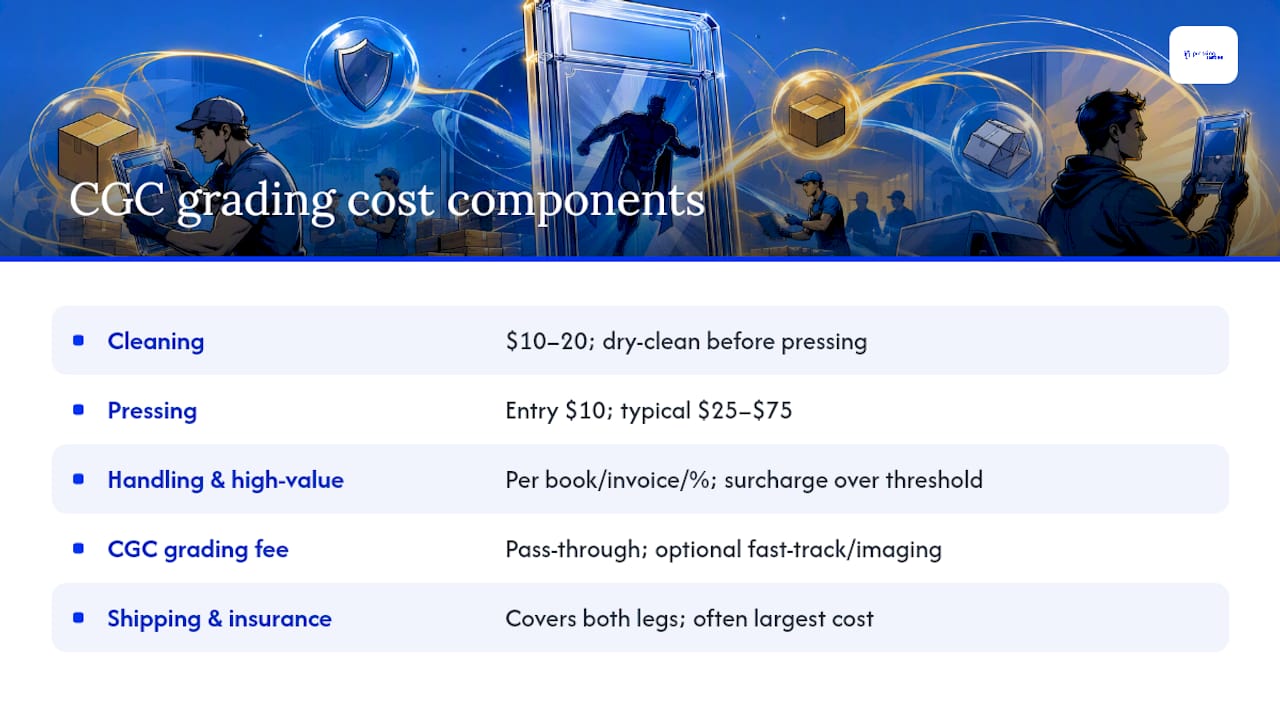
Shop handling fees cover the paperwork, CGC submission form prep, and tracking that a shop does on your behalf. These may be charged per book, per invoice, or sometimes as a flat percentage, and they appear as their own line rather than being included in pressing costs.
CGC's grading fee appears as a pass-through line item, sometimes with optional add-ons like fast track or CGC's imaging service tacked on, both of which raise the total while cutting turnaround time.
Shipping and insurance often surprise first-time submitters. Because it covers two legs, book to shop and shop to CGC and back, and insurance scales with declared value, shipping frequently becomes the single largest cost on a one-book submission.
High-value fees apply to genuinely valuable books. Shops often add a percentage on top of standard handling once declared value crosses a threshold, since insured shipping and liability increase accordingly.
Pro Tip: Ask upfront whether the handling fee is charged per book or per invoice. That single distinction is often the biggest lever you have for cutting your per-book cost on a batch submission.
How Do You Lower the Per-Book Cost of Grading?
The fastest way to shrink your total is to stop thinking one book at a time.
- Batch your submissions. A $35 per-invoice handling fee split across one book costs $35; split across ten, it's $3.50 each. Shared shipping cartons compound the savings further.
- Skip add-ons you don't need. Fast track and CGC's imaging service both add cost. Save them for books where turnaround speed or presentation genuinely matters, not every submission.
- Consolidate approvals. Approving pressing estimates and CGC tiers in one round trip, instead of book by book, avoids duplicate handling charges some shops apply per approval cycle.
- Choose dry-clean-only when it's enough. If a book's main issues are surface grime rather than warping or indentations, dry-cleaning alone at $10 to $20 is the safer, cheaper route than full pressing.
Is Pressing and Grading Worth It for This Book?
Run the math before you commit, because not every book clears the bar. A modern key selling for a low retail price that gains a half-grade bump from pressing might reach a modestly higher graded price. After all-in costs, this could result in a loss rather than a gain.
Vintage and higher-value books behave differently. A single half-grade jump can unlock nonlinear value increases, especially once a book crosses from a 9.0 to a 9.4 or higher, where population reports thin out fast.
Grade outcomes are never guaranteed. A book can come back lower than expected, and no shop or presser can promise a specific number.
What Happens After You Drop Your Book Off?
A typical shop workflow runs through the same stages regardless of book value, though turnaround length depends on tier and add-ons.
- Intake and condition inspection, where defects get documented before any work begins.
- Estimate approval, so you sign off on cleaning, pressing, and CGC tier before charges are locked in.
- Dry-cleaning, followed by humidity treatment and pressing for books that need structural correction.
- A recheck against the original estimate to confirm the work matches expectations.
- Submission to CGC, with declared value and insurance set based on the book's market worth.
- Insured return shipping once grading is complete.
Turnaround stacks shop time plus CGC's own processing window, and express or fast-track options can shave weeks off at a higher price. High-value books usually need separate written approval for declared value before a shop will insure and ship them.
What Should You Ask Before Approving an Estimate?
Getting comparable quotes means asking the same questions of every shop.
- Is pressing priced per tier, and what separates entry-level from full pressing?
- Is dry-cleaning billed separately from pressing?
- Is the handling fee per book or per invoice?
- What percentage, if any, applies above a declared-value threshold?
- Is shipping billed at actual cost, and how is insurance calculated?
- What's the turnaround with and without fast-track?
| Line Item | Single Book | 10-Book Batch |
|---|---|---|
| Pressing + cleaning | varies by book | varies by batch size |
| Handling fee | can be high for a single book | significantly lower per book in a batch |
| Shipping and insurance | varies; higher per single book | shared among batch, reducing per-book cost |
| Per-book total | higher for single books | lower with batch submissions |
What I've Learned Handling Hundreds of Submissions
The mistake I see most often is a collector submitting one book at a time, thrilled about the grade, then realizing shipping and handling ate most of the upside. It's rarely the pressing or the CGC fee that kills the math. It's the fixed costs that don't shrink just because you only sent one comic. That's the whole case for batching with a full-service handler instead of going solo.
— Charles
Get a Line-Item Estimate Before You Ship Anything
Pressing Issues is built for readers who just did this math and want someone else to run it for them. We handle cleaning, pressing, CGC paperwork, and shipping coordination as one service, so you get a single estimate instead of five separate invoices to reconcile.
Our published rates and turnaround times are posted upfront, so you know your per-book cost before you commit a single comic. If you're weighing a batch submission or just want a real number for that one key issue sitting in your longbox, request an estimate through our comic cleaning and pressing services page and we'll walk you through the line items before anything ships.
Where These Numbers Come From
Cost ranges and workflow details draw from Mint Condition's pressing and cleaning guide, Comic Book CPR's dry-cleaning and rate pages, and Comic Book Co's all-in cost breakdown. Read more on Pressing Issues' CGC submission handling and step-by-step submission guide.
Sources
- Pressing & Cleaning Before Grading — Mint Condition
- Dry Cleaning Comic Books - Comic Book CPR
- How Much Does CGC Grading Cost? 2026 Prices and the Real All-In Total - Comic Book Co