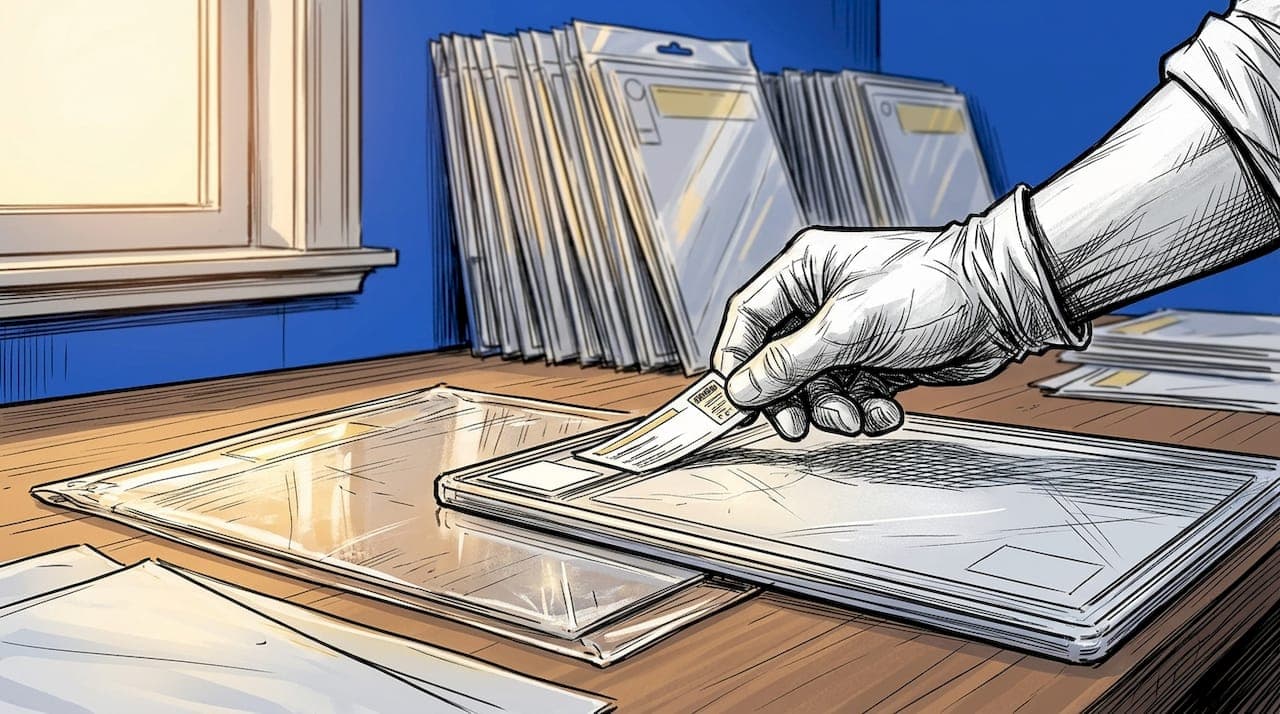
Label every crossover comic as its own line item on the CGC submission form, mark it with the CrossOver service designation, and match a numbered bag-and-board label to that exact line so graders and couriers never have to guess what they're holding. Get this right before the box leaves your hands, and you skip research fees, mislabeled holders, and weeks of resubmission headaches.
Here's your immediate checklist:
- Enter each crossover comic as a separate submission-form entry, never grouped or abbreviated.
- Select CrossOver as the primary service field when the comic already sits in another company's holder.
- Pull the title, issue number, publisher, and variant details straight from the indicia, not the cover art.
- Assign a matching item number to the bag/board label, the packing slip, and the form line item.
- Note any signature, restoration flag, or second-printing detail explicitly, in writing, before you seal the box.
Pro Tip: Write your bag/board label exactly like this: "Item 04 | CrossOver | Avengers #1 (2018) | 2nd Printing | Signed: Stan Lee (no COA) | Owner: JT | 3/2026." That one line answers every question a grader would otherwise have to research.
| Point | Details |
|---|---|
| One line, one comic | Never combine crossover issues on a single submission-form entry. |
| CrossOver tier matters | Select the tier based on declared FMV to avoid fee surprises. |
| Match every number | Bag/board, packing slip, and form line item all need the same ID. |
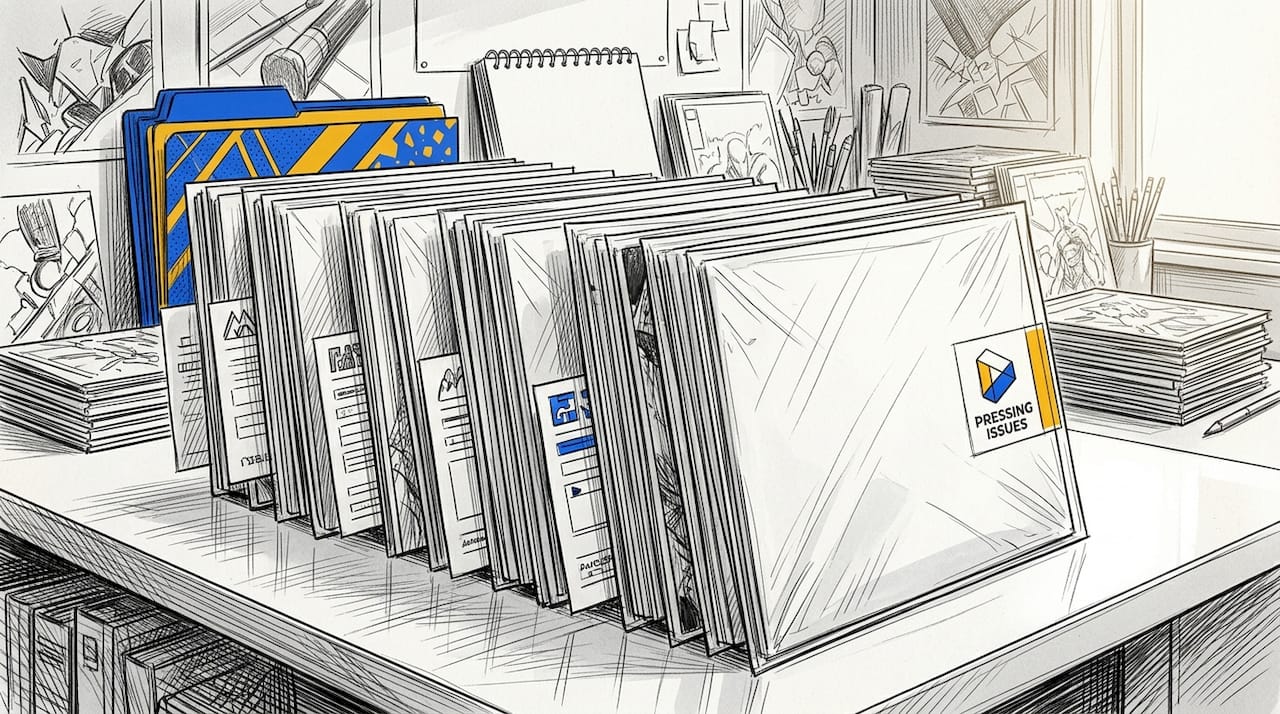
Key Takeaways
Correct crossover labeling means one submission-form line per comic, a matching item number on every bag/board and packing slip, and explicit variant, signature, and FMV details entered before the box ships.
| Point | Details |
|---|---|
| One entry per comic | Never combine crossover issues into a single submission-form line. |
| Match your numbers | Bag/board labels, packing slips, and form lines all need identical item IDs. |
| Verify before you guess | Check the indicia and copyright page rather than assuming a variant status. |
| Know the 14-day rule | Holder defects require the original submitter to report within 14 days; label defects don't. |
| Let Pressing Issues handle it | Pressing Issues manages cleaning, pressing, appraisal, and CGC paperwork for crossover lots. |
Table of Contents
- How Do You Fill Out the CGC Form for a Cross-Over Submission?
- What Goes on the Physical Label and Packing Slip?
- What Mistakes Cause CGC Fees or Delays?
- When Should You Pay for Cleaning, Pressing, or Handled Submission?
- How Do You Pack and Insure a Cross-Over Shipment?
- How Pressing Issues Handles Your Cross-Over Submission
- Frequently Asked Questions
- Sources
How Do You Fill Out the CGC Form for a Cross-Over Submission?
CGC's online portal walks you from the account dashboard into New Submission, where you'll choose CrossOver as the primary service for any comic already encapsulated by another grading company. That choice matters early because CGC's own guidance is explicit: a CrossOver submission must arrive intact in its original holder, and CGC removes it, grades it independently, and re-encapsulates it in a CGC holder. There's no guarantee the new grade matches the old one, and CGC has said as much in its own CrossOver service notice.
Once you're in the form, treat every comic as its own record:
- Enter the title exactly as it appears on the cover, not a shorthand or series nickname.
- Add the issue number, publisher, and cover year.
- Flag variant status explicitly: retailer incentive, second printing, newsstand edition, or standard.
- Declare a fair market value (FMV) that reflects the comic's actual condition and rarity.
- Note any signature or restoration in the dedicated fields, never buried in a general comments box.
Tier selection follows FMV, and it's not a formality. Choose too low a tier and you risk an insurance shortfall if the comic is lost or damaged in transit; choose too high and you're paying more than the book warrants. CGC's tiered CrossOver pricing has shifted over the years, sometimes with promotional discounts attached, so check current fees before you commit.
Pro Tip: When a variant is ambiguous, the CGC submission form's search suggestion tool can help, but the indicia and copyright page are the final word. Photograph both before you submit, so you have proof if a question comes up later.
What Goes on the Physical Label and Packing Slip?
Your bag-and-board label is the bridge between the digital form and the physical comic, and it needs to carry enough information that a grader never has to open a laptop to figure out what they're holding.
Each label should include:
- Item number (matches the packing slip and submission line)
- Short title and issue number
- Variant shorthand (e.g., "2nd Print," "RI," "NS")
- Declared FMV
- CrossOver marker if applicable
- Owner initials and submission date
Map submission-form line numbers to packing-slip item numbers in sequence, so line 1 on the form is item 1 in the box, line 2 is item 2, and so on. Photograph every comic three times: the full cover, the indicia or copyright page, and a close-up of any signature or damage. When you're packing a multi-book lot, group comics by CrossOver tier and label the outer box manifest with a simple list, because processing speeds up when graders can work through similar tiers together instead of hunting for outliers.
Pro Tip: Keep a spare copy of your packing slip in your own files. If CGC's intake team has a question, you can answer it in one email instead of digging through old photos.
What Mistakes Cause CGC Fees or Delays?
Wrong title entries, missing variant notes, and incorrect issue numbers are the most common errors collectors make, and each one can trigger a research fee because CGC staff has to stop and verify what you should have confirmed yourself.
- Guessing at a variant instead of checking the indicia.
- Leaving the FMV field blank or wildly underestimating it.
- Failing to flag a signature or restoration, which can misrepresent the final label.
- Assuming CrossOver will produce the same grade as the original grading company.
CGC treats label defects and holder defects differently, and knowing the difference saves you time. Label defects, like a typo in the title, can be reported by anyone at any time. Holder defects, like a crack in the plastic case, generally require the original submitter to return the item within 14 days of receipt. Miss that window and you may be stuck covering a re-encapsulation fee yourself.
Pro Tip: Open every returned slab within 48 hours and inspect the holder under good light. A cracked case is easy to miss in dim shipping-dock lighting.
When Should You Pay for Cleaning, Pressing, or Handled Submission?
Three questions decide whether professional service pays for itself: what's the comic's estimated grade potential, how does its current FMV compare to total submission cost, and does it carry real collecting weight, like a key issue or a documented first appearance?
- If pressing can plausibly move a comic from a 8.5 to a 9.4, and that jump adds meaningfully more value than the cleaning and submission fees combined, it's worth doing.
- If the comic is a mass-market modern with soft resale value, the math rarely works in your favor.
- If it's a rare vintage book or a key issue with genuine collector demand, the calculation shifts in your favor almost every time.
Handled submission earns its fee differently, by removing the operational risk of mislabeling, mispacking, or missing a deadline. Pressing Issues manages non-restorative cleaning, pressing, FMV appraisal, and the full CGC paperwork trail, so the labeling strategy above gets executed correctly the first time.
How Do You Pack and Insure a Cross-Over Shipment?
Every comic gets its own bag and board, stacked flat and straight inside a rigid, padded box, wrapped in enough bubble wrap that nothing shifts in transit. Skimping here is the fastest way to turn a 9.6 into a 9.0 before it even reaches CGC's door.
- Use water-resistant outer packaging and tape every seam.
- Add secure interior separators between comics of different tiers.
- Declare the true FMV on your shipping insurance, not a rounded-down guess.
- Choose a courier that offers tracking and signature confirmation.
- Photograph the sealed box before you hand it off, and save the tracking screenshot the moment it generates.
Pro Tip: Log your drop-off timestamp in the same file as your packing slip. If a claim ever comes up, you want every piece of documentation in one place, not scattered across three apps.
A Note From the Field
The single biggest fix we see: collectors who map every bag-and-board number to its CGC line item before shipping cut resubmission requests dramatically. One dealer we worked with had spent months resolving a mislabeled variant claim, then adopted the mapping method and never saw the issue again. Small labeling habits, done consistently, are what actually protect your turnaround time.
How Pressing Issues Handles Your Cross-Over Submission
Pressing Issues is the alternative to juggling spreadsheets, shipping labels, and CGC's online portal by yourself. We handle non-restorative cleaning, pressing, FMV appraisal, photo documentation, and the entire submission workflow described above, so your crossover lot arrives correctly labeled and mapped the first time.
Getting started is straightforward: request an estimate, approve the handling fee for any high-value comics, schedule your drop-off or shipment, and receive a documented packing list with tracking attached. If you're weighing whether a book is worth pressing before it goes into a CrossOver submission, our pressing and cleaning service page walks through pricing and expected turnaround so you can make that call with real numbers in front of you.
Frequently Asked Questions
What does "CrossOver" mean on the CGC submission form?
CrossOver is the service you select when submitting a comic already encapsulated by another grading company. CGC removes it from that holder, grades it independently, and re-encapsulates it, with no guarantee the new grade matches the original.
Do I need a separate submission-form entry for each crossover comic?
Yes. Each comic needs its own line, with title, issue number, publisher, variant details, and declared FMV entered individually, even if you're shipping several in one box.
What's the difference between a label defect and a holder defect?
A label defect, like a typo, can be reported by anyone at any time. A holder defect, like a cracked case, generally requires the original submitter to return the item within 14 days of receipt.
Should I press or clean a comic before submitting it for CrossOver grading?
It depends on the comic's estimated grade potential and current value. High-value or key issues often justify the cost; low-value modern books usually don't.
How do I avoid extra research fees from CGC?
Verify title, issue number, and variant status against the indicia before submitting, and declare an accurate FMV rather than leaving fields vague or blank.
Sources
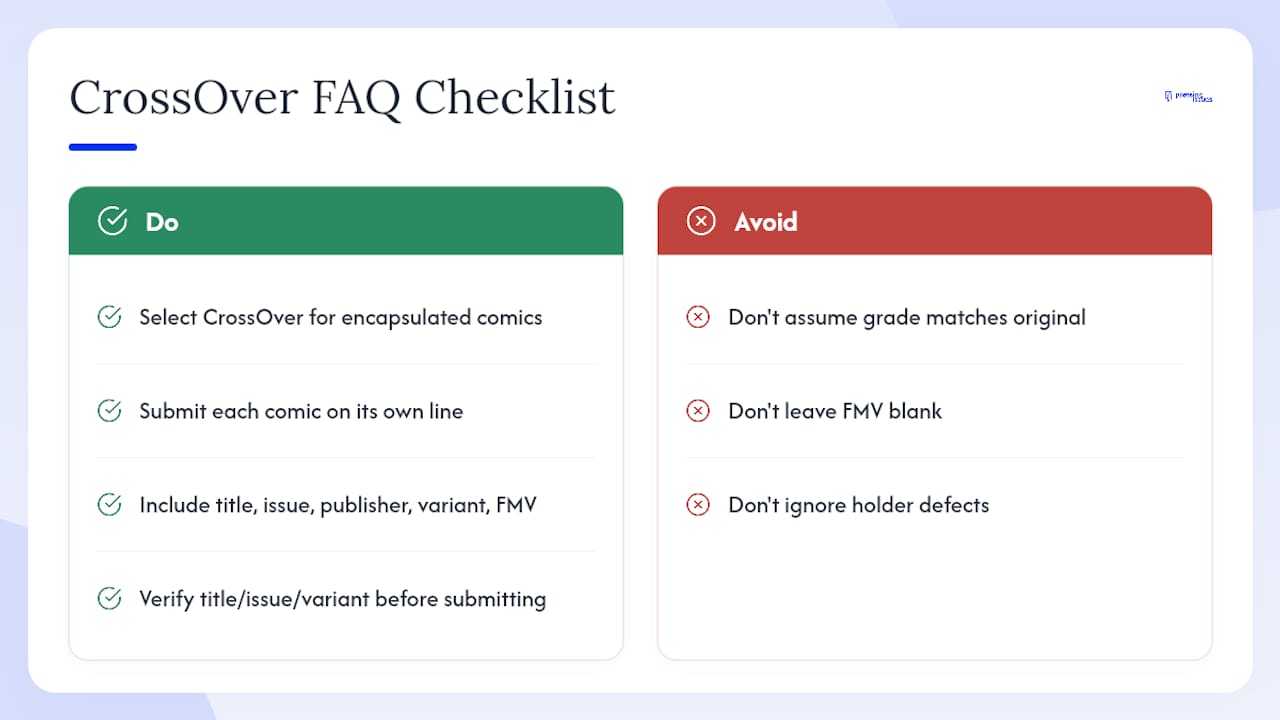
Check CGC's own CrossOver service notice for eligibility and grading disclaimers, and the LegalClarity submission-form walkthrough for field-by-field guidance on labels and defects. The first-submission guide covers cost thresholds worth reviewing before you commit. Pressing Issues also publishes a step-by-step CGC submission guide with printable checklists.
- How to Fill Out and Submit the CGC Submission Form for Grading - LegalClarity
- Elevate Your Collection — CGC Now Offering 20% Off CrossOver Comic Submissions! | CGC
- First CGC Submission Guide: Complete 2026 Guide