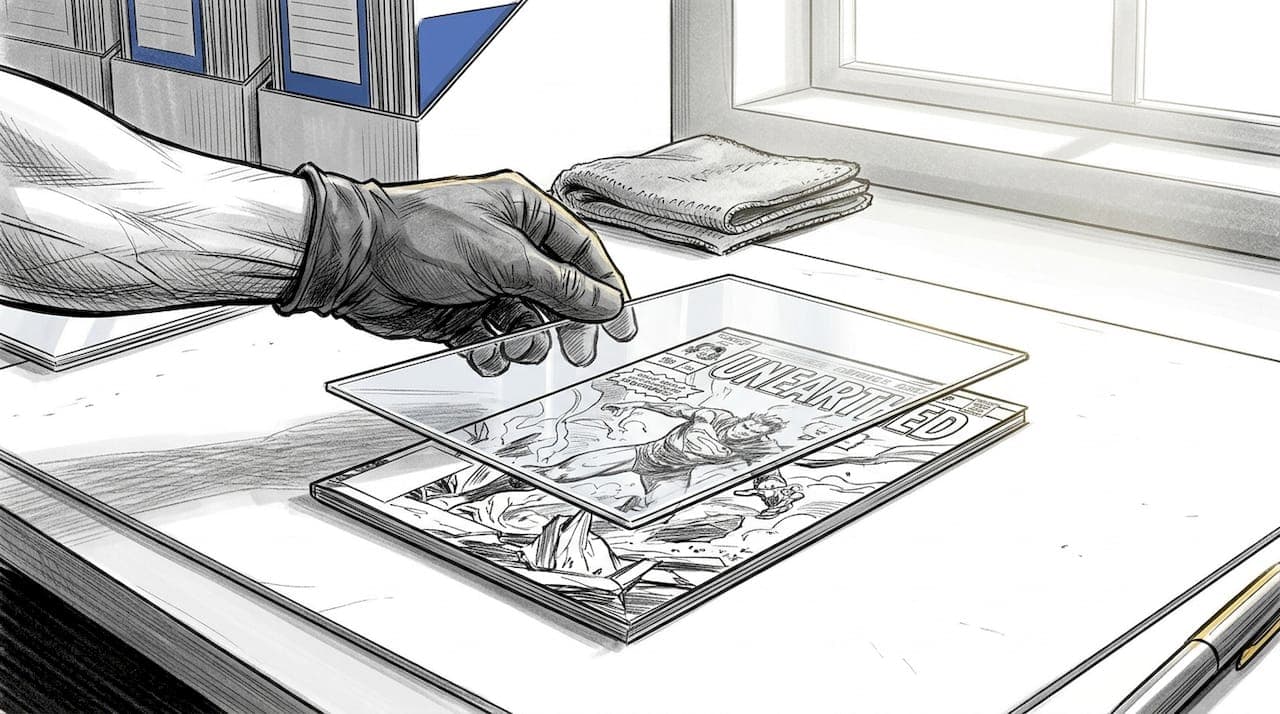
A card in gem mint condition can be worth ten times the price of the same card graded one point lower, and the difference often comes down to what happens before the card ever leaves your hands. Remove only loose dust with a clean microfiber cloth. Sleeve your top candidates in fresh acid-free penny sleeves and Card Saver 1 holders, photograph the front, back, and every corner, then run an AI grade predictor before you commit a dollar to submission fees.
- Inspect every card at 10x magnification before deciding it's submission-worthy
- Sleeve top-edge first into a new penny sleeve, then into a Card Saver 1
- Photograph front, back, all four corners, and edges under bright, even light
- Pre-screen with an AI grading tool before paying PSA or BGS submission fees
Careful preparation commonly improves grades by 0.5 to 1 full point on cards that were otherwise headed for a lower tier. On a valuable card, that single point can be the difference between a nice bonus and a life-changing sale.
Key Takeaways
Careful inspection, sleeving, and documentation before submission are what separate a lucky grade from a predictable one.
| Point | Details |
|---|---|
| Inspect before anything else | Use 10x magnification to catch centering, corner, edge, and surface flaws before you spend on fees. |
| Sleeve correctly | Insert top-edge first into a fresh penny sleeve, then a Card Saver 1, secured with painter's tape. |
| Document everything | Photograph front, back, corners, and edges, and include a printed submission form in the box. |
| Use AI as a filter | Pre-screen with a multi-pass tool to avoid paying fees on cards unlikely to hit your target grade. |
| Know your limits | Pressing Issues handles non-restorative cleaning, pressing, and submission for cards where a mistake isn't an option. |
Table of Contents
- Pre-Submission Checklist Every High Value Card Must Clear
- What Graders Actually Look For, and Why One Flaw Caps Everything
- Safe Cleaning and Handling: What to Do and What to Never Attempt
- Housing, Labeling, and Photo Documentation That Protects You
- Choosing the Right Grading Tier: Costs and Turnaround Expectations
- Packing and Shipping a High Value Submission Without Risking Damage
- When a Professional Grading-Prep Service Makes More Sense Than DIY
- At-Home AI Pre-Screening: A Quick Workflow and Its Limits
- Get Professional Prep Without the Risk of Doing It Yourself
- Frequently Asked Questions
- Sources
Pre-Submission Checklist Every High Value Card Must Clear
Run this sequence on every card before it goes anywhere near a grading company's mailer.
- Magnified inspection. Check the surface under 10x for print lines, scratches, and factory chipping.
- Centering measure. Eyeball or measure the front and back border ratios against your target grade.
- Corner and edge check. Look for whitening, soft corners, or rough cut lines along all four edges.
- Surface tilt test. Angle the card under a bright light to catch scuffs invisible from straight on.
- Full photo set. Capture front, back, corners, and edge shots for your records.
- Fresh housing. Sleeve top-edge first, then load into a Card Saver 1.
- AI pre-screen. Confirm a confidence score that supports your target grade.
- Declared value and insurance note. Log the value you'll declare and match it to shipping coverage.
Pro Tip: Most home preparers insert the card into the penny sleeve corner-first out of habit, which is exactly how you catch a corner tip and create the fold you were trying to prevent. Always lead with the top edge.
Before spending a dime on fees, apply a simple decision rule: only submit when the projected graded value comfortably clears your total cost of fees, shipping, and insurance by a significant margin.
What Graders Actually Look For, and Why One Flaw Caps Everything
Professional graders evaluate four attributes: centering, corners, edges, and surface. Each one gets scored independently, but the lowest score usually sets the ceiling for the whole card. A flawless surface can't rescue a card with badly off-center printing.
- Centering is measured as a front-to-back ratio. A PSA Gem Mint 10 typically requires roughly 60/40 centering or better on the front, with NM-MT 8 grades often tolerating something closer to 70/30.
- Corners get checked for whitening, softness, or the faintest hint of a rounded tip that only shows up under magnification.
- Edges are scanned for chipping or a rough factory cut, which shows up more on vintage cardstock than modern printing.
- Surface covers scratches, print lines, and any residue from handling or storage.
BGS is often chosen by collectors chasing sub-grades and a black-label designation, since its four-number breakdown rewards near-perfect scores across all categories. PSA tends to be the default for high-liquidity cards where a single clean number moves the market faster.
Pro Tip: Micro-corner whitening is the invisible killer most sellers miss. Hold the card at an angle under a strong light and rotate it slowly. A whisper of white along the tip that you can't see head-on is often enough to drop a grade a full point.
Safe Cleaning and Handling: What to Do and What to Never Attempt
Wash your hands, work over a lint-free surface, and treat every card like it's already worth more than you think it is.
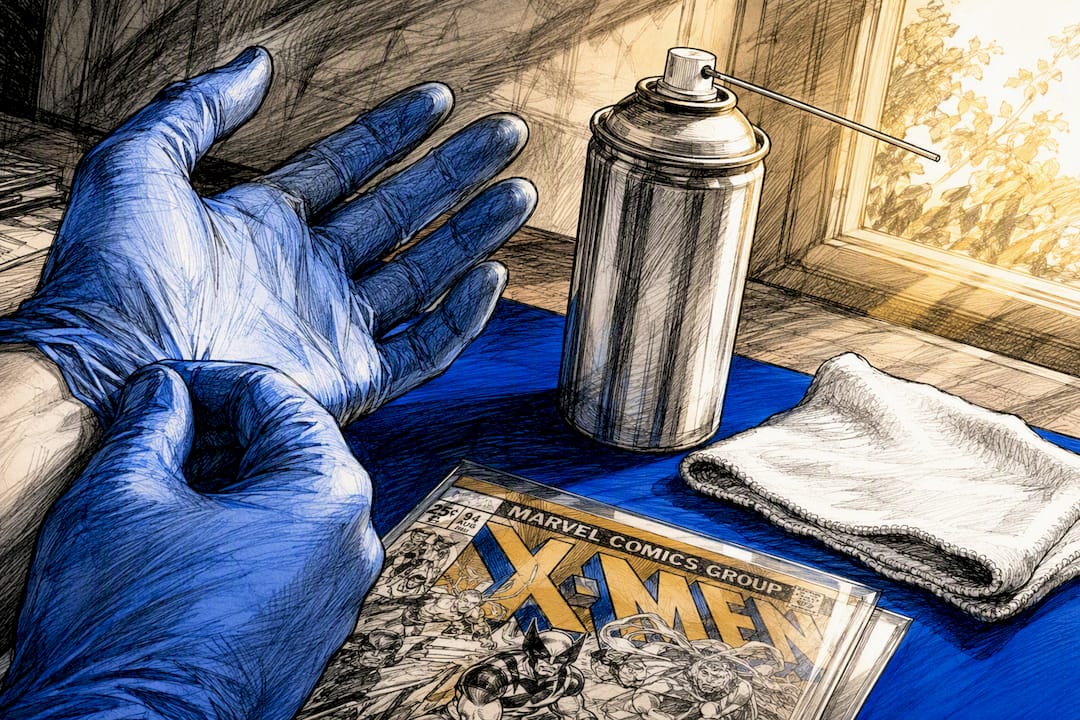
Safe actions include a light pass of compressed air to knock loose dust free, followed by a single gentle wipe with a clean, dry microfiber cloth if needed. Insert cards top-edge first into sleeves to avoid catching a corner on the opening. Nitrile or cotton gloves help on cards with high oil transfer risk from prior handling.
Never use water, cleaning chemicals, erasers, or any polishing method. These actions frequently leave micro-abrasions or residue that graders flag as alteration, which tanks resale value even worse than a lower numeric grade. Adhesive tape near the card, even to temporarily hold something in place, carries the same risk.
Pro Tip: If a card needs more than dust removal, it needs a professional, not a paper towel.
Small handling choices, top-edge insertion, a fresh sleeve, careful placement into the Card Saver, prevent the majority of damage that happens after a card leaves your desk.
Housing, Labeling, and Photo Documentation That Protects You
Use a new acid-free penny sleeve for every card, inserted top-edge first, then load it into a Card Saver 1 semi-rigid holder, which PSA prefers because it allows extraction without direct pressure on the edges. Toploaders work for casual storage but increase handling risk during the submission process itself.
- Secure the Card Saver opening with painter's tape, never adhesive tape that leaves residue
- Photograph front, back, all four corners, and each edge under bright, even light
- Name your files with the date, a card ID, and declared value for easy cross-reference
- Write a clear card description on the submission form (set, year, card number)
- Attach any provenance notes or purchase receipts you have
- Include a printed copy of the submission form inside the box, not just the shipping label
Pro Tip: A complete photo record taken before shipping is your best evidence if a card comes back with unexpected damage or a dispute over its pre-submission condition.
Choosing the Right Grading Tier: Costs and Turnaround Expectations
Grading fees scale with declared value and turnaround speed, and picking the wrong tier either wastes money on a card that didn't need express service or leaves a genuinely valuable card sitting in a slow queue for months.
| What Graders Prioritize | Typical Fee Range | Turnaround | Best For |
|---|---|---|---|
| Surface and centering (standard tier) | Lower base fee | Several weeks to a few months | Modern cards with moderate declared value |
| Full sub-grade breakdown | Mid-range fee | Weeks | Cards chasing a black-label or pristine sub-grade |
| Declared value tiers | Scales with value | Faster as value/fee rises | High-value cards where speed offsets premium cost |
| Authentication add-ons | Additional fee | Extends standard timeline | Vintage or suspected-altered cards |
Packaging supplies for a standard submission of ten to twenty cards typically run under $15, which is almost never the deciding cost. Submission fees and insurance dominate the budget, so weigh those against your projected graded value before committing.
Standard service fits most modern cards without time pressure. Expedited or premium tiers make sense for vintage keys, cards tied to a market spike, or submissions where cash flow matters more than saving a percentage on fees.
Packing and Shipping a High Value Submission Without Risking Damage
A card that survives your desk perfectly can still get damaged in transit if the box isn't packed to prevent movement.
- Stack Card Saver holders flat, never on edge, inside the shipping box
- Layer bubble wrap on all sides, with cardboard separators between stacks of multiple cards
- Seal each Card Saver opening with painter's tape before boxing
- Place a printed submission form and inventory list inside the box, sealed in a resealable bag
- Choose a carrier and insurance level that matches your declared value, with signature confirmation for higher-value shipments
Pro Tip: Shipping and packing mistakes cause more post-submission damage than almost any handling error made at home. Spend the extra few dollars on tracked, insured shipping. It's cheap compared to what you're protecting.
Track the package until delivery confirmation, then give the grading company its normal processing window before reaching out. Contacting them too early just adds noise to a system that's usually working as expected.
When a Professional Grading-Prep Service Makes More Sense Than DIY
Some cards simply carry too much risk to prep yourself, and knowing when to hand that risk to a professional is its own skill.
- The gap between raw value and estimated graded value is large enough to justify a fee
- The card is rare enough that a mistake can't be undone or replaced
- Surface issues are complex enough that DIY cleaning risks an altered designation
- You lack a clean, controlled workspace or the time to do the job right
- Ask what cleaning methods they use and confirm they're strictly non-restorative
- Ask about insured shipping and what happens if a card is damaged in their care
- Ask for references or examples of past submission results
- Watch for red flags: vague answers about cleaning methods, no insurance offered, or pressure to skip documentation
A legitimate prep service should offer non-restorative cleaning, pressing for comics, proper holder loading, full photo documentation, submission handling, and insured shipping as standard scope. Anything less leaves gaps you'd otherwise be covering yourself.
At-Home AI Pre-Screening: A Quick Workflow and Its Limits
Photograph the card under controlled, even lighting, run it through a multi-pass scanning tool, then read the confidence score before deciding whether to submit.
- Shoot front and back under bright, glare-free light
- Run the images through an AI grading predictor
- Check the confidence percentage, not just the predicted number
- Submit only cards where the tool supports your target grade with real confidence
Averaging several independent scans reduces the noise caused by glare or compression artifacts, which is closer to how professional human graders actually work a card under multiple passes. But AI tools still miss subtle centering issues, factory print defects, and can be overconfident on certain print runs. Treat the score as a filter that saves you from wasting fees, not as a substitute for your own magnified inspection.
Pro Tip: If your AI pre-screen and your own eye disagree, trust the magnification. The tool is trained on patterns; your eyes are looking at the actual card in front of you.
A Publisher's Take on Prepping High-Value Collectibles
We built our process around one rule: never do anything to a card or comic that a grader could later call alteration. Our work stays non-restorative, whether that's cleaning, pressing, or handling for submission. When a piece is valuable enough that a mistake would be costly, that's exactly when we recommend sending it to professionals rather than risking it on a kitchen table. If you're weighing that decision, our comic book pressing page walks through what we actually do.
Get Professional Prep Without the Risk of Doing It Yourself
Pressing Issues is the alternative to going it alone on your highest-value submissions. Instead of risking an alteration flag on a card or comic worth real money, you get non-restorative cleaning, pressing, and full submission handling from people who do this work every day.

We handle the sleeving, the photo documentation, the paperwork, and the insured shipping, then submit on your behalf so nothing gets lost in translation between your kitchen table and the grading company's door. Our services and rates page breaks down turnaround and pricing so you can compare it against doing the prep yourself. If a comic or card in your collection is valuable enough that a mistake would sting, request an estimate through our comic cleaning service page and let us walk you through what we'd do differently before you submit.
Frequently Asked Questions
Does cleaning a card myself risk an "altered" designation? Yes, if you go beyond dust removal. Chemical cleaning, erasing, or polishing can leave residue or micro-abrasions that graders flag as alteration, which hurts value far more than a lower numeric grade would.
How much can proper prep actually improve my grade? Careful preparation commonly adds 0.5 to 1 full point to cards that were otherwise borderline, which can mean hundreds or thousands of dollars on a valuable card.
Should I use a toploader or a Card Saver 1 for submission? Card Saver 1 semi-rigid holders are generally preferred for PSA submissions because they allow safer extraction without direct edge pressure, unlike rigid toploaders.
Is AI grade prediction reliable enough to trust? It's a strong filter for triage, not a replacement for magnified inspection. Multi-pass tools that average several independent scans reduce noise from glare and compression artifacts, but they can still miss subtle centering issues or factory defects.
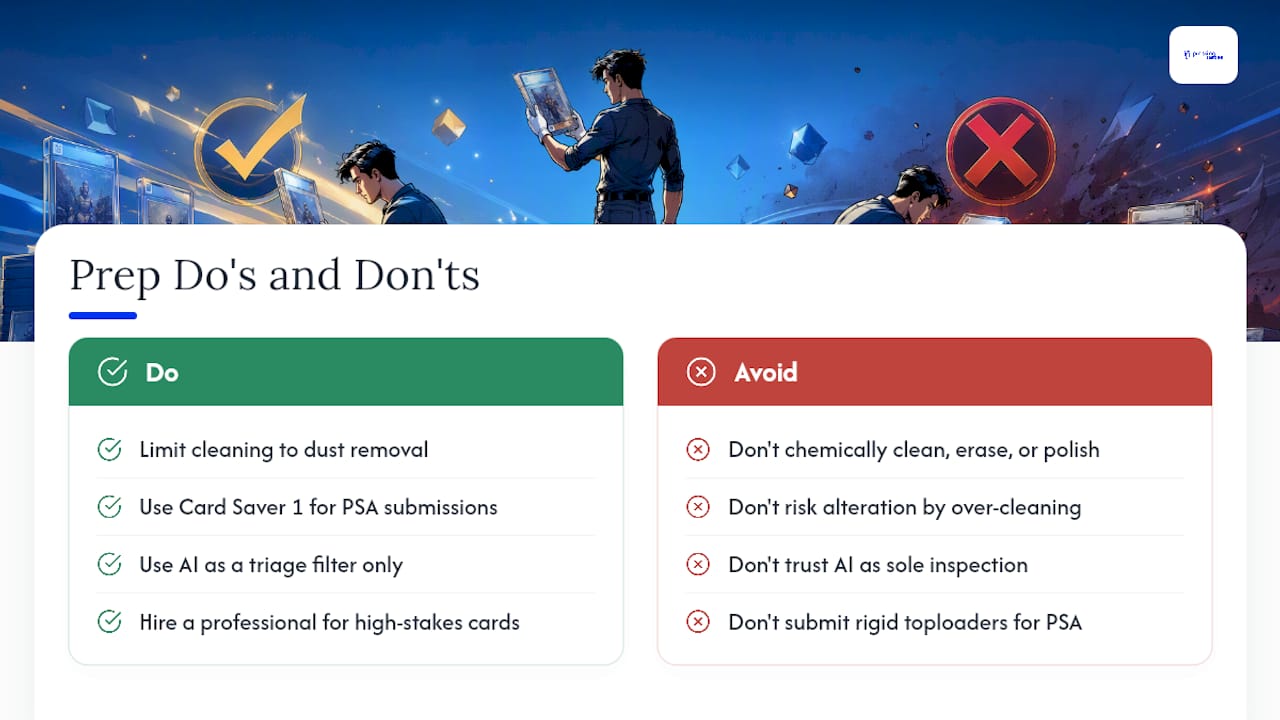
When does it make more sense to hire a professional than prep at home? When the gap between raw and graded value is large, the card is rare enough that mistakes can't be undone, or the surface issues are complex enough that DIY cleaning risks an alteration flag.
Sources
- How to Prepare Cards for Grading: Pre-Submission Checklist | PreGradeCards
- Trading Card Grading Supplies: PSA & BGS Prep Guide – Cardshellz
- How to Prepare Cards for Grading Submission | CardGrade
- MasterGrade methodology
Recommended
- The Grading Upgrade Game: Where Are the Sweet Spots for Pressing and Cleaning? — Pressing Issues
- Graded Comic Book Resale Workflow: Maximize Your Value — Pressing Issues
- How to Identify High-Value Pressing Candidates
- The 9.8 Gambit: How to Use the CGC Prescreen to Optimize Your Collection — Pressing Issues