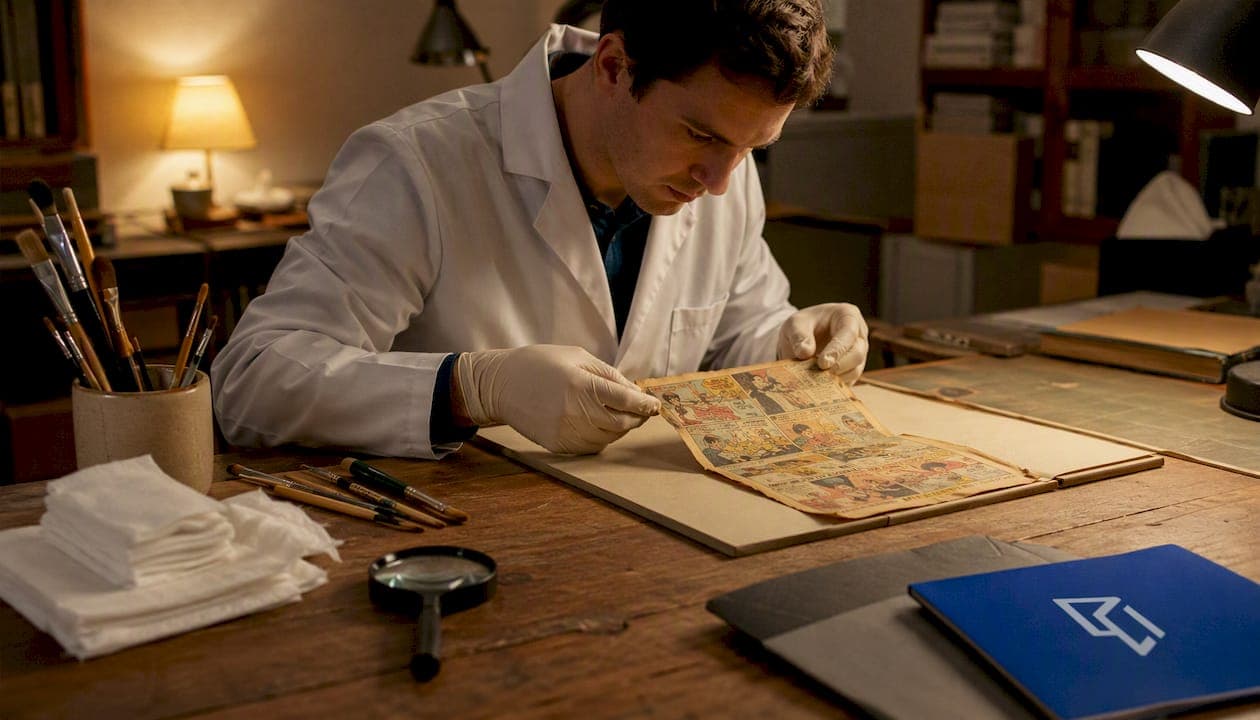
Golden Age pressing complexity is the significantly elevated risk of irreversible damage when cleaning and pressing comics from the 1930s–1950s, caused by acidic wood-pulp newsprint that is chemically unstable and mechanically fragile. This is not a matter of degree — it is a categorically different process from pressing a modern or Silver Age book. Three consequences define the stakes for collectors:
- Spine splitting from mechanical stress on brittle, lignin-heavy paper
- Color loss at folds and edges where fiber integrity is already compromised
- Reversion, where improperly cured paper "bounces back" to its unpressed state within days
The professional standard, followed by services like Pressing Issues and documented by Comic Book CPR, requires dry cleaning before any pressing and a thorough visual diagnosis as the primary risk-mitigation step. According to industry practitioners, that visual diagnosis determines a large majority of the final outcome before a single tool touches the book.
Table of Contents
- Why does Golden Age paper make pressing so risky?
- What can go wrong when pressing a Golden Age comic?
- What does a professional Golden Age workflow actually look like?
- What can pressing actually fix — and what can't it touch?
- When will a professional refuse to press a Golden Age book?
- How do you choose a professional Golden Age pressing service?
- Shipping, insurance, and CGC submission handling
- What does professional Golden Age pressing cost, and how long does it take?
- Key Takeaways
- Why the conservative approach is the only defensible one
- Pressing Issues handles Golden Age books the right way
- Authoritative sources and further reading
Why does Golden Age paper make pressing so risky?
Golden Age comics were printed on acidic wood-pulp newsprint that is high in lignin, the organic polymer that gives wood its rigidity. Over decades, lignin oxidizes and releases acids that break down cellulose chains, yellowing the paper and reducing its tensile strength. The result is a sheet that tears more easily, holds creases more permanently, and responds unpredictably to heat and moisture.
Modern comic stock, by contrast, uses lignin-reduced, alkaline-buffered paper that tolerates controlled humidification and heat pressing far better. The table below shows the key structural differences:
| Property | Golden Age newsprint | Modern comic stock |
|---|---|---|
| Lignin content | High (mechanically ground) | Low (chemically reduced) |
| Paper pH | Acidic (pH ~4) | Alkaline or neutral (pH alkaline-buffered) |
| Tensile strength | Low, decreases with age | Moderate to high |
| Response to moisture | Unpredictable, prone to rippling | More controlled |
| Pressing risk level | High — conservative approach required | Moderate — standard workflow applies |
Thin sheets, staple-driven binding, and decades of storage stress compound these vulnerabilities. The spine area on a Golden Age book is often the first point of failure under pressing pressure.
What can go wrong when pressing a Golden Age comic?
The specific hazards are concrete and worth knowing before you submit a book:
- Spine splitting: Pressure on brittle newsprint can crack the spine fold, creating a defect that did not exist before pressing.
- Color loss at folds and edges: Heat accelerates ink breakdown on already-fragile paper; color-breaking creases become permanent.
- Tears and chips: Mechanical stress during handling or pressing can extend existing micro-tears.
- Reversion/waviness: Failure to cure in a controlled environment for at least 24 hours causes Golden Age paper to rebound toward its original distorted shape.
- Mold reactivation: Any moisture applied to a book with dormant mold spores can reactivate them, spreading staining and biological damage.
- Grader risk on re-submission: Cracking a slab for pressing introduces handling risk; re-submission may reveal hidden defects or stricter scrutiny, sometimes resulting in the same or a lower grade.
- Permanently set dirt: Pressing a soiled book without dry cleaning first locks contaminants into porous fibers permanently.
Pressing a soiled book is a foundational error — heat and pressure drive surface oils and particulates deep into the paper structure, making them impossible to remove afterward.
Pro Tip: Never press a book with active mold, heavy tide lines, or visible water staining. Photograph every defect before any work begins and document it in writing.
What does a professional Golden Age workflow actually look like?
The process has five distinct checkpoints, and a responsible shop will pause or refuse at any one of them.
1. Visual diagnosis and pressing potential assessment. This is where roughly 80% of the outcome is determined. The presser examines the cover, spine, staple area, and interior pages under good lighting, assessing whether defects are pressable, whether the paper is too brittle to tolerate moisture, and whether the expected grade improvement justifies the risk.
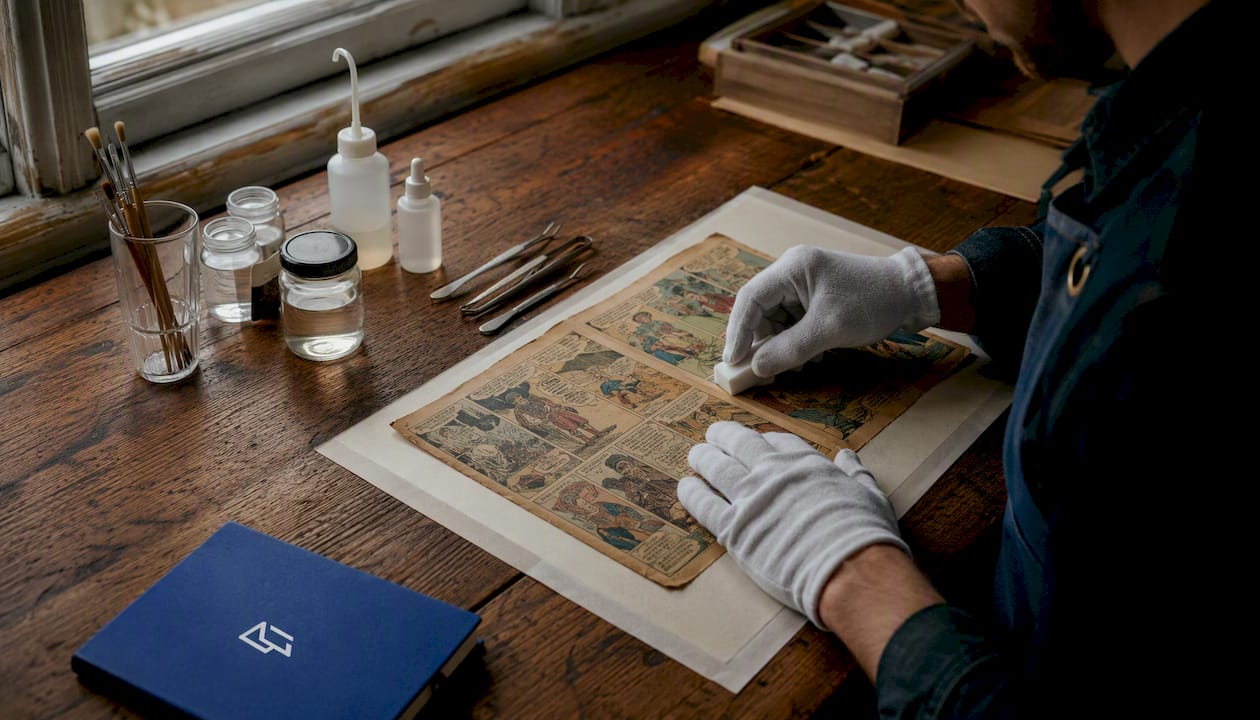
2. Mandatory dry cleaning. Surface contaminants — dust, finger oils, eraser debris — must be removed before any heat or moisture is applied. For Golden Age newsprint, this typically involves soft brushes, dry cleaning pads, or specialized erasers applied with minimal mechanical pressure. Skipping this step is not an option on fragile stock.
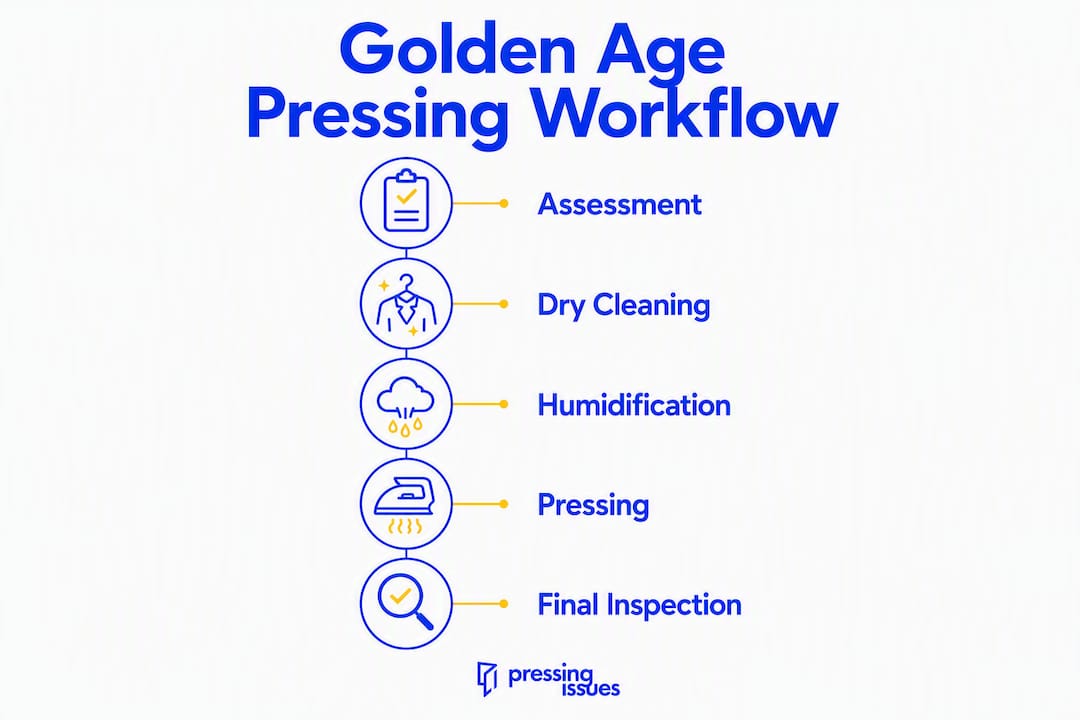
3. Controlled humidification and pressing. Standard technique involves humidification cycles of 8–24 hours depending on fragility, followed by controlled heat pressing at lower temperatures than modern stock requires. Fluctuations in pressing room temperature or humidity cause defects like flaring, rippling, and waviness — so environment control is non-negotiable.
4. Cold stabilization and cure. After pressing, the book must cure in a temperature-controlled environment for at least 24–48 hours. Total cycle time typically runs 36–72 hours. Cutting this short is the most common cause of reversion.
5. Before/after photo documentation and chain-of-custody paperwork. Every defect present before work begins should be photographed and logged. This protects both the collector and the shop, and it is a baseline requirement for any CGC submission workflow.
A preservation-first workflow means we document what we find before we touch anything. If a book is too fragile to press safely, the right answer is to say so — not to press it anyway and hope for the best.
Pro Tip: When submitting a Golden Age book, disclose its full storage history: any known water exposure, mold, prior restoration, or color touch. A professional shop needs that information to assess risk accurately.
What can pressing actually fix — and what can't it touch?
Setting realistic expectations before you submit a book saves time, money, and heartbreak.
Pressing typically improves:
- Curl and roll from storage
- Light bends and minor dents
- General waviness and page rippling
- Minor spine rolls without color breaking
Pressing cannot fix:
- Color-breaking creases (broken fibers cannot be re-fused)
- Missing paper, chips, or tears
- Rust holes from staple oxidation
- Heavy water stains or tide lines
- Active mold or biological damage
CGC classifies pressing as a non-restorative process, meaning a properly pressed book receives no restoration notation. Dry cleaning is also classified as non-restorative when performed as part of the pressing service. That said, grader risk is real: re-submitting a previously graded book can expose defects that were hidden under the original slab or result in stricter scrutiny.
| Defect type | Pressing outcome | Typical grade impact |
|---|---|---|
| Storage curl/roll | Usually resolved | Meaningful improvement possible |
| Light bends, minor dents | Usually resolved | Moderate improvement |
| Color-breaking creases | Cannot fix | No improvement; risk of worsening |
| Water stains/tide lines | Cannot fix | No improvement |
| Missing paper/chips | Cannot fix | No improvement |
| Spine roll (no color break) | Often improved | Moderate improvement possible |
When will a professional refuse to press a Golden Age book?
Red flags that cause a responsible presser to decline work:
- Active mold or visible spore growth anywhere on the book
- Heavy water damage or tide lines covering significant areas
- Color-breaking creases that pressing would worsen
- Detached covers or loose pages that cannot survive handling
- Extreme brittleness where the paper crumbles at the edges
- Raw value too low relative to the cost and handling risk
The value-to-cost threshold matters. Any raw Golden Age book valued above $200, or any key issue regardless of raw value, typically warrants professional handling. For lower-value books with significant structural risk, the honest answer is often to leave the book unrestored and preserve what remains.
Pro Tip: If the realistic grade improvement is one notch and the book requires transit, handling, and re-submission, weigh that against the risk carefully. Preservation beats a grade chase on a fragile book.
How do you choose a professional Golden Age pressing service?
Ask these questions before you hand over a book:
- Do you dry-clean before pressing, and is that included in the fee?
- What temperature and humidity parameters do you use for Golden Age newsprint specifically?
- Do you provide before/after photos and a written pressing potential appraisal?
- How do you handle insurance and chain-of-custody for CGC submissions?
- Can you show documented case studies or references for Golden Age work?
Trust signals to require:
- Documented visual diagnosis before any work begins
- Demonstrated experience with pre-1960s newsprint
- Written pressing potential appraisal with realistic grade expectations
- Before/after photo documentation for every book
- Insured shipping with trackable courier and signature confirmation
Red flags to avoid:
- Guarantees of specific grade upgrades
- No documentation or process transparency
- Refusal to disclose temperature/humidity parameters
- Uninsured or untracked shipping
Pressing Issues specializes in Golden Age books and provides complimentary value analysis alongside its cleaning and pressing service — a useful starting point for collectors deciding whether pressing makes financial sense before committing.
Shipping, insurance, and CGC submission handling
Packaging a Golden Age book for transit requires more than a bag and board:
- Double-box with rigid backing boards on both sides of the book
- Mylar or archival poly bag sealed before boxing
- Shock-absorbing filler (foam, bubble wrap) on all sides
- Label the outer box "Fragile — Comics" and note orientation
For insurance and chain-of-custody:
- Insure at declared replacement value, not purchase price
- Use a trackable courier with signature required on delivery
- Retain photo documentation at every transfer point
- Keep copies of all submission paperwork
CGC's pressing service can be combined with its grading submission in a single workflow. Professional services that handle CGC submissions directly manage the paperwork, submission tiers, and grader note expectations — Golden Age books often receive blue labels with grader notes describing observable defects, which is worth understanding before you crack a slab expecting a clean result.
What does professional Golden Age pressing cost, and how long does it take?
Cost drivers include the book's fragility, required pre-press treatments, declared value, and whether it is a single submission or part of a batch. Classics Inc. pricing ranges from $18 to $40 per book depending on era and complexity, with Golden Age books at the higher end of that range. High-value items typically carry a percentage-based fee on top of the base pressing rate.
| Service component | Typical fee range | Turnaround estimate |
|---|---|---|
| Visual diagnosis/appraisal | Complimentary (at Pressing Issues) | Same session |
| Dry cleaning | Included or $5 per book | 1–2 days |
| Golden Age pressing | $18–$40+ per book | 36–72 hours (press + cure) |
| CGC submission handling | Per-submission fee + CGC tier cost | CGC turnaround varies by tier |
| High-value percentage fee | Varies by declared value | Included in workflow |
Total timeline from submission to returned graded book depends heavily on CGC's current turnaround, which varies by service tier. Budget several weeks to several months for the full press-to-slab cycle.
For Pressing Issues' current rates and turnaround times, the service page lists up-to-date pricing by service type.
Key Takeaways
Golden Age pressing complexity demands a preservation-first approach: dry cleaning, visual diagnosis, controlled humidification, and a full stabilization cure are non-negotiable steps, not optional upgrades.
| Point | Details |
|---|---|
| Dry cleaning is mandatory | Pressing a soiled Golden Age book permanently locks contaminants into brittle paper fibers. |
| Visual diagnosis drives outcomes | Industry practitioners note that visual diagnosis determines roughly 80% of the final result before pressing begins. |
| Reversion is a real risk | Without a 24–48 hour cold-stabilization cure, Golden Age paper can rebound to its original distorted state. |
| Pressing has hard limits | Color-breaking creases, water damage, and missing paper cannot be fixed; attempting it risks permanent damage. |
| Pressing Issues specializes here | Pressing Issues offers Golden Age pressing, dry cleaning, value analysis, and full CGC submission handling from Seattle and Portland. |
Why the conservative approach is the only defensible one
There is a temptation in this hobby to treat pressing as a low-risk upgrade — submit the book, get it back looking better, watch the grade climb. That framing works reasonably well for a 1990s book on modern stock. It is genuinely dangerous applied to a 1940s book on acidic newsprint.
What most collectors underestimate is how little margin for error exists on a Golden Age book. The paper has already spent 70–80 years degrading. Every mechanical intervention — humidification, heat, pressure, handling — adds stress to a substrate that has almost no reserve left. A presser who treats a Golden Age book the same way they treat a modern book is not being efficient; they are being reckless.
The documentation-first approach that Pressing Issues follows is not bureaucratic caution. It is the only way to make a defensible decision about whether pressing will help or hurt a specific book. Before/after photos, written pressing potential appraisals, and client consent before work begins are what separate a preservation service from a gamble.
For collectors holding genuinely valuable Golden Age material, the question is never "should I press this?" It is "does this specific book, in this specific condition, have pressable defects that justify the risk?" That answer requires expertise, patience, and a willingness to say no when the math does not work.
Pressing Issues handles Golden Age books the right way
When you have a Golden Age book worth protecting, the process matters as much as the outcome. Pressing Issues provides professional dry cleaning, preservation-first pressing, written value analysis, and full CGC submission handling for collectors and dealers across the United States, operating out of Seattle and Portland.
To get an estimate, send clear photos of the cover, spine, staple area, and any visible defects, along with a brief storage history and your declared value. Pressing Issues will assess pressing potential, explain the risks honestly, and give you a written appraisal before any work begins. High-value books are handled under a percentage-based fee structure that aligns the shop's incentives with yours.
Request an estimate or review the full service details to get started. If you are still deciding which books are worth submitting, the selection guide walks through the decision criteria in detail.
Authoritative sources and further reading
- Dry Cleaning Comic Books — Comic Book CPR: Explains why dry cleaning must precede pressing and what happens when soiled books are pressed without it.
Recommended
- Comic Book Pressing Secrets Revealed: What Experts Don't Want You to Know — Pressing Issues
- Modern Age Comic Pressing: What Collectors Need to Know
- Modern Age Comic Pressing: What Collectors Need to Know — Pressing Issues
- How to Choose a Comic Book Pressing Service (And Why Process Transparency Matters) — Pressing Issues