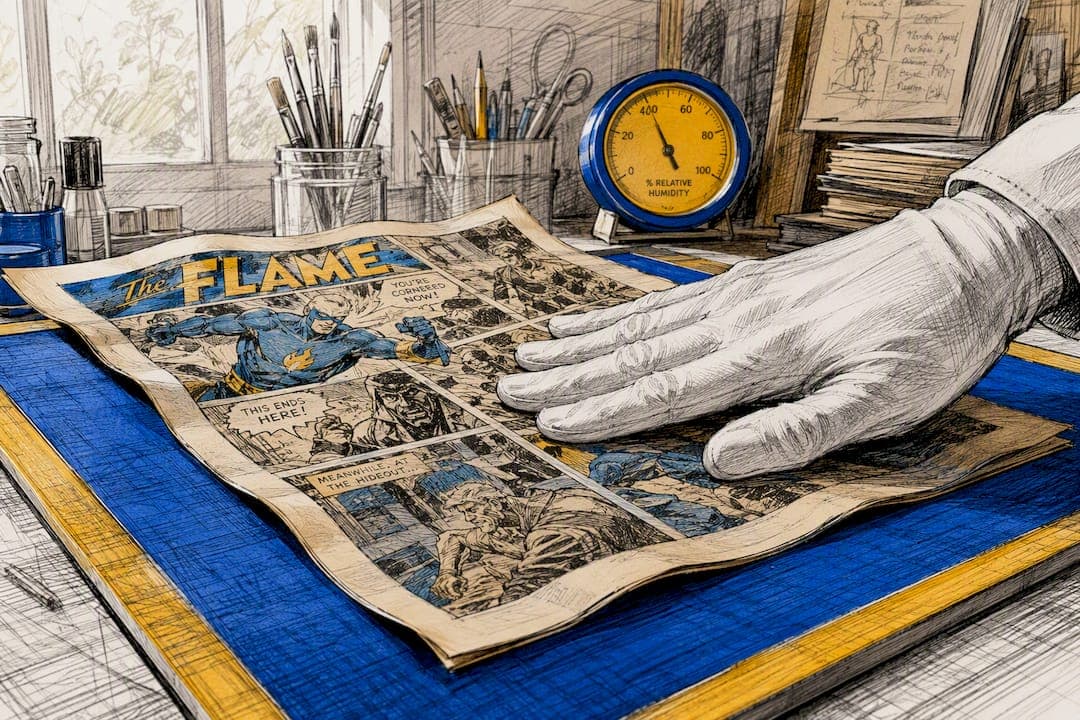
Mild waviness in a comic book page is usually reversible with careful cold flattening or a proper press. Severe rippling, color-breaking creases, fused pages, or active mold are not DIY territory, and pushing forward anyway can cost you more than the comic is worth. Start by stabilizing your storage environment so the problem stops getting worse, then judge the damage honestly before you touch anything.
- Mild waviness (light cockling, no cracked ink): try cold weighted flattening first.
- Moderate waviness (visible ripples across several pages): a controlled humidity chamber or professional press is safer.
- Severe waviness (color break, stuck pages, mold smell): stop and call a professional.
CGC notes that heavy rippling can lower a comic's grade, and some paper fiber distortion never fully reverses, even with expert intervention. That's the line that separates a weekend project from a job for someone who does this daily.
Key Takeaways
Fixing comic waviness comes down to matching the severity of the damage to the right method, since mild cockling responds to careful flattening while color-breaking or fused pages require professional conservation.
| Point | Details |
|---|---|
| Diagnose before acting | Distinguish general cockling from localized water damage before choosing a fix. |
| Start with cold flattening | Try glassine and weighted backer boards for 48 to 72 hours before attempting heat. |
| Respect the temperature limit | Keep heat pressing under roughly 140°F and always use glassine protection. |
| Watch for stop signals | Halt immediately if you see color break, page fusion, or a mold smell. |
| Call Pressing Issues for high-value books | Professional cleaning, pressing, and CGC submission handling suit books where a failed DIY attempt risks real resale value. |
Table of Contents
- What Causes Comic Pages to Go Wavy?
- How Do You Fix Mild Comic Waviness at Home?
- What Can Professional Pressing Actually Fix?
- When Should You Stop DIY and Call a Professional?
- How Do You Prevent Comic Pages From Warping Again?
- Sources
What Causes Comic Pages to Go Wavy?
Waviness almost always starts with moisture. Paper fibers absorb ambient humidity and swell unevenly, and when the humidity drops again, those fibers shrink back at different rates across the page. That mismatched expansion and contraction is what creates the rippled, cockled texture collectors dread.
There's a real difference between general cockling and localized water damage. General cockling spreads evenly across a book, usually from months or years of high relative humidity in storage. Localized water damage looks different: tide lines, brown rings, or a stiff patch where a specific spill or leak hit the paper. The first is a storage problem. The second is an event, and it often leaves marks that pressing can't remove.
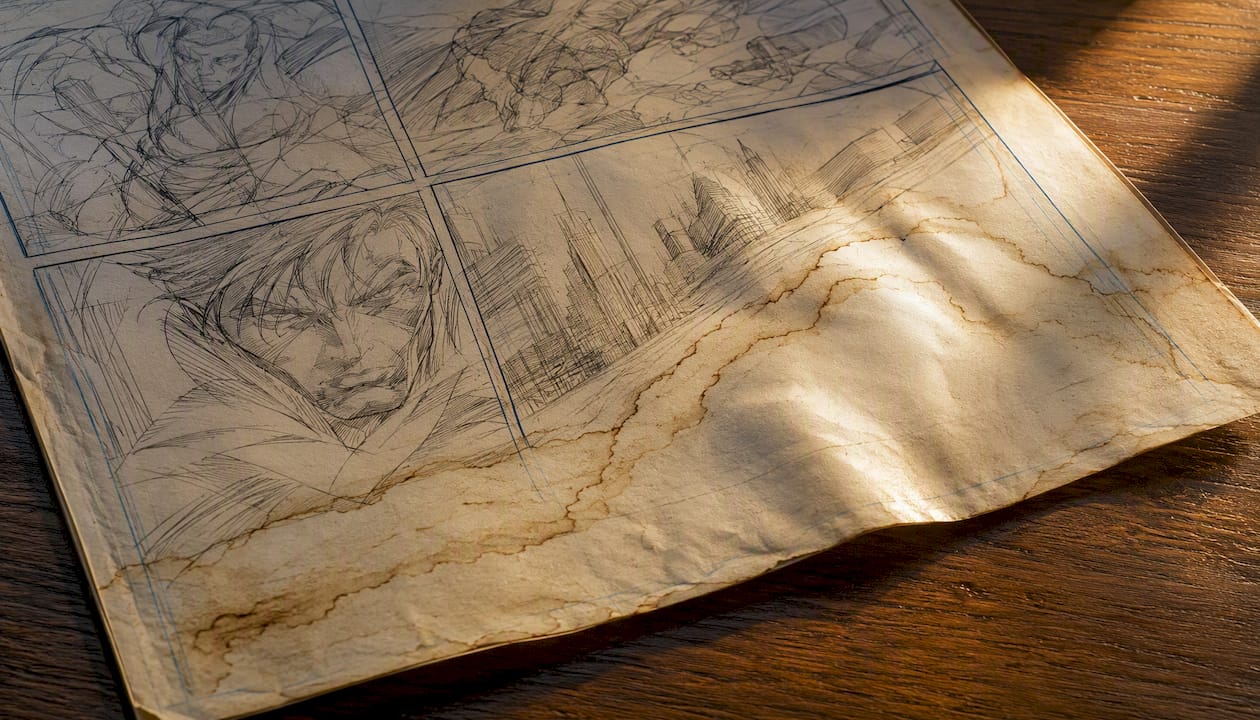
Storage habits play a bigger role than most collectors realize. Books packed too tightly on a shelf can't "breathe," which traps moisture against the pages. Closets, basements, and garages tend to have their own microclimates, often several points more humid than the rest of the house, especially if they share a wall with plumbing or sit near an exterior wall that gets cold at night.
Pressing errors cause a distinct kind of waviness, too:
- Thermal shock from pulling a book off the heat too fast, which locks in uneven fiber tension.
- Over-humidification that oversaturates the paper before pressing even starts.
- Uneven pressure during the press, which flattens some areas while leaving others rippled.
Collector forums are full of reports of wavy pages returning after a bad press, almost always tied to skipping the cooling and stabilization steps. That pattern shows up often enough that it's worth treating as a rule, not an exception.
How Do You Fix Mild Comic Waviness at Home?
Start with the least invasive option and only escalate if it doesn't work. Here's the order that keeps risk low.
- Cold weighted flattening. Sandwich the comic between two sheets of glassine, then place it under rigid backer boards. Stack flat, heavy books or dedicated pressing weights evenly across the surface, not just in the center. Leave it for 48 to 72 hours, checking once a day for shifting.
- Humidification chamber (moderate cases only). Use distilled water exclusively; tap water leaves mineral deposits that stain paper. Suspend the comic above the water source, never touching it, inside a sealed container. Monitor relative humidity with a digital hygrometer and keep sessions under two hours. This step should be temporary conditioning before flattening, not a fix on its own.
- Basic heat pressing (experienced DIYers only). Modern glossy interiors and vintage newsprint tolerate different temperature ranges, so match your settings to the paper stock. Guides consistently recommend staying under roughly 140°F for many books, always with glassine protecting the surface, and keeping cycles brief.
Check for color break or page fusion at every stage, not just at the end. If you see ink lifting, a crease turning white, or pages sticking together, stop immediately and let the book cool naturally under light weight.
Pro Tip: Never use an iron, hair dryer, or microwave on a comic book. These tools heat unevenly and far too fast, which is exactly the thermal shock that causes waviness in the first place.
Skip chemical flattening sprays entirely. They're marketed for paper crafts, not seven-decade-old newsprint, and there's no way to predict how they'll interact with vintage inks.
What Can Professional Pressing Actually Fix?
Professional pressing follows a five-stage cycle: assessment, controlled humidification, heat pressing, gradual cooling under pressure, and cold stabilization. That last stage, holding the book flat under weight for 24 to 48 hours after the heat press, matters as much as the heat itself. Skip it, and waviness tends to creep back within days.
The full cycle, start to finish, often runs 36 to 72 hours depending on how much distortion the book carries. Rushing any stage to save time is how books end up worse than when they arrived.
Pressing is conservation work, not restoration. It's a distinction worth sitting with: pressing repositions existing paper fibers, it doesn't repair paper that's already torn, missing, or chemically damaged. That means:
- Spine roll, cover ripples, and light dents respond well to a proper press.
- Color-breaking creases don't reverse. Once ink has cracked along a fold, pressing can't restore it.
- Active mold needs remediation before pressing, not during it. Pressing a moldy book risks spreading spores throughout the entire stack.
- Pages already fused together from moisture damage often can't be separated without tearing.
CGC's own grading notes acknowledge that waviness reduction has real limits, and that some distortion counts against a grade regardless of what pressing accomplishes afterward. That's exactly why pros are cautious with high-value keys: one miscalculated press cycle on a book worth thousands isn't a mistake you get to try again.
When Should You Stop DIY and Call a Professional?
Certain signs mean it's time to set the book down and get an estimate instead of experimenting further.
- Bare paper showing through a crease, which signals the ink layer has already broken.
- Brown rings or tide lines from water exposure, rather than uniform cockling.
- Pages that feel stuck or slightly fused when you fan the book gently.
- Any musty smell or visible spotting that could indicate active mold.
- A book you estimate at several hundred dollars or more, where a failed DIY attempt could erase real resale value.
DIY pressing setups work fine for practice on low-value books, but the learning curve is steep enough that beginners frequently damage books before they get the technique right. That's an acceptable risk on a dollar-bin comic. It's not acceptable on a key issue.
When you reach out for a professional quote, send clear photos of the affected pages, a description of when you first noticed the waviness, and any details about the book's estimated value. That context lets a pressing service assess severity before you ship anything.
How Do You Prevent Comic Pages From Warping Again?
Prevention comes down to controlling humidity and keeping air moving around your collection.
- Hold relative humidity between 40% and 55%, with minimal swings, using a digital hygrometer to check it rather than guessing. Stable humidity control is the single biggest factor in whether a pressed book stays flat.
- Bag and board every book, and move long runs into archival boxes rather than stacking them loose.
- Avoid sealed closets, bathrooms, and rooms with poor ventilation. These spaces trap moisture with nowhere for it to escape.
- Run a dehumidifier or dedicated HVAC zone in any room where books are stored long term, especially in basements.
- Store books upright and snug on shelves, not loose enough to bow, and interleave long runs with acid-free paper if you keep them flat.
- Inspect your collection periodically for musty smells or new cockling, and re-stabilize anything that starts drifting before it becomes a bigger repair.
A pressing mistake I won't repeat
Early on, I pulled a book off a heat press a few minutes too soon because I was impatient to check the results. The pages rippled right back within a day. Cold stabilization under weight for 48 hours fixed what the rushed cooling had undone. Three habits stuck after that: check relative humidity weekly, never store books in a closet, and box and board on a routine, not just when something looks off.
— Charles
Why some jobs belong with Pressing Issues
There's a real cost to guessing wrong on a book that's already worth something. Pressing Issues exists for exactly that gap: collectors who've read every DIY guide but don't want to risk a key issue on a first attempt. Our process covers cleaning, water stain removal, comic pressing, and full CGC submission handling, so a book that needs both a press and grading paperwork moves through one workflow instead of three.
If your book shows color break, fusion, mold, or you're just not confident pressing a book worth real money, that's your signal to bring it to a pro rather than experiment further. Request an estimate through our comic pressing service page, send a few clear photos of the defect, and we'll walk you through turnaround expectations before you commit to anything.
Sources
- CGC — Comics grader notes: distortion
- How to Press a Comic Before CGC Submission — MyComicsCollection