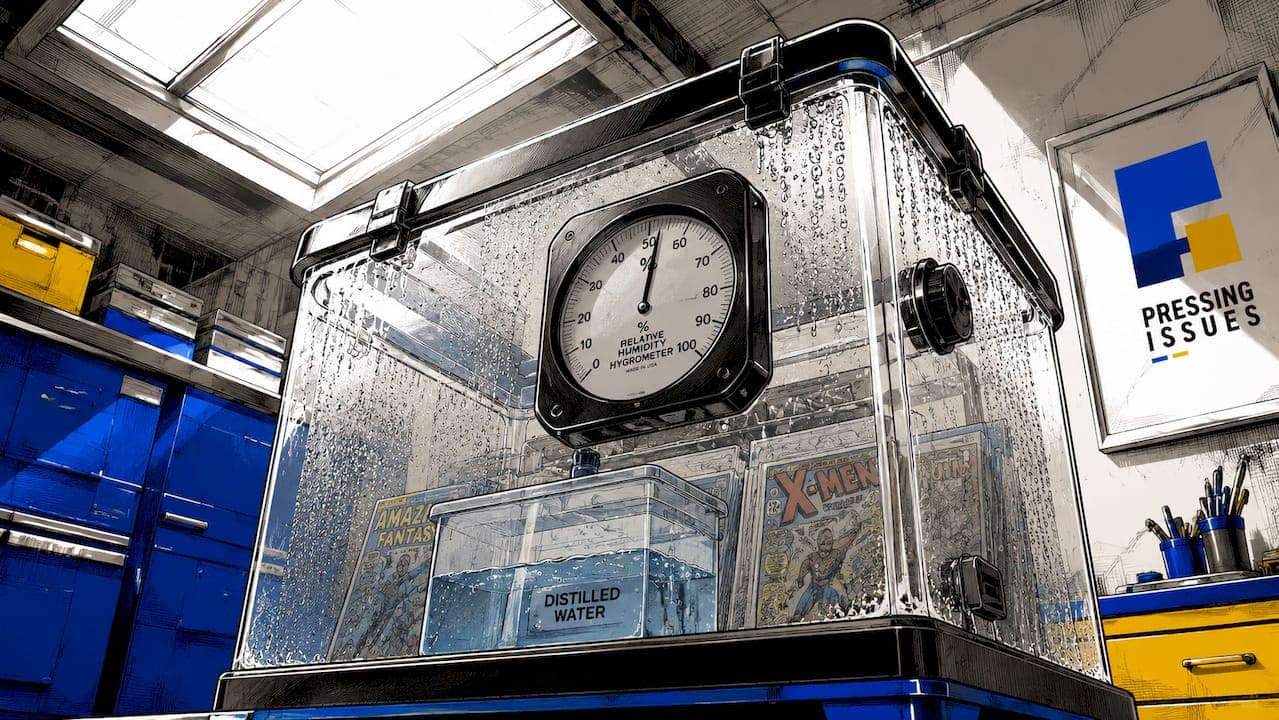
Aim for a moderate relative humidity and temperature in your press room, and never let a tank climb into a high humidity range. That's the range vendor guidance from ComicBookCPR points to as the sweet spot: enough moisture to relax paper fibers without pushing them into the danger zone where mold and permanent waviness take hold. The safe order of operations is simple, but skipping a step can cause collectors to damage books that pressing might have improved.
Here's the workflow we follow on every book that comes through our shop:
- Humidify only if needed — a hygrometer-monitored tank, 30 to 60 minutes, adjusted for paper stock.
- Remove dents and creases while the paper is pliable, using calibrated heat and pressure, not force.
- Press and stabilize under cold weight for at least 24 hours before the book goes back into a bag and board.
Three risks can undo all of that in minutes: oversaturation (spongy pages that tear), active mold (which spreads once trapped in a warm, damp tank), and brittle paper that was never a candidate for humidification in the first place. If any of those show up, that's your cue to stop and call a professional like Pressing Issues rather than push forward on instinct.
Key Takeaways
| Point | Details |
|---|---|
| Target range | Keep press-room conditions at 40 to 50% RH and 70 to 75°F; never let a tank exceed 55 to 60% RH. |
| Order of operations | Humidify only if needed, remove defects while pliable, press, then cold-stabilize for at least 24 hours. |
| Watch for oversaturation | Spongy pages, persistent waviness, and mold risk within 48 hours all signal you've gone too far. |
| Storage differs from pressing | Long-term storage RH should sit lower, around 35 to 40%, not the higher press-room target. |
| Call a professional for red flags | Active mold, brittle pages, and high-value key issues call for Pressing Issues rather than a DIY attempt. |
Table of Contents
- The Role of Humidity in Comic Pressing: Why Paper Behaves the Way It Does
- What Are the Best Humidity and Temperature Ranges for Pressing?
- How Do You Humidify a Comic Safely Without Damaging It?
- What Equipment Do You Need to Monitor Humidity Accurately?
- What Happens When You Over-Humidify a Comic?
- How Do You Prevent Reversion After Pressing?
- When Should You Avoid Humidifying a Comic Entirely?
- Conservator Note: Humidity, Heat, and the Chemistry of Aging Paper
- Quick Pre-Press Checklist for Your Bench
- What Judgment Calls Actually Separate a Good Press from a Bad One?
- If You'd Rather Not Risk It Yourself, Here's What Professional Pressing Involves
- Frequently Asked Questions
- Sources
The Role of Humidity in Comic Pressing: Why Paper Behaves the Way It Does
Paper fibers are hygroscopic, meaning they absorb and release moisture from the surrounding air constantly. When you introduce controlled humidity, the cellulose fibers in the paper temporarily loosen their bonds and become pliable. That pliability is the entire mechanism behind pressing. Without it, you're just applying heat and pressure to stiff, resistant fibers that will crack before they'll flatten.
Picture the fiber structure in three stages. Before humidification, the fibers sit rigid and interlocked, holding every crease and wave exactly where decades of handling put them. During humidification, water molecules work into the fiber structure and the bonds loosen just enough to let the paper move. After controlled exposure and pressing, the fibers re-bond in a flatter configuration, and the crease is gone or dramatically reduced.
The trouble starts when "pliable" tips over into "saturated." Temporary pliability is reversible and useful. Oversaturation is neither. Once fibers absorb more moisture than they can shed evenly, the paper swells unevenly across the sheet, and that swelling doesn't fully retreat when the book dries out.
The consequences of getting this wrong show up in predictable ways: waviness that won't flatten under normal pressing weight, cockling (rippled texture across the page), ink migration where pigments bleed or smear, mold colonies in the tank itself, and reversion, where a book looks great on day one and slowly re-wrinkles over the following weeks. Long-term storage guidance from the Library of Congress recommends around 35% relative humidity for stable, permanent storage.
What Are the Best Humidity and Temperature Ranges for Pressing?
Vendor-tested guidance settles on a fairly narrow band, and drifting outside it is where most DIY pressing attempts go wrong. ComicBookCPR recommends a press-room environment of roughly 70 to 75°F with 40 to 50% relative humidity for most comics, and that number shows up consistently across practical vendor experience because it hits the balance point: fibers loosen enough to move, but the paper never approaches the saturation threshold where swelling becomes permanent.
| Parameter | Recommended Range | Notes |
|---|---|---|
| Press-room relative humidity | 40% to 50% RH | Sweet spot for pliability without swelling risk |
| Press-room temperature | 70°F to 75°F | Stable ambient conditions support even humidification |
| Humidity tank exposure | 30 to 60 minutes | Shorter for glossy modern stock, longer for dense newsprint |
| Danger threshold | Above 55% to 60% RH | Risk of swelling and mold increases sharply |
| Long-term storage RH | Around 35% to 40% RH | Lower than press-room target; stable, not transient |
Modern glossy comics absorb moisture quickly because of their coated stock, so they typically need the shorter end of the tank-time window. Heavier newsprint or magazine-style paper, common in Silver Age and Bronze Age books, takes longer to relax because the fibers are denser and less uniform, a distinction covered in more depth in our breakdown of how different paper types demand different pressing protocols. Press heat has its own ceiling, too. Push it too high and you risk ink transfer or cover gloss damage rather than a clean flatten, which is why we treat heat-press temperature limits as a hard boundary, not a suggestion.
How Do You Humidify a Comic Safely Without Damaging It?
A humidity tank, sometimes called a humidity chamber, is a sealed container where you introduce moisture, usually from a small reservoir of distilled water, and let the enclosed air reach a target RH before placing the book inside on a rack or suspended holder. The book never touches water directly. It sits in the humid air, absorbing moisture gradually while a hygrometer tracks the chamber's actual conditions in real time.
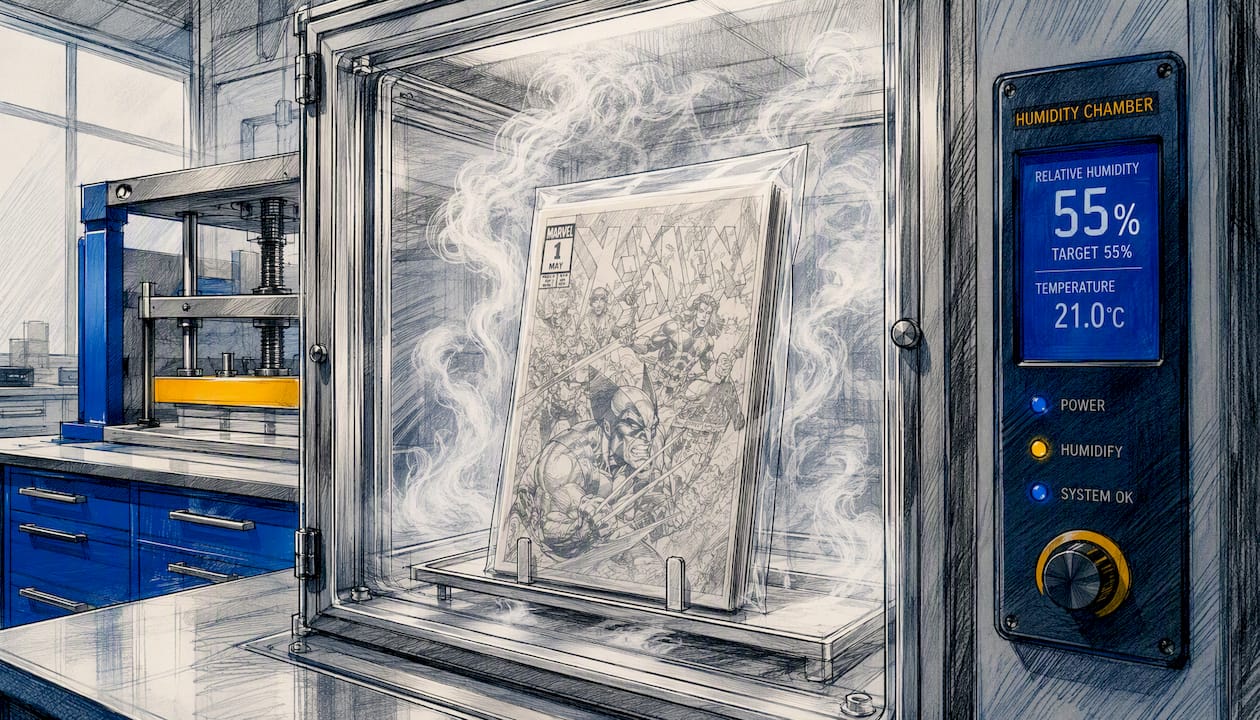
Suspend the comic on a rack rather than laying it flat, so both sides receive even exposure. Check the hygrometer at the 15 and 30 minute marks, then decide whether the book needs the full 60 minutes based on how the paper feels and how the creases are responding.
Some more aggressive protocols push chamber RH up to 80 to 92% for extended eight to 24 hour pre-humidification sessions, an approach some DIY guides describe for deep, stubborn creases. That method can work on the right book, but it demands constant monitoring and dramatically shorter exposure for anything fragile. We don't recommend it for collectors without conservation training, because the margin for error shrinks fast once you're above 60% RH for hours at a time.
Localized moistening and short steam bursts are the more surgical alternative. Rather than humidifying the entire book, you target a single deep crease or fold with minimal, controlled moisture, then press just that section. This works well for otherwise-stable books that have one stubborn defect and don't need a full tank cycle.
A do-not-do list worth memorizing:
- Never let a tank exceed 55 to 60% RH without a specific, monitored reason.
- Never humidify a book showing active mold. Moisture feeds it.
- Avoid humidity exposure on gem/foil covers unless you understand exactly how that finish reacts to moisture.
- Never introduce heat before the book has finished absorbing and equalizing its humidity. Heat locked in too early sets defects rather than releasing them.
| Method | Best For | Tradeoff |
|---|---|---|
| Standard humidity tank (40 to 50% RH) | Most modern and Silver Age books | Balanced, low-risk, widely used |
| Extended high-RH chamber (80 to 92%) | Deep, stubborn creases | Requires constant monitoring, higher risk |
| Localized moistening | Single defects on otherwise stable books | Precise, but slower for whole-book issues |
Pro Tip: Run a test cycle on a low-value duplicate or a common back-issue before you humidify anything valuable. Ten minutes learning how your specific tank and hygrometer behave together will save you from guessing on the book that actually matters.
What Equipment Do You Need to Monitor Humidity Accurately?
Reliable pressing depends more on measurement than on any single piece of gear. A digital hygrometer is the one non-negotiable tool, and we recommend running two: one inside the humidity tank itself and one in the ambient room. Relying on a single reading anywhere in the process means you're guessing the moment that sensor drifts or gets placed somewhere unrepresentative, like too close to the water reservoir.
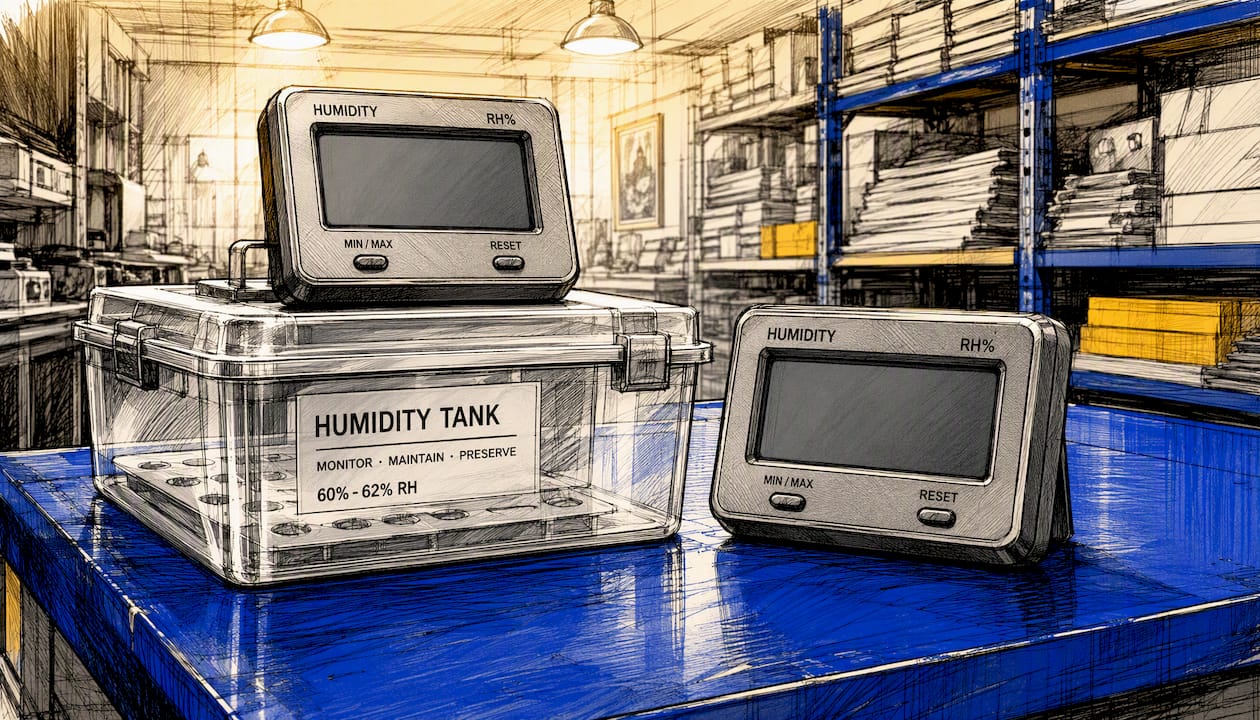
Your full equipment list should include two digital hygrometers, a humidity tank or chamber, distilled water (tap water introduces minerals and inconsistent evaporation), glassine or acid-free interleaving sheets, and a press machine or a flat-weight setup for the stabilization phase. Distilled water isn't optional. Mineral deposits from tap water can leave residue on pages during evaporation cycles.
Sensor placement matters as much as sensor count. Put one hygrometer inside the tank near where the book actually sits, not against the reservoir wall where humidity reads artificially high. Put a second in the general room environment so you know your baseline conditions before you even open the tank. If you're running a press station near a window or an HVAC vent, a third reading near the press itself catches drafts that skew your numbers without you noticing.
Calibrate hygrometers periodically using a saltwater calibration method or a manufacturer-specific reference check. Cheap hygrometers can drift several percentage points over months of use, and a drifted sensor telling you 45% when the tank is actually at 58% is how oversaturation happens without anyone realizing it. Before every session, run a quick safety check: inspect the book and the tank interior for any sign of mold, confirm the room has adequate ventilation, and make sure the tank itself is clean and dry from the last use.
What Happens When You Over-Humidify a Comic?
Too much moisture doesn't just fail to help. It actively damages the book, and the damage often isn't visible until the paper has already crossed a threshold it can't recover from. ComicBookCPR notes that mold can begin developing in as little as 48 hours inside a warm, damp tank environment, which is a sobering timeline for anyone tempted to "just leave it in a little longer."
The failure modes worth watching for:
- Waviness and cockling that persists even after pressing, because the fibers swelled unevenly and never fully re-bonded flat.
- Flaring or wavy edges, especially along the spine or corners where moisture concentrates.
- Ink movement or pigment disturbance, particularly on books with certain inks that are more moisture-sensitive than the surrounding paper stock.
- Glue or staple failure, where saddle-stitch staples rust or the binding glue softens and shifts.
- Mold growth, which can appear as faint discoloration before it becomes visibly fuzzy or colored.
Telling normal pliability apart from oversaturation comes down to feel and visual cues. A properly humidified page feels slightly soft and flexible, similar to a fresh sheet of paper, but it still has structure. An oversaturated page feels spongy, almost damp to the touch, and it may look slightly translucent in spots where it's absorbed more than the surrounding fibers.
If you suspect a book has crossed that line, stop immediately. Isolate it from other books to prevent any mold spores from spreading. Let it air-dry slowly at room temperature rather than introducing heat, which can lock in warping. If you see any hint of mold or the damage looks beyond what basic drying will fix, that's the point to contact a professional rather than experiment further on a book that's already compromised.
How Do You Prevent Reversion After Pressing?
Reversion, where a pressed book slowly re-develops the waves or creases it appeared to lose, is almost always a stabilization failure rather than a pressing failure. The press itself flattened the fibers correctly. What went wrong is what happened, or didn't happen, in the hours right after.
Cold stabilization means placing the pressed book under flat, even weight, without heat, for a defined period before it goes back into a bag and board. We recommend at least 24 hours under weight, and up to 72 hours for books that had significant waviness or came from denser newsprint stock. Skipping this step, or rushing a book back into circulation right off the heat press, is the single most common reason collectors see a "successful" press quietly undo itself over the following weeks.
Ambient conditions during that stabilization window matter too. Big swings in ambient moisture during stabilization are exactly what re-activates the fiber movement you just corrected.
Inspect the book at the 24-hour mark, again at one week, and once more at the one-month point. Most reversion, if it's going to happen, shows up within that first week as a subtle return of edge waviness. If a book shows any reversion signs at the one-week check, a second, shorter press cycle combined with a longer cold-stabilization period usually resolves it. Books that revert twice are telling you something about their paper stock or original damage severity that a third identical press won't fix, and that pattern is worth an appraisal to see whether continued attempts are worth the book's value.
When Should You Avoid Humidifying a Comic Entirely?
Some books are better left alone, and recognizing that early saves you from turning a fixable defect into an unfixable one. Active mold is the clearest red flag: introducing any moisture to a book already growing mold accelerates the exact problem you'd be trying to solve. Isolate that book immediately, don't attempt any humidification, and document its condition with photos before deciding next steps.
Other situations that call for caution or a full stop:
- Unresolved water stains — humidifying a book with active or unclear water damage can spread the staining further rather than help. Our guide on water stain removal covers what's fixable versus what isn't.
- Brittle pages — paper that's already lost flexibility from age or acid degradation can crack under humidification rather than relax.
- Spine splits or cover detachment — structural failures like these can worsen under moisture exposure rather than improve, a distinction we cover in our guide to comic cover detachment.
- Specialty inks and foil covers — some finishes react unpredictably to moisture, and there's no reliable way to test this on a one-of-a-kind book.
- High-dollar key issues — the cost of a mistake scales with the book's value, and that's precisely when a professional opinion is worth the fee.
For any of these, the safest next step is the same: isolate the book, photograph its current condition thoroughly, and get a value-impact estimate before attempting anything. If you decide to send it to a professional, pack it flat between acid-free boards in a rigid mailer, note any known history (prior pressing attempts, water exposure, storage conditions), and ship it insured. A little documentation up front makes for a much faster, more accurate assessment on the other end.
Conservator Note: Humidity, Heat, and the Chemistry of Aging Paper
Most comics, especially Golden Age through Bronze Age issues, were printed on wood-pulp paper that's chemically unstable by nature. That instability, often called inherent vice, means the paper is already breaking down slowly from the acids embedded in its own fiber structure, independent of anything a collector does.
This is the core tension of comic pressing: the same moisture that makes fibers pliable enough to flatten a crease is also, chemically speaking, feeding the degradation process that's already underway in the paper. Conservators aren't saying don't humidify. They're saying humidify conservatively, minimize exposure time, and treat every session as a calculated trade-off rather than a free tool.
That's the same logic behind why paper acidity matters so much to long-term book health, a subject we go deeper on in our guide to pH and comic preservation. The practical takeaway for pressing: keep exposure time as short as the crease allows, never treat a longer tank session as automatically better, and get books into stable, moderate-RH storage the moment stabilization is complete rather than letting them sit in transitional conditions any longer than necessary.
Quick Pre-Press Checklist for Your Bench
Run through these steps in order every time, no matter how experienced you are with a given book:
- Inspect the book under good light for existing damage, ink sensitivity, foil elements, or signs of mold before touching a hygrometer.
- Document condition with photos, front and back, plus close-ups of any creases you're targeting.
- Dry-clean the surface to remove loose dirt before introducing any moisture, since trapped debris can smear once the page softens.
- Test your hygrometer against a known reference or fresh calibration check before relying on its reading.
- Set tank timing based on paper stock: shorter for glossy modern books, longer for dense newsprint or magazine stock.
- Set press temperature within the safe range covered in our heat-press guide, never pushing past the ink-safe ceiling.
- Schedule stabilization for at least 24 hours under cold weight before bagging and boarding.
If at any point a reading looks off, a page feels spongy instead of pliable, or the book's condition doesn't match what you expected going in, pause. Set it aside and call a professional rather than pushing forward on a guess. That single pause has saved more books than any piece of equipment on this list.
What Judgment Calls Actually Separate a Good Press from a Bad One?
What actually determines whether a press succeeds is the judgment calls made inside that framework, and that's where most self-taught pressing goes sideways.
Timing adjustments matter more than most collectors expect. We treat the number as a guide, not a stopwatch. If a page still feels stiff at the 40-minute mark on a dense newsprint book, that's more useful information than blindly following a fixed 30-minute rule pulled from someone else's glossy modern comic.
Running test cycles on common paper is one of the most underused habits among collectors we talk to. Before working on anything with real value, press a duplicate, a beat-up back-issue, something with genuinely low stakes, and pay attention to how it responds at each stage. That single test tells you more about your specific tank, your specific hygrometer, and your specific room conditions than any general guideline can.
Reading a hygrometer in context means understanding that a number alone doesn't tell the whole story. That's part of why we always pair a humidity reading with a temperature reading, never one without the other.
When a book crosses into territory we've flagged throughout this piece, active mold, brittle pages, high-value key issues, that's when we tell collectors to reach out rather than experiment. The information that actually helps at that point is straightforward: clear photos of the front and back, the book's dimensions if there's any doubt about grade-relevant sizing, and whatever history you know, prior pressing attempts, water exposure, storage conditions. That context turns a guess into an informed assessment.
If You'd Rather Not Risk It Yourself, Here's What Professional Pressing Involves
Pressing Issues exists for exactly the moments this article just walked you through: the book where the humidity call is close enough that a mistake would cost more than the service fee. We inspect every book before touching it, use non-restorative pressing methods with calibrated heat and pressure control, and follow the same cold-stabilization principles covered above, holding books under weight before they ever ship back to you.

When you send a book to us, the process starts with an estimate based on photos and your description of the defects, so you know the value-impact potential before committing to anything. We handle the packing guidance, the turnaround timeline, and, if you're chasing a grade, the paperwork for CGC submission handling as part of the same engagement. Books that need cleaning before they're ready to press get that step too, through our dedicated comic cleaning service, rather than forcing you to sequence two separate vendors.
If your book shows any of the red flags covered earlier, active mold, brittle pages, a key issue with real dollar value on the line, get a value-impact estimate before deciding whether to press it yourself. Check our service rates and turnaround times and send us photos to start that conversation.
Frequently Asked Questions
What is the ideal humidity level for comic pressing? Most vendor guidance points to a moderate relative humidity range as the safe working range for pressing, paired with a moderate room temperature.
How long should a comic stay in a humidity tank? Typically 30 to 60 minutes, though glossy modern comics usually need less time and dense newsprint or magazine stock needs more, since different paper types absorb moisture at different rates.
Can too much humidity ruin a comic book? Yes. Oversaturation causes persistent waviness, spongy pages, ink migration, and creates conditions where mold can develop in as little as 48 hours in a warm, damp tank.
Is it safe to press a comic with water stains? Not without caution. Humidifying a book with unresolved water staining can spread the damage rather than fix it, so it's worth assessing the stain first before introducing any additional moisture.
When should I hire a professional instead of pressing at home? Any time you see active mold, brittle pages, spine splits, specialty inks, or you're working with a high-value key issue, the cost of a mistake outweighs the cost of a professional estimate.
This article provides general information on comic pressing techniques and is not a substitute for professional conservation advice, particularly for high-value or fragile books.
Sources
Recommended
- Heat Press Comics: What Every Collector Needs to Know
- How to Choose a Comic Book Pressing Service (And Why Process Transparency Matters) — Pressing Issues
- Comic Book Pressing Secrets Revealed: What Experts Don't Want You to Know — Pressing Issues
- The Results Speak: Professional Pressing vs. The YouTube Rabbit Hole — Pressing Issues