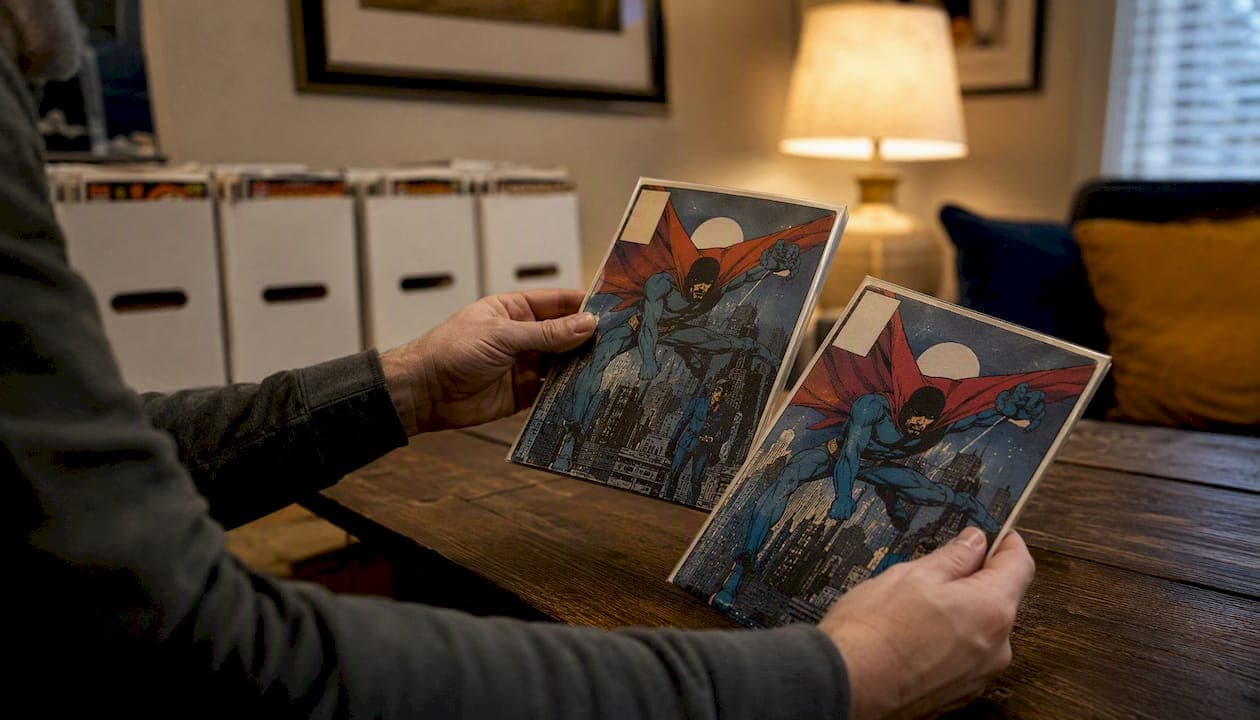
Newsstand editions were sold through traditional retail channels like drugstores, grocery stores, and magazine racks, while direct editions went exclusively to comic specialty shops. The practical difference for collectors: later-era newsstand copies tend to be rarer in high grades because readers bought and discarded them, while direct-edition buyers were typically collectors who stored their books carefully.
- Primary ID signal: Newsstand copies carry a standard UPC barcode; many direct editions replaced the UPC box with a spider, logo, or artwork, or used a different digit pattern in the UPC's second group.
- Distribution difference: Newsstand copies were returnable to publishers; direct editions were sold final sale to comic shops, which removed the need for return-tracking marks.
- Survivorship: Because newsstand copies circulated through general retail, far fewer survived in collector-grade condition, which is the engine behind any premium they command.
Key Takeaways
Newsstand editions are rarer in high grades because of survivorship, not print run, and that scarcity drives premiums only when census data confirms a meaningful population gap versus the direct edition counterpart.
| Point | Details |
|---|---|
| Primary ID method | Check the UPC box for artwork (direct) or a standard barcode, and count the digits in the UPC's second group. |
| Survivorship drives value | High-grade newsstand copies are scarce because casual retail handling damaged most of them before collectors could preserve them. |
| CGC label recognition | CGC notes newsstand editions when a distinct direct counterpart exists; submit with UPC photos and provenance notes for accurate labeling. |
| Era determines relevance | Marvel ended newsstand in 2013, DC in 2017; issues after those dates have no newsstand variant to compare against. |
| Pressing Issues service | Pressing Issues documents edition markers before pressing and includes them in CGC submission paperwork to protect label accuracy. |
Table of Contents
- What "newsstand edition" and "direct edition" actually mean
- How to identify newsstand vs. direct editions at a glance
- How the market split from newsstand to direct distribution
- When newsstand copies command a premium and when they do not
- How CGC and other grading services label newsstand editions
- Real sale examples showing the newsstand price gap
- What to do when you find a potential newsstand copy
- How pressing and cleaning interact with newsstand copies
- How distribution differences affect condition and common damage types
- Publisher-specific variations and exceptions worth knowing
- Current market trends for newsstand versus direct edition collecting
- An editor's perspective on the newsstand premium
- Ready to get your newsstand copy professionally pressed and submitted?
- Authoritative resources for further research
- Sources
What "newsstand edition" and "direct edition" actually mean
A newsstand edition is a copy distributed through traditional mass-market retail: newsstands, drugstores, grocery stores, and convenience stores. Publishers sold these on a returnable basis, meaning that unsold copies could be sent back for credit. That returnability required a visual identifier on the cover so publishers could track which copies came back and from which distribution channel.
A direct edition went to comic specialty shops through a separate distribution network. These copies were non-returnable. The shop bought them outright, which meant publishers had no logistical reason to mark them for return tracking. Early direct editions often replaced the UPC box with a small piece of artwork or a logo. Later, as both formats adopted full UPCs, the distinction shifted to subtler cues like digit patterns and price box text.
The definitions matter because they are supply-chain markers, not quality markers. CGC recognizes newsstand editions on the label when a distinct direct-market counterpart exists or when content or price differences justify separate recognition. That label recognition is what drives the collector premium, not any inherent superiority of one format over the other.
How to identify newsstand vs. direct editions at a glance
Visual identification is the first skill every collector needs before paying a premium or submitting a book for grading. The cues break down into primary and secondary checks.
Primary visual cues:
- UPC box content: Early direct editions (roughly 1979 through the mid-1980s) replaced the standard UPC with a small piece of artwork, a spider logo (Marvel), or a similar mark. If you see art where the barcode should be, it is almost certainly a direct edition.
- UPC digit pattern: On later issues where both formats carry a full UPC, check the second group of digits. Direct editions frequently show five digits in the second group, while newsstand editions often show two. This is a reliable starting point, but not universal.
- "Direct Edition" text: Many publishers printed the words "Direct Edition" or "Direct Sales" explicitly in the price box or on the cover. If you see that text, identification is straightforward.
- Price box differences: Newsstand copies sometimes carried a different cover price or listed multiple regional prices. Direct editions typically showed a single price.
Secondary cues:
- Interior ad content occasionally differed between formats, particularly in the 1980s.
- Some issues included posters or inserts exclusive to one format.
- Paper stock and printing quality were generally identical, so those are not reliable differentiators.
Marketplace mislabeling is widespread. Sellers frequently list direct editions as newsstand copies, sometimes unknowingly, which means you cannot rely on a listing's description alone.
Pro Tip: When two visual cues conflict, photograph the UPC box, the price box, and the inside front cover before paying a premium or submitting. A grader or experienced dealer can resolve the ambiguity from clear photos far faster than you can from a blurry scan.
How the market split from newsstand to direct distribution
The single-channel newsstand era ended gradually, not overnight. Before 1979, virtually every comic sold in the United States went through the same mass-market distribution network. The direct market split began in 1979, when publishers started selling non-returnable copies directly to specialty shops through dedicated distributors like Pacific Comics Distributors and later Diamond Comic Distributors.
Through the early 1980s, both channels ran in parallel. The direct market grew steadily as comic shops multiplied, and by the mid-1980s a meaningful share of total sales had shifted to specialty retail. Collectors who shopped at comic shops were far more likely to bag and board their purchases immediately. Newsstand buyers, by contrast, were often casual readers who folded, rolled, or simply read and discarded their copies.
That handling difference is the root of the survivorship gap. Newsstand copies passed through more hands, sat on wire racks exposed to humidity and light, and were bundled and shipped in ways that introduced spine stress and cover wear. The result: high-grade newsstand survivors from the late 1980s onward are genuinely scarce relative to their direct-edition counterparts.
Marvel ended newsstand distribution in 2013; DC followed in 2017. That timeline matters because it defines which issues can even have a newsstand variant. A Marvel book from 2014 has no newsstand edition. An issue from 1991 almost certainly does.
When newsstand copies command a premium and when they do not
The premium is not automatic. It depends on three variables: the era of the issue, the grade, and whether the graded census shows a meaningful survivorship gap between the two formats.
For issues published before the mid-1980s, the direct market was still small. Many early issues had no direct-edition counterpart at all, so there is nothing to compare against and no premium logic applies. The premium argument is strongest for issues published roughly between 1986 and 2013, where both formats existed simultaneously but newsstand copies circulated through general retail in far smaller collector-friendly quantities.
GoCollect's survivability analysis shows a significantly higher share of surviving graded copies are direct editions versus newsstand copies, which supports the scarcity argument for high-grade newsstand copies in that era. The gap is most pronounced at grades of 9.6 and above, where condition sensitivity is highest and the handling differences between a casual reader and a dedicated collector show up most clearly.
The premium also disappears when a key issue had a massive newsstand print run that dwarfs the direct edition. Print run alone does not create scarcity; what matters is how many copies survived in gradeable condition.
| Scenario | Newsstand premium likely? | Primary driver |
|---|---|---|
| Late-era key (1986–2013), grade 9.6+ | Yes | Survivorship gap in high grades |
| Early-era issue (pre-1979), no direct counterpart | No | No comparison population exists |
| Low-grade copy (below 8.0) | Rarely | Condition gap narrows at lower grades |
| Modern key with documented census gap | Yes, on select issues | Census data confirms scarcity |
For variant-driven value dynamics across collectibles categories, the same survivorship logic appears in sports card insert collecting, where short-print variants command premiums only when census data confirms genuine scarcity.
How CGC and other grading services label newsstand editions
CGC's policy is specific: the label will note "newsstand edition" when a distinct direct-market counterpart exists for that issue and when the edition difference is meaningful enough to affect market recognition. CGC has formally recognized newsstand editions on its labels, and that recognition has materially changed how collectors and dealers price graded copies. A CGC-slabbed newsstand copy with an explicit label notation carries more market credibility than a raw copy or a slab where the label is silent on edition type.
UPC presence alone is not decisive for CGC. The grader looks at the full picture: UPC digit pattern, price box text, "Direct Edition" markings, and any content differences. Submitting with clear documentation significantly improves the likelihood of accurate label notation.
CBCS also recognizes newsstand editions and notes them on labels, though its census data is smaller than CGC's, which affects how much weight the market places on CBCS-graded newsstand copies. PGX recognition is less consistent and carries less market weight for edition-specific variants.
Pro Tip: When submitting a suspected newsstand copy, include a cover scan, a close-up of the UPC box, and a photo of the price box in your submission notes. Graders work faster and more accurately with clear visual documentation, and it reduces the chance of a label dispute after the fact.
Real sale examples showing the newsstand price gap
The following examples reflect observed market patterns for modern-age keys where newsstand premiums have been documented. Exact sale prices fluctuate with market conditions; use GoCollect and eBay completed sales to verify current figures before buying or selling.
The pattern across these examples is consistent: the premium concentrates at the top of the grade scale. A 9.4 copy of the same issue often shows little or no premium because the survivorship gap narrows as grade requirements become less strict. For comic book resale value factors, edition type is one variable among several, and it rarely overrides the grade itself.
What to do when you find a potential newsstand copy
A systematic approach protects you from overpaying, mislabeling, or damaging a book before you understand what you have.
- Photograph everything first. Cover, UPC box (close-up), price box, inside front cover, and inside back cover. Do this before handling the book further.
- Record the UPC digits. Write down the full UPC number and note the digit count in the second group. Cross-reference against known direct-edition UPCs for that issue using collector databases.
- Check for "Direct Edition" text. Look at the price box and the cover corners. If the text is absent and the UPC shows a two-digit second group, that is a strong newsstand indicator.
- Verify against census data. Pull the CGC census for that issue and compare the newsstand population to the direct edition population at the grade you expect. A thin newsstand census at 9.6+ is the clearest signal of real scarcity.
- Assess condition honestly. Spine ticks, corner blunts, and cover creases are common on newsstand copies because of rack handling. Pressing and cleaning can address many of these defects non-restoratively, but assess the book's potential grade before committing to a submission.
- Decide on pressing before submission. If the book shows handling defects that pressing can address, do that before grading. A pressed 9.4 that grades to 9.6 is worth more than an unpressed 9.4, and the edition premium multiplies at higher grades.
- Package carefully for shipping. Use a rigid top-loader or Mylar sleeve inside a comic-specific mailer with backing board. Newsstand copies that survived decades of retail handling should not be damaged in transit to a grader.
Marketplace mislabeling means you should never skip step 2 and 3 when buying a raw copy described as newsstand. Verify independently.
How pressing and cleaning interact with newsstand copies
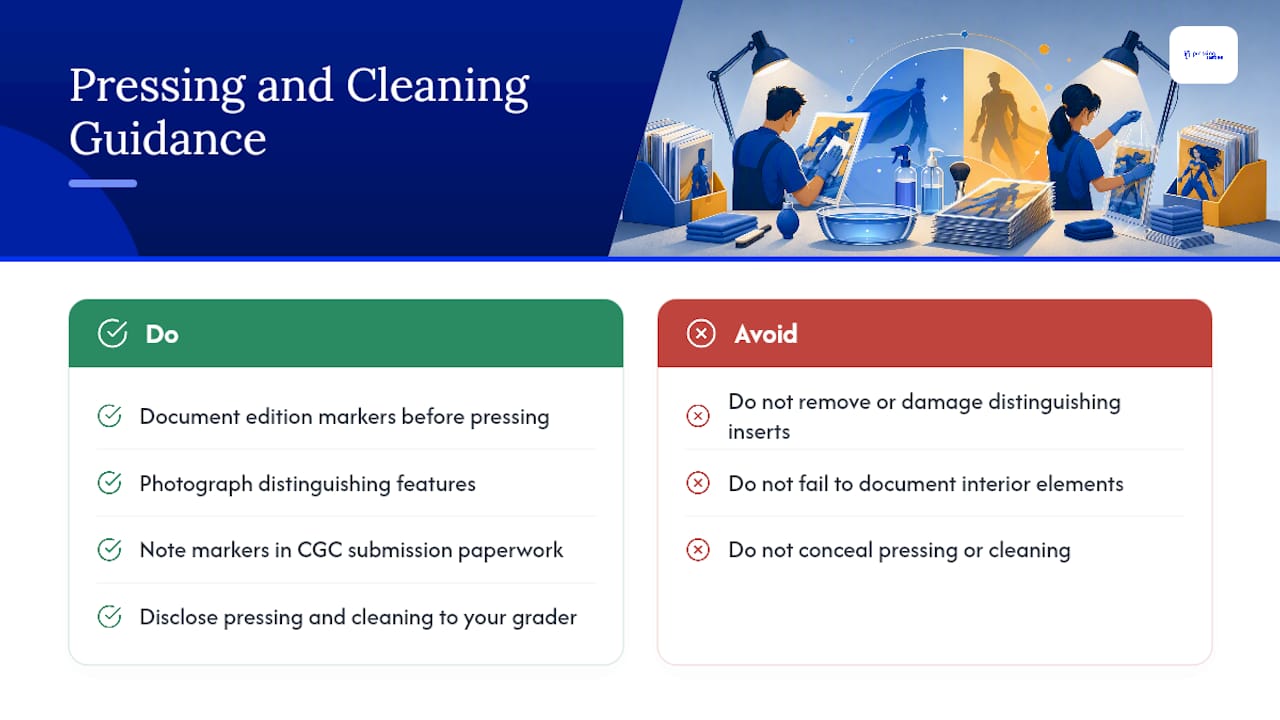
Non-restorative pressing and cleaning can improve a newsstand copy's grade without altering any of the edition-identifying elements. The UPC box, price box text, and cover markings that graders use to confirm edition type are on the cover surface, not embedded in the paper structure. A proper press addresses spine stress, corner blunts, and reading creases without touching those markers.
The risk area is inserts and interior content. If a newsstand copy contains a regional insert, a price sticker, or any interior element that distinguishes it from the direct edition, those elements must be documented before pressing and preserved through the process. Removing or damaging a distinguishing insert during cleaning could eliminate the provenance evidence a grader needs to confirm the edition.
At Pressing Issues, our workflow includes a documented appraisal step before any book is pressed. We record edition markers, photograph distinguishing features, and note them in the submission paperwork we prepare for CGC. That documentation travels with the book so graders have the full picture. Eye appeal matters alongside grade, and a well-pressed newsstand copy with a clean label notation commands more than a raw copy at the same numeric grade.
Pro Tip: Tell your grader explicitly that the book has been pressed and cleaned, and note the edition markers you observed before submission. Transparency protects the label and prevents disputes after grading.
How distribution differences affect condition and common damage types
The physical journey a newsstand copy took before reaching a collector is fundamentally different from a direct edition's path, and that difference shows up in predictable damage patterns.
Newsstand copies were bundled in groups, wrapped with wire or plastic strapping, and shipped to distribution warehouses before going to individual retail locations. That bundling process introduced spine stress along the left edge and corner blunts at the top and bottom of the spine. Wire strapping in particular left indentation marks on the top copy in a bundle. Rack display added another layer of wear: copies sat in wire spinner racks or wall pockets that abraded the bottom edge and introduced moisture exposure in humid retail environments.
Direct editions arrived at comic shops in flat cardboard boxes, handled by staff who understood the product. Spine stress from bundling was minimal, and the books went directly from box to shelf or into a collector's bag. The result is that direct editions from the same print run routinely survive in better structural condition than their newsstand counterparts, which is precisely why the types of comic book damage most associated with newsstand copies, including spine rolls, corner blunts, and moisture toning, are less common on direct editions from the same era.
Publisher-specific variations and exceptions worth knowing
The general newsstand/direct framework holds across most major publishers, but the details vary enough that publisher-specific research is always worth doing before drawing conclusions.
Marvel used artwork in the UPC box for direct editions from 1979 through the mid-1980s, then transitioned to a full UPC with a different digit pattern. Marvel's newsstand distribution ended in 2013, making any Marvel book from 2014 onward a direct-only issue.
DC Comics ran a parallel system but used "Direct Sales" text in the price box rather than artwork in the UPC box for much of the 1980s. DC's newsstand distribution continued until 2017, meaning DC has a longer window of dual-format issues than Marvel.
Independent publishers like Image, Dark Horse, and Valiant followed less consistent practices. Some Image titles from the early 1990s show newsstand variants with meaningful census gaps; others show no meaningful difference. Valiant's newsstand copies from the early 1990s are particularly sought after for key issues because the direct market was the primary sales channel for that publisher, making newsstand copies genuinely scarce.
Canadian price variants add another layer of complexity. Some issues printed with a Canadian cover price are functionally newsstand copies distributed through Canadian retail channels. These are treated as separate variants by CGC and can carry their own premiums independent of the standard newsstand/direct distinction.
Current market trends for newsstand versus direct edition collecting
Collector interest in newsstand variants has grown steadily over the past several years, driven largely by CGC's formal label recognition and the rise of census-based pricing tools. When CGC began noting newsstand editions on labels, it gave the market a standardized way to track population data, and that data confirmed what experienced collectors had observed anecdotally: high-grade newsstand copies are genuinely scarce for many late-era keys.
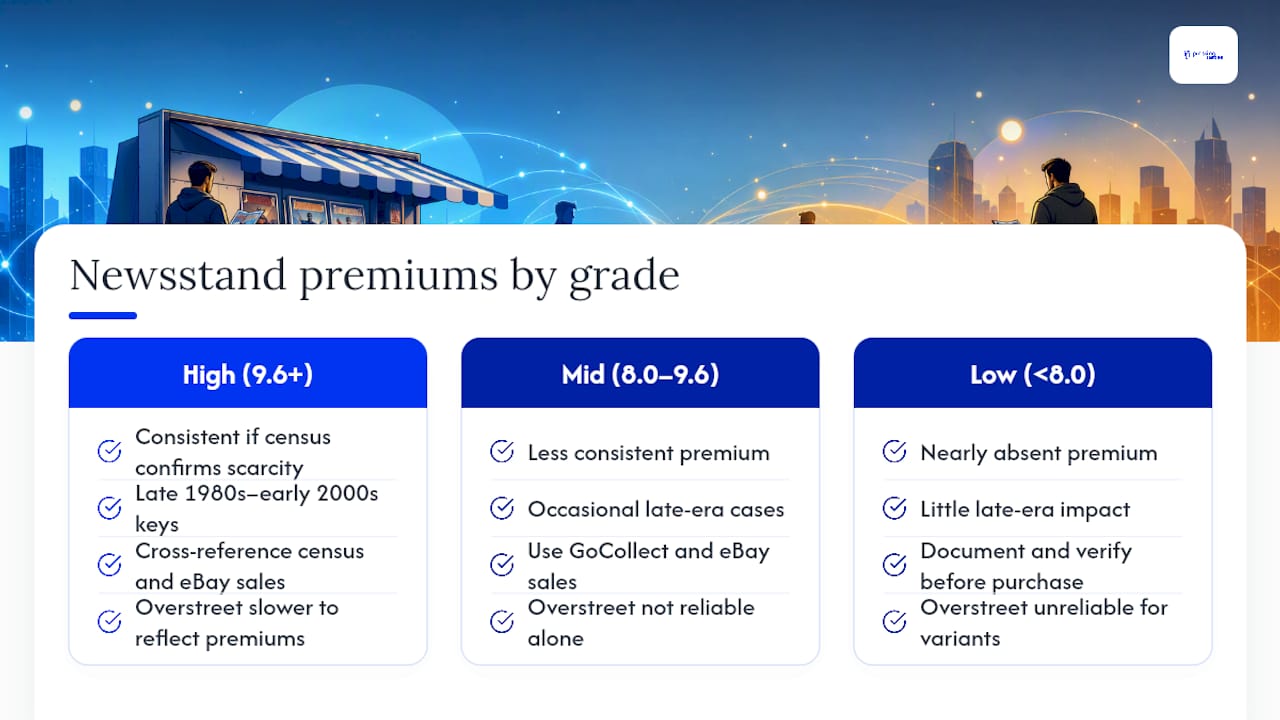
The modern-key segment has seen the most visible price movement. Issues from the late 1980s through the early 2000s, particularly first appearances and origin issues, show consistent newsstand premiums at grades of 9.6 and above when census data supports the scarcity claim. The premium is less consistent for mid-grade copies and nearly absent below 8.0.
Tools like GoCollect and eBay completed sales have made it easier to verify whether a specific issue's newsstand copies actually trade at a premium before committing to one. The Overstreet Price Guide has been slower to reflect newsstand premiums in its printed values, which means Overstreet alone is not a reliable pricing reference for edition-specific variants. Cross-referencing census data with recent eBay sales gives a more accurate picture than any single source.
One trend worth watching: as more collectors become aware of the newsstand/direct distinction, mislabeling on marketplace platforms is becoming more consequential. A buyer who pays a newsstand premium for a direct edition has real recourse only if they documented the discrepancy before purchase.
An editor's perspective on the newsstand premium
The newsstand premium is real, but the collector community sometimes treats it as more universal than the data supports. The honest picture is narrower: the premium is meaningful for specific issues, at specific grades, where census data confirms a genuine survivorship gap. Outside those conditions, paying a newsstand premium is speculation, not value investing.
What strikes me about this market is how much the premium depends on documentation rather than the physical object itself. Two copies of the same newsstand issue, identical in condition, can have very different market outcomes depending on whether the edition was correctly identified, properly disclosed to the grader, and accurately labeled on the slab. That is a documentation problem as much as a collecting problem, and it is one that professional pressing and submission services are well-positioned to solve.
The collectors who do best with newsstand variants are the ones who treat identification as a research task, not an assumption. They pull census data, verify UPC patterns, photograph provenance details, and submit with full documentation. The ones who overpay are usually the ones who trusted a marketplace listing without verifying.
Ready to get your newsstand copy professionally pressed and submitted?
At Pressing Issues, we work with collectors in Seattle and Portland who want to maximize the value of their books before CGC submission. Our process starts with a complimentary comic book appraisal that documents edition markers, assesses pressing potential, and gives you a clear picture of what a graded copy could realistically sell for.
For newsstand copies specifically, we photograph UPC boxes, record digit patterns, and include edition documentation in every submission package we prepare. That transparency protects your label and gives graders everything they need to confirm edition type accurately. Our comic book pressing and cleaning service uses non-restorative methods that improve eye appeal without disturbing the cover markings graders rely on. Send us photos of your book along with the UPC details and any provenance notes you have, and we will give you an honest assessment of whether pressing makes sense before you commit to a submission.
Authoritative resources for further research
These are the primary sources collectors should consult when researching specific issues, verifying identification, or tracking market prices.
For grading policy and label recognition: The CGC newsstand recognition article is the definitive reference for understanding when and how CGC notes edition type on a label. Read it before submitting any newsstand copy.
For survivorship and market data: GoCollect's survivability analysis and their basics overview are the strongest publicly available resources for understanding the census gap between formats. GoCollect also tracks recent sales, making it the most useful tool for current pricing.
For publisher timelines: Comichron's documentation of the DC newsstand phaseout, alongside their broader distribution history data, is the authoritative source for confirming which issues can have newsstand variants and which cannot.
For identification methods: J-Monty Comics' identification guide covers UPC digit patterns and marketplace mislabeling pitfalls in practical detail.
For current market pricing: eBay completed sales filtered by grade and edition type, cross-referenced with GoCollect census data, gives the most accurate real-time picture of what newsstand copies are actually trading for. The Overstreet Price Guide is useful for general value context but lags on edition-specific premiums.
Sources
- CGC Now Recognizes Newsstand Editions and Multi-Packs on CGC Label | CGC
- Newsstand vs. Direct - The Basics | GoCollect
- End of era: last DC newsstand issues | Comichron
- Newsstand editions vs direct editions — everything explained | J-MONTY COMICS