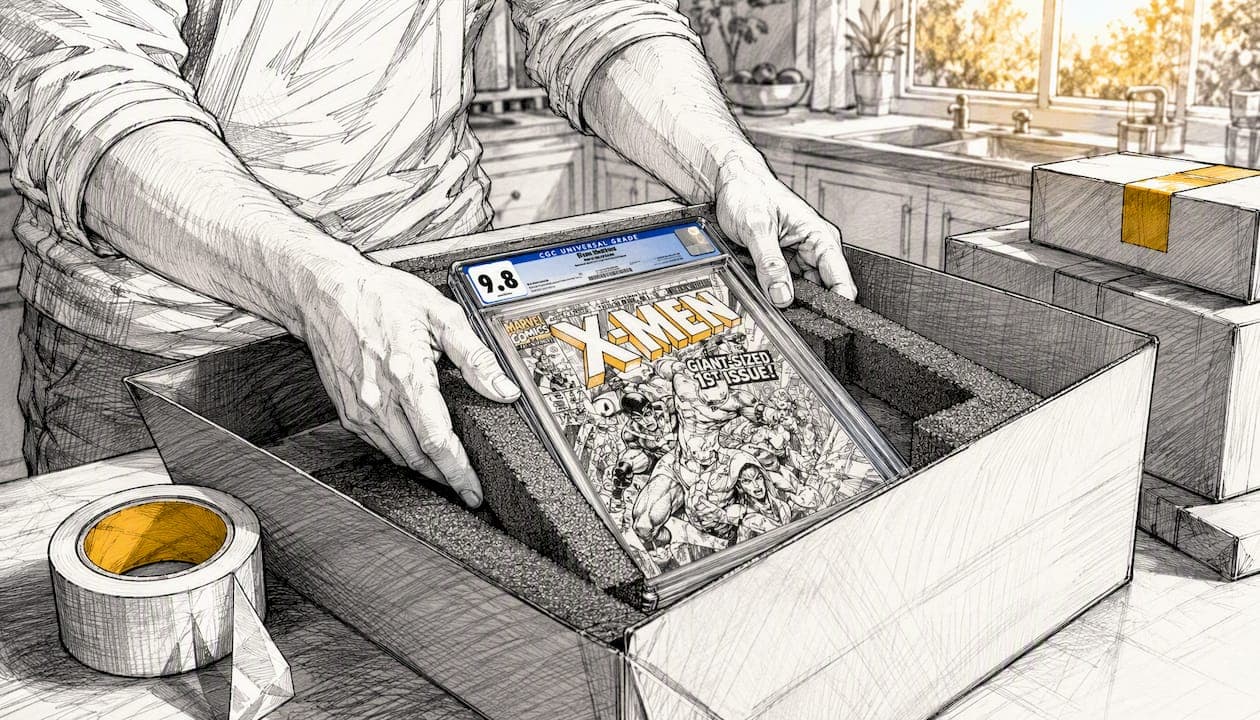
For most single raw comics, the right default is a poly bag, backing board, and rigid mailer shipped via USPS Ground Advantage with declared value added at the counter. For graded slabs or any book worth more than $250, add third-party shipping insurance or a collectors policy before the package leaves your hands.
Three things to do before you leave the house:
- Photograph the comic front, back, and edges, plus the sealed package, with timestamps on every image.
- Choose your service: USPS Ground Advantage for routine raw comics, Priority Mail for faster or higher-value shipments, and UPS or FedEx Ground for heavier multi-book boxes.
- Buy insurance: declare value with the carrier, add a third-party policy through Shippo's XCover/Cover Genius integration, or rely on a standing collectors policy from Collectibles Insurance Services or American Collectors Insurance for ongoing coverage.
One rule to memorize: comics do not qualify for USPS Media Mail. Using it voids any carrier liability and risks package seizure.
Key Takeaways
Proper packaging prevents most transit damage, and declared value or a collectors policy covers the losses that packaging alone cannot stop.
| Point | Details |
|---|---|
| Pack with the comic sandwich | Bag, board, and rigid mailer are the baseline; double-box all slabs with two inches of cushioning on every side. |
| Never use Media Mail | Comics are explicitly excluded; using it voids carrier liability and risks package seizure. |
| Insure graded keys above $250 | Declare the current market value and photograph the slab before sealing. |
| Document before you seal | Timestamped photos of front, back, edges, and packaging are required evidence for any claim. |
| Pressing Issues handles it professionally | Pressing Issues provides documented packing, appraisal, and insured CGC submission management for high-value books. |
Table of Contents
- How to pack comics so your shipping insurance claim won't be denied
- Which U.S. carrier and service should you use for shipping comics?
- What are your best insurance options for shipping comics?
- How to document value and file a claim successfully
- When does insurance actually make financial sense?
- Special handling for graded and slabbed comics
- What U.S. sellers need to know about international shipments
- What to do if your insurance claim is denied
- When a professional shipping and submission service makes sense
- The part most collectors get backwards
- Pressing Issues handles the packing, insurance, and submission paperwork for you
- Sources
How to pack comics so your shipping insurance claim won't be denied
Packaging quality is the single most common reason a claim gets approved or rejected. Industry-standard packing starts with the "comic sandwich," and skipping any layer gives an insurer grounds to deny your claim.
Step-by-step for a single raw comic:
- Slide the comic into a properly sized poly bag with a matchbook flap. For bag types and sizing, our comic bag guide covers current-size, silver-age, and golden-age options.
- Insert a rigid backing board behind the comic inside the bag, then seal the flap.
- Place the bagged-and-boarded comic between two additional boards of equal size. This is the sandwich: board, comic, board.
- Slide the sandwich into a rigid cardboard mailer or a purpose-built comic mailer. The mailer should have no flex when you press the center.
- Tape all seams. Mark the outside clearly: "DO NOT BEND" on the front and back, and add a "FRAGILE" label near the address.
For multiple raw comics or small lots, stack them bagged-and-boarded, wrap the stack in a layer of bubble wrap, and box them in a snug corrugated box with at least one inch of packing material on every side. The books should not shift when you shake the box.
For slabbed/graded comics, the stakes are higher because a cracked slab can reduce a 9.8 to unslabbed in one rough handling event. Double-boxing is the standard:
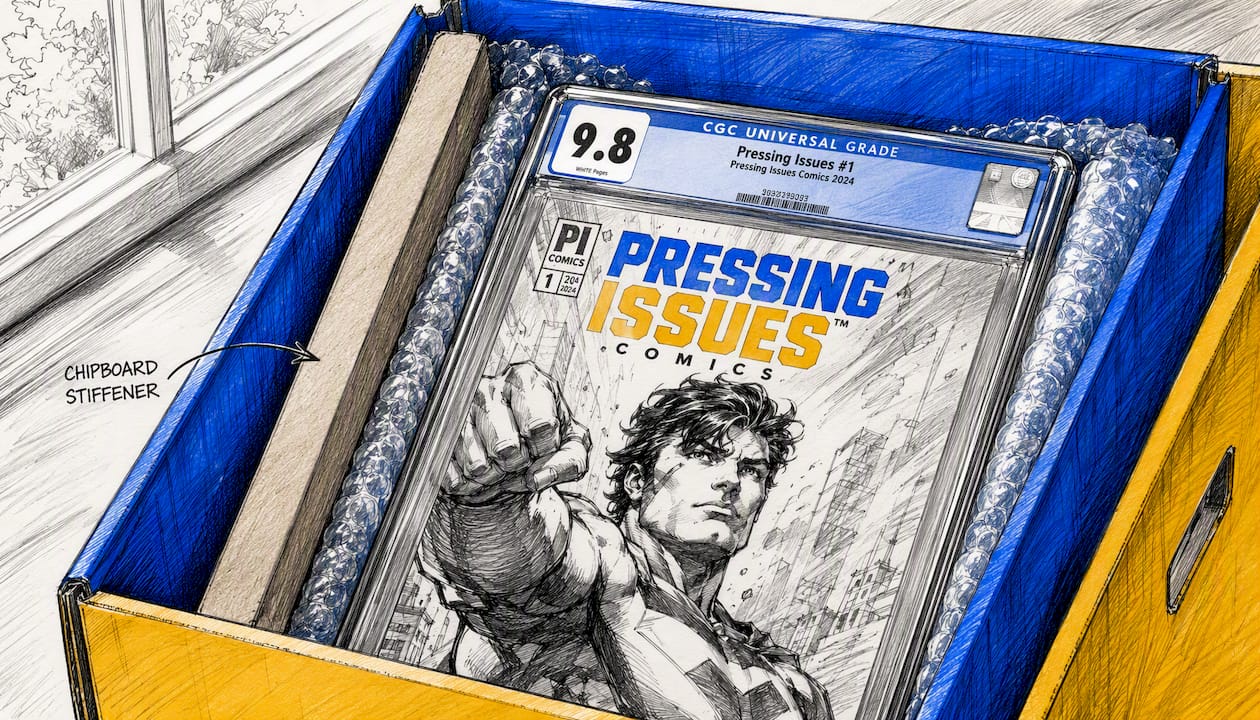
- Wrap the slab in two full layers of bubble wrap, covering all four edges.
- Place it in an inner box sized so the slab cannot move. Fill any gap with foam or crumpled kraft paper.
- Place the inner box inside a larger outer box with at least two inches of cushioning material on every side.
- The slab must be immobile. Shake the outer box. If you hear or feel movement, add more fill.
For humid climates or long-transit routes, add a small desiccant packet inside the inner bag before sealing. Moisture can cause tanning and wave even inside a poly bag over several days in a hot truck.
What to photograph before sealing:
- Front and back of the comic or slab
- All four edges
- The CGC or CBCS certification label (for slabs)
- The comic inside its bag and board, before the outer mailer goes on
- The sealed, labeled package ready for drop-off
Every photo should carry a timestamp. Your phone's camera app does this automatically, but verify the metadata is on before you shoot.
Pro Tip: The single packing step most collectors skip is a thin chipboard stiffener placed between the inner box and the outer box wall on the slab's spine side. That extra layer absorbs lateral impact, which is the most common cause of micro-cracks that only show under raking light.
Which U.S. carrier and service should you use for shipping comics?
Carrier choice affects both your cost and your insurance options. The right pick depends on the book's value, its weight, and how fast it needs to arrive.
Scenario-by-scenario recommendations:
- Single raw comic, value under $100: USPS Ground Advantage. Tracking is included, rates typically run $4–$12 depending on weight and distance, and you can declare value at the counter for a modest fee.
- Higher-value raw comic or faster delivery needed: USPS Priority Mail. Faster transit windows and slightly higher included liability make it worth the extra cost for books in the $100–$500 range.
- Very high declared value or maximum security: USPS Registered Mail offers the most secure handling chain in the USPS network, with locked transport at every transfer point. It's slower, but the documented chain of custody is valuable for rare books.
- Multi-book boxes or heavier shipments: UPS Ground or FedEx Ground. Both carriers handle larger declared values more cleanly than USPS for packages over a few pounds, and their online label tools make it easy to add declared value at purchase.
Never use Media Mail for comics. USPS Media Mail is restricted to educational materials and does not cover comics. If a postal inspector opens the package and finds comics, the shipment can be returned or seized with no liability on USPS's part.
Carrier-included liability is limited. USPS Ground Advantage includes $100 of coverage by default. Priority Mail includes $100 as well. UPS and FedEx include $100 of declared value at no extra charge. Anything above those thresholds requires either a declared-value fee paid to the carrier or a separate insurance policy.
Rate increases across USPS, UPS, and FedEx in late 2025 and early 2026 raised per-package costs, making discounted label services worth using. Buying labels through Shippo, Pirate Ship, or similar platforms typically saves a significant percentage off retail counter rates, and those savings add up fast if you ship regularly.
When to require signature confirmation:
- Any book valued above $250
- All graded slabs being returned to a buyer
- Any shipment going to CGC, CBCS, or another grading service
- High-value lots going to dealers or auction houses
Adult signature required (rather than standard signature) adds a layer of protection for packages above $500 because it prevents a carrier from leaving the package unattended.
What are your best insurance options for shipping comics?
Three distinct coverage paths exist for U.S. comic shippers, and the right one depends on how often you ship and how much your books are worth.
Carrier declared value is the simplest option. You tell the carrier the item's value at label purchase or at the counter, pay a small fee, and the carrier's liability increases to that amount. USPS charges a fee on a sliding scale above the included $100. UPS and FedEx follow similar structures. The catch: carrier liability is not insurance. It covers loss or damage caused by the carrier's negligence, and carriers may dispute claims citing inadequate packaging.
Third-party shipping insurance through platforms like Shippo's XCover/Cover Genius integration works differently. You add coverage at label purchase, paying a percentage of declared value for domestic shipments and a somewhat higher percentage for cross-border shipments. On a $500 comic, that's $6.25 domestic. The policy is separate from the carrier, so a claim doesn't depend on proving the carrier was negligent. Before you rely on XCover for high-value collectibles, read the exclusions carefully: some categories of antiques, art, and collectibles carry deductibles or coverage limits that differ from standard parcels.
One important warning: some third-party insurers explicitly exclude shipments going to a grading service because the item's value is considered unestablished until graded. Verify this exclusion before insuring a submission-bound package.
Collectors policies from Collectibles Insurance Services or American Collectors Insurance are the strongest option for anyone with a meaningful collection. These policies cover transit, exhibition, and storage under a single annual premium. Deductibles can start at zero for collector plans, and coverage often travels with the collection. Standard homeowners policies often exclude transit and accidental damage to collectibles, so collectors policies fill that gap.
Pro Tip: *If you sell more than a dozen comics a month, a collectors policy almost always costs less per shipment than buying per-package insurance on every sale.
Documentation each option requires:
- Carrier declared value: receipt showing declared amount; photos and original packaging if you file a claim.
- Third-party (XCover/Shippo): photos before sealing, proof of purchase or sale invoice, and the original packaging saved until the claim resolves.
- Collectors policy: commercial invoice, appraisal, or grading certificate for high-value items; some policies require individual scheduling for items above a set threshold.
How to document value and file a claim successfully
Good documentation before the package ships is what separates a paid claim from a denied one.
Pre-shipment documentation checklist:
- High-resolution photos of the comic front, back, and all four edges.
- Photo of the certification label (for slabs), showing the grade and certification number clearly.
- Photo of the comic inside its bag and board, before the outer mailer is sealed.
- Photo of the sealed, addressed package.
- Proof of value: a recent sale invoice, a CGC/CBCS grading certificate, or a comparable sales record from a recent auction.
- For high-value books, a written appraisal from a recognized dealer or appraiser.
Claim filing sequence:
- When damage or loss is discovered, save all packaging immediately. Do not discard the outer box, inner materials, or any tape. Carriers and insurers often require the original packaging for inspection.
- Photograph the damaged item and all packaging before touching anything further.
- File within the carrier's claim window. USPS requires claims for damage to be filed within 60 days of the mailing date. UPS allows 60 days for damage claims. FedEx requires notification within 60 days as well.
- For third-party insurance, contact the insurer directly through the platform where you purchased coverage (e.g., Shippo's claims portal for XCover).
- Submit all documentation: photos, proof of value, original packaging evidence, and tracking records.
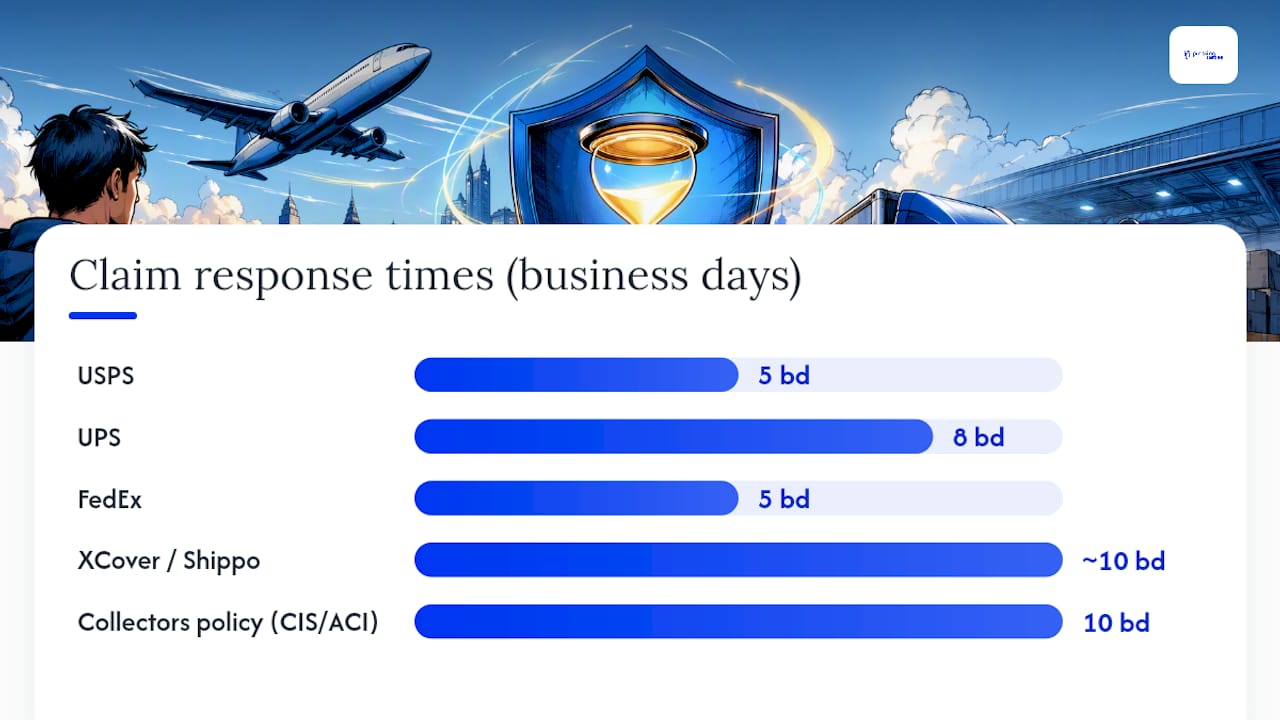
Typical claim windows and response times:
| Provider | Filing window | Typical response time |
|---|---|---|
| USPS | 60 days from mailing | 5 business days after submission |
| UPS | 60 days from shipment date | 8 business days |
| FedEx | 60 days from delivery | 5 business days |
| XCover/Shippo | Per policy terms | Varies; typically about two weeks |
| Collectors policy (CIS/ACI) | Per policy terms | 10 business days depending on complexity |
Pro Tip: Name your claim files with a consistent format: CARRIER_TRACKINGNUMBER_DATE. Store them in a dedicated folder by year. If you run multiple sales a month, this naming convention lets you pull any claim's evidence in under a minute, which matters when an insurer gives you a tight response window.
When does insurance actually make financial sense?
Not every comic needs extra coverage. Here's a practical framework.
Simple thresholds:
- Raw comics under $50: carrier-included liability ($100 default) is usually sufficient.
- Raw comics $50–$250: consider declared value with the carrier. The fee is small relative to the risk.
- Any graded slab or key issue above $250: always add declared value or third-party insurance. The cost of a cracked slab or lost package far exceeds the premium.
- Books above $1,000: a collectors policy or scheduled-item coverage is worth the annual cost, especially if you ship regularly.
Example cost calculations:
| Item value | XCover domestic (~1.25%) | Carrier declared value (USPS, approx.) |
|---|---|---|
| $100 | ~$1.25 | small fee above included $100 |
| $500 | ~$6.25 | small declared value fee |
| $1,000 | small declared value fee | small declared value fee |
| high-value threshold | higher declared value fee | higher declared value fee |
Carrier declared value can be competitive at higher shipment values, but third-party insurance often provides a clearer claims process without needing to prove carrier negligence.
Pro Tip: Shippo and similar label platforms let you set automatic insurance rules: any label above a declared-value threshold gets insurance added automatically. Set that threshold at $250 and you'll never accidentally ship a key issue bare.
Special handling for graded and slabbed comics
A CGC 9.8 copy of a key issue can be worth thousands of dollars. The slab itself is fragile in ways that raw comics are not: the inner well can shift, the label can scratch, and micro-cracks in the case can appear from lateral compression alone.
Exact packing checklist for slabs:
- Wrap the slab in two full layers of bubble wrap, paying extra attention to the corners and spine edge.
- Place the wrapped slab in a snug inner box. The slab should not move at all inside the inner box.
- Fill any remaining space in the inner box with foam inserts or crumpled kraft paper.
- Place the inner box inside a larger outer box with at least two inches of cushioning on every side.
- Seal and label the outer box: "FRAGILE," "DO NOT BEND," and "THIS SIDE UP" if the slab is oriented vertically.
Insurance notes for slabs:
- Declare the full current market value, not the original purchase price. Graded key issues appreciate, and an outdated declared value leaves money on the table in a claim.
- Many insurers require a grading certificate and pre-shipment photos to substantiate a high declared value for slabbed items. Have both ready before you seal the box.
- CGC's default return method uses FedEx with insurance up to $100,000 per package for domestic submissions. If you use your own shipping account to send to CGC, that shipment is not insured by CGC, and you are responsible for arranging your own coverage.
- For books above $5,000, consider a white-glove courier or a service that provides documented chain-of-custody handling.
For more on what encapsulation means for packing and insurance requirements, our comic book encapsulation guide covers the basics clearly.
When to require signature confirmation for slabs:
- All slabs valued above $250 going to buyers.
- Any slab being shipped to a grading service.
- Returns from graders above $500: use adult signature required.
Pro Tip: Before sealing the outer box, shoot a short time-stamped video panning across the slab, showing the certification number, grade, and all four edges. A 30-second video is far harder for an insurer to dispute than a still photo when micro-crack damage is the issue.
What U.S. sellers need to know about international shipments
International shipping adds layers of complexity that domestic shipments don't have, and insurance gaps are the biggest risk.
Common insurance limitations for international transit:
- Many third-party insurers, including XCover via Shippo, limit or exclude cross-border coverage for certain countries. The cross-border rate through XCover is approximately 1.50% of declared value, but coverage eligibility varies by destination country. Check the provider's country exclusion list before purchasing.
- Sanctioned countries are universally excluded. Some high-risk destinations are also excluded even without a formal sanction.
- Carrier liability for international USPS shipments (First-Class Package International, Priority Mail International) is limited and varies by destination country. Many countries have no indemnity coverage at all under USPS international services.
Customs declarations:
- Always declare the accurate value on customs forms. Under-declaring to reduce import duties is illegal and voids most insurance policies.
- If you're shipping a comic to a grading service abroad or returning a graded book to an international buyer, the customs description matters. "Sale of collectible" and "return for grading" carry different duty implications in many countries. When in doubt, consult a customs broker.
- Attach a commercial invoice for any shipment above the destination country's de minimis threshold.
International shipping checklist:
- Verify insurer country eligibility before purchasing coverage.
- Use a carrier with real-time international tracking (USPS Priority Mail International, FedEx International, or UPS Worldwide).
- Require signature confirmation on all international shipments above $100.
- Keep copies of all customs forms, invoices, and tracking records until the package is confirmed delivered and the return window has passed.
Warning: XCover and similar third-party insurers publish country exclusion lists that change periodically. Always check the current list at the time of purchase, not a cached version from a previous shipment.
What to do if your insurance claim is denied
A denial is not necessarily final. Most carriers and insurers have a formal appeals process, and a well-organized appeal packet reverses a meaningful share of initial denials.
Step-by-step appeal checklist:
- Request the denial reason in writing. You need the specific grounds stated clearly before you can address them.
- Gather your complete evidence packet: before/after photos, the original invoice or sale record, grading certificate, all packaging photos, and any tracking or delivery confirmation records.
- Write a concise appeal letter addressing the denial reason point by point. If the denial cites inadequate packaging, your photos of the sandwich pack and rigid mailer are your primary rebuttal.
- Submit the appeal through the carrier's or insurer's formal appeals channel. For USPS, this means the Consumer Advocate office after the standard claims process is exhausted. For UPS and FedEx, escalate to their claims resolution teams.
- If the denial involves a dispute over the item's value, consider engaging a third-party appraiser. A written appraisal from a recognized dealer carries more weight than a comparable sales printout.
What to include in your appeal packet:
- Pre-shipment photos (timestamped) showing condition and packaging.
- Post-damage photos showing the item and all packaging materials.
- Original invoice or proof of sale.
- Grading certificate if applicable.
- Chain-of-custody notes (drop-off receipt, tracking history, delivery scan).
- Any written statement from a packing professional if packaging quality is disputed.
When escalation makes sense: for claims above $500 that are denied on packaging grounds, a third-party packing assessment from a shipping store or professional packer can provide the written statement an insurer needs to reverse the decision. For claims above $1,000 that remain denied after appeal, small-claims court is a realistic option in most U.S. states, and the filing cost is low relative to the potential recovery.
Pro Tip: If a denial hinges on packaging quality and you packed the book correctly, ask a local UPS Store or FedEx Office location to provide a written statement confirming that your described method meets their professional packing standards. Insurers respond differently to a third-party professional statement than to a shipper's self-assessment.
When a professional shipping and submission service makes sense
Some shipments are worth more than the time and risk of doing it yourself. High-value keys, batch CGC submissions, and cross-border consignments are the clearest cases.
What Pressing Issues handles:
- Professional cleaning and pressing to maximize grade potential before submission.
- Comic book appraisal and value analysis to establish documented market value, which directly supports declared-value insurance and collectors policy claims.
- Packing and insured shipping management for CGC and CBCS submissions, including time-stamped photography and chain-of-custody documentation.
- Submission paperwork handling so you don't have to navigate CGC's tier system, turnaround options, or shipping requirements yourself.
When to use a professional service instead of DIY:
- Any book you believe could grade 9.0 or above, where pressing could meaningfully increase value.
- Batch submissions of five or more books, where the paperwork and packing complexity compounds quickly.
- Books valued above $500 where documented professional packing strengthens any future insurance claim.
- Cross-border consignments where customs documentation and insurer country eligibility require experience to navigate correctly.
Our CGC submission guide walks through the most common mistakes collectors make when preparing books for grading, including the shipping and insurance decisions that cost people money.
Pro Tip: Send us your books before you ship to CGC, not after. Pressing and cleaning before grading is where the value increase happens. Once a book is slabbed, those options are gone.
The part most collectors get backwards
Most of the shipping and insurance problems we see at Pressing Issues trace back to one mistake: collectors treat insurance as the safety net and packaging as the afterthought. The reality is the opposite. A correctly packed comic survives the handling that generates most claims in the first place. Insurance is for the rare catastrophic loss, not for routine transit damage that good packaging prevents.
The second most common mistake is under-declaring value. A collector ships a $1,200 CGC 9.8 key issue with $100 of declared value because they don't want to pay the extra fee. When the package arrives damaged, they're arguing with a carrier over $100 instead of $1,200. The fee to declare full value on a $1,200 book is a few dollars. That math is not complicated.
One rule we give every collector who asks: if the book is worth more than a tank of gas, insure it for what it's actually worth and photograph it before it leaves your hands. Everything else in this guide is detail on top of that principle.
Pressing Issues handles the packing, insurance, and submission paperwork for you
Collectors who want their books pressed, cleaned, appraised, and shipped to CGC without managing every step themselves have a direct option. Pressing Issues, based in Seattle and Portland, handles the full workflow: professional cleaning and pressing, documented appraisal, insured packing, and CGC submission management.

The practical difference between DIY and professional handling shows up most clearly on high-value books. When Pressing Issues packs and ships a submission, the package includes time-stamped photography, professional packing documentation, and insured return handling, all of which strengthen any claim if something goes wrong in transit. For collectors sending a batch of keys or a single high-grade book they've been holding for years, that documentation layer is worth more than the packing fee.
To get started, visit our comic book pressing and cleaning services page or review our full services, rates, and turnaround times. You can reach us directly through the site to discuss your books and get an estimate before committing.
Sources
These are the primary policy pages and support articles worth bookmarking before you ship.
- Collectible Insurance for Comic Books | American Collectors Insurance
- How to Ship Comic Books Safely | ShippingLabel
- How to insure shipments containing rare items and collectibles | Pirate Ship Help
- Shipping Insurance Options in Shippo | Shippo support
- Shipping Collectibles to CGC | CGC help center
This article is general information, not a substitute for advice from a qualified financial advisor. Consult a qualified financial professional about your own circumstances before acting on anything here.