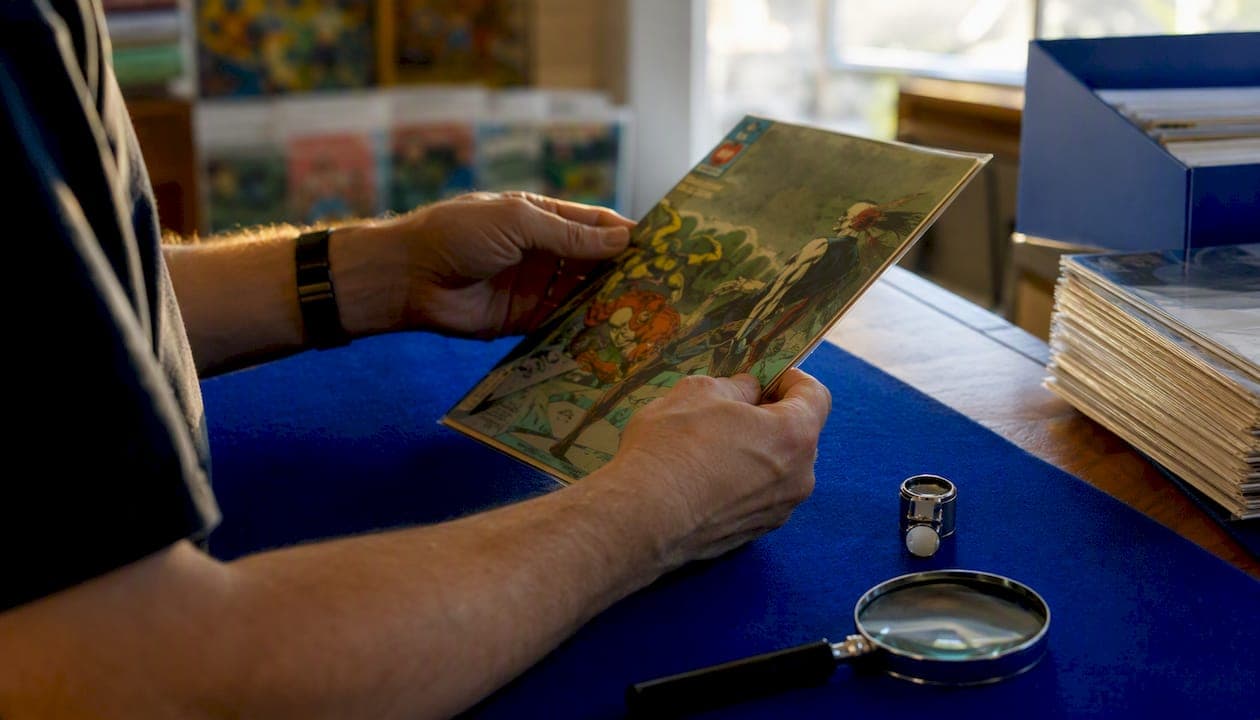
A Silver Age pressing candidate is a comic published roughly between 1956 and 1970 whose grade is held back primarily by non-color-breaking, surface-level defects that professional pressing can safely reduce. If your book has a spine roll, light handling creases, or minor corner bends with no color break, it is very likely a candidate. If it has tape, missing pieces, or brittle tanned pages, pressing will not help and may cause harm.
The short verdict: pressing makes economic sense when the defects are surface-level, the book has meaningful market value, and the expected grade bump translates to a price difference that covers pressing and grading costs. CGC classifies pressing as a non-restorative service and screens every submission to separate pressable from non-pressable defects before any work begins. Pressing Issues applies the same logic at the prescreen stage, evaluating each Silver Age book against that same defect taxonomy before recommending a course of action.
Key Takeaways
A Silver Age pressing candidate is a book whose grade is limited by surface defects, not structural damage, and where the post-press grade increase justifies the combined cost of pressing and grading.
| Point | Details |
|---|---|
| Definition of a candidate | Non-color-breaking, surface defects on a 1956–1970 comic that professional pressing can safely reduce. |
| Pressable vs non-pressable | Spine rolls, light creases, and minor bends are pressable; tape, color breaks, tears, and brittleness are not. |
| Grade sweet spot | The 8.5–9.4 range most often yields meaningful market value increases from cosmetic improvements. |
| Economics check | Compare post-press grade price differential against pressing plus grading costs before submitting any book. |
| Pressing Issues prescreen | Pressing Issues evaluates every Silver Age submission with a photo checklist and written recommendation before any work begins. |
Table of Contents
- What pressing can and cannot fix on Silver Age comics
- How to inspect a Silver Age comic for pressing candidacy
- When pressing actually moves the grade and the value
- How to prepare and ship a Silver Age comic for professional pressing
- What professional pressers actually do, and the risks for Silver Age books
- How Pressing Issues evaluates Silver Age candidates
- When to press and when to hold
- Pressing Issues handles Silver Age comics from prescreen to CGC submission
- Sources
What pressing can and cannot fix on Silver Age comics
Professional pressing uses controlled heat, humidity, and pressure to relax paper fibers and flatten defects that have not broken the ink layer. ComicMintAI's pressing guide explains this mechanism clearly and recommends professional pressing over DIY for any book with real value, because the temperature and moisture tolerances are narrow enough that an inexperienced hand can cause permanent damage.
Silver Age paper is thinner and more acidic than Modern Age stock. That matters because the same technique that works on a glossy 1990s cover can crack or mottle a 1965 newsprint page. Ultimate Key Issue Comics warns that pressing is not easy and that operator experience with era-specific paper types is what separates a clean result from a ruined book.
| Defect | Pressable? | Notes |
|---|---|---|
| Non-color-breaking spine roll | Yes | Most common Silver Age issue; responds well |
| Light handling creases (no color break) | Yes | Shallow creases flatten reliably |
| Minor corner bends | Yes | Depends on severity; usually safe |
| Spine ticks (light) | Partially | May reduce but rarely eliminate completely |
| Color-breaking creases | No | Ink is already fractured; pressing cannot repair |
| Tape or adhesive residue | No | Restoration territory; flags as restored by CGC |
| Tears or missing pieces | No | Structural damage; pressing cannot add paper |
| Water stains or foxing | No | Pressing may spread or set stains further |
| Brittleness or heavy tanning | No | Fragile paper can crack under any pressure |
| Writing or stamps | No | Surface marks are not affected by heat/pressure |
Caution: Color-breaking damage is the hard line. Once the ink layer has cracked, pressing cannot restore it and may make the fracture more visible by flattening the surrounding paper. If you are unsure whether a crease breaks color, hold the book at a 45-degree angle under a bright light and look for a white or silver line along the fold.
Pro Tip: Silver Age books printed on newsprint-style stock tend to tan and become brittle with age. Before submitting, gently flex a corner page. If it resists naturally and springs back, the paper is still pliable enough for pressing. If it feels stiff or crackles, disclose that to your presser immediately.
How to inspect a Silver Age comic for pressing candidacy
A thorough inspection at home saves you money and protects your book. Think of it the way experienced record collectors approach identifying an original pressing: no single clue is definitive, and cross-checking multiple physical signals is what builds a reliable verdict. Here is the workflow we recommend.
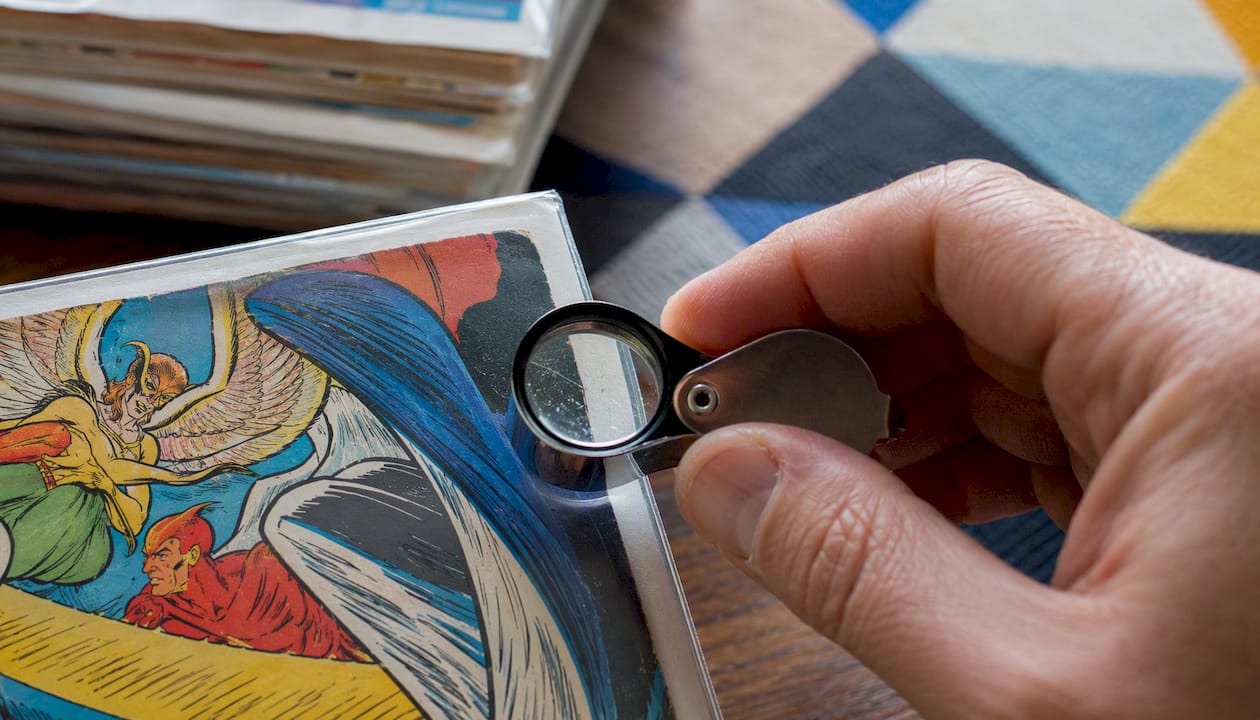
1. Surface scan. Lay the book flat under bright, indirect light. Look across the cover at a low angle to catch any waves, indentations, or raised areas. Note every defect location using clock positions (e.g., "crease at 7 o'clock on front cover").
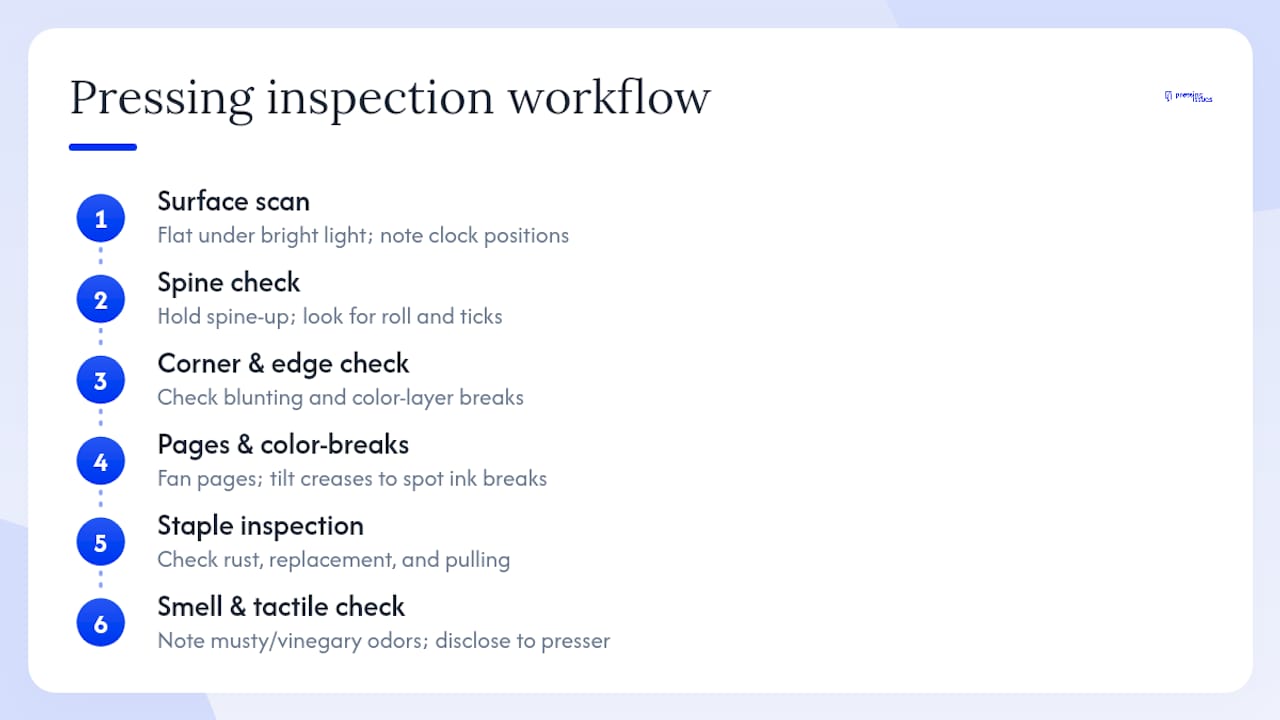
2. Spine check. Hold the book spine-up and look down its length. A rolled spine will be immediately visible. Check for spine ticks (small stress marks along the spine edge) by running a light source parallel to the spine.
3. Corner and edge check. Examine all four corners for blunting, bending, or fraying. Note whether any bends break the color layer.
4. Page thumb. Slowly fan through the pages. You are checking for brittleness, loose or detached pages, interior writing, stamps, and any water tide lines.
5. Staple inspection. Check both staples for rust, replacement, or pulling. Rusty staples can stain surrounding paper; replaced staples flag as restoration.
6. Color-break test. At each crease, tilt the book under light. A white or silver line means the ink has broken. Mark these separately from pressable creases.
7. Smell and tactile check. Musty or vinegary odors can indicate active paper degradation. Disclose this to your presser.
Photo guidance for prescreen submissions: shoot the front cover, back cover, spine head, spine tail, all four corners close-up, both staples, and one interior page sample. Use natural daylight or a daylight-balanced lamp. Shoot at an angle to catch surface texture, not just straight-on. A resolution of at least 1200 pixels on the short side gives a presser enough detail to assess defects remotely.
What to transcribe: list every defect by type and location, note staple condition, flag any writing or stamps, and include your smell and flex-test observations. The more specific your notes, the faster and more accurate the prescreen response.
Pro Tip: A jeweler's loupe at 10x magnification is one of the most useful tools you can own for this inspection. It reveals color breaks and surface abrasions that are invisible to the naked eye, and it costs less than a single CGC submission fee.
When pressing actually moves the grade and the value
Not every press is worth the cost. The economics depend on three variables: the book's current grade, the likely post-press grade, and the price difference between those two grades in the current market.
The Comic Locker's pressing guide identifies the 8.5–9.4 grade band as a common sweet spot where cosmetic fixes most often translate into meaningful market value increases. Books with very high grades have little room to improve, while low-grade books usually have structural or color-breaking defects that pressing cannot address, so pressing typically does not increase their grade.
For Silver Age keys, the math can be compelling. Consider a Fantastic Four #48 (first Silver Surfer) grading at a raw 7.5 with a spine roll and two light creases. If pressing improves the grade moderately, the price differential between those grades can amount to a significant value increase on a key issue. Subtract pressing fees and CGC submission costs, and the net gain is often positive. For a non-key Silver Age book grading at 6.0 with a current market value of $30, the same math rarely works: pressing plus grading will cost more than any realistic grade bump returns.
Pro Tip: Before committing to a press, look up the CGC census data for your specific issue and grade. If the census shows hundreds of copies at 9.0 and above, the market may already be saturated at the top end, which compresses the price premium for a grade bump.
The decision framework is straightforward: couple a technical inspection with a simple ROI calculation, estimate the post-press grade, check the price differential on recent sales, and subtract all costs. Skip pressing when the book has color-breaking defects, brittle pages, or a market value too low to absorb the fees. Press when the defects are surface-level, the book is a key issue or high-demand title, and the grade differential carries a real price gap.
For a deeper look at the factors that drive Silver Age resale prices, the comic book resale value guide on the Pressing Issues blog is a useful companion resource.
How to prepare and ship a Silver Age comic for professional pressing
Getting the book to the presser safely is half the job. Silver Age comics are decades old, and transit damage on a fragile book can be worse than the defects you were trying to fix.
Do's:
- Bag the comic in a fresh, acid-free Mylar or polyethylene bag with a properly sized backing board.
- Use a rigid, oversized cardboard flat (at least two inches larger on each side than the comic) to prevent flex during shipping.
- Sandwich the bagged comic between two pieces of corrugated cardboard and tape the edges so the book cannot shift inside the package.
- Ship with full insurance declared at the book's current market value, not replacement cost.
- Disclose everything: restoration history, previous water damage, brittleness, and any known repairs.
Don'ts:
- Never attempt DIY pressing with a household iron, book press, or any uncontrolled heat source. ComicMintAI specifically warns against DIY pressing for valuable books because temperature control is critical.
- Do not use rubber bands, binder clips, or anything that applies localized pressure to the cover.
- Do not ship without tracking and insurance, even for lower-value books.
Packing order:
- Bag and board the comic.
- Place inside a rigid toploader or between two pieces of chipboard taped at the edges.
- Center inside a corrugated cardboard flat with at least one inch of padding on all sides.
- Seal the outer box and label it "Do Not Bend" on all sides.
Pro Tip: For high-value Silver Age keys, photograph the book and the packed box before sealing. If a damage claim arises with the carrier, documentation of the pre-ship condition and packing method is what gets the claim approved.
PSA's help center guidance on comic pressing reinforces the importance of full disclosure at submission. Grading services and professional pressers rely on accurate condition notes to make safe decisions about whether to proceed.
What professional pressers actually do, and the risks for Silver Age books
The professional pressing workflow follows a consistent sequence. First, a prescreen: the presser reviews your photos and notes, identifies pressable versus non-pressable defects, and either approves the book or declines it. Books with color-breaking damage, tape, or active brittleness are typically declined at this stage. ComicXpress notes that pressers sometimes reject books specifically to avoid causing damage, and that different eras require different techniques.
After approval, the book is conditioned, meaning it is exposed to controlled humidity to make the paper pliable. Then it is pressed under calibrated heat and weight for a set period. After pressing, the presser inspects the result and either returns the book or routes it directly to a grading submission.
Risks specific to Silver Age comics:
- Moisture spotting if humidity is applied too aggressively to already-tanned paper.
- New edge tears if brittle pages are handled without adequate support.
- Slip marks or surface abrasion from improper pressing surfaces.
- Overstretching of thin newsprint stock, which can cause waviness in a different direction.
Turnaround times and costs vary by presser and service tier. Most professional pressers quote a few weeks for standard service, with expedited options available. Fees typically run per book, with higher rates for high-value or complex submissions. Always confirm current pricing directly with your presser before submitting.
When a book is declined, the alternatives are limited but worth knowing: conservation-grade storage in Mylar with acid-free boards can stabilize a fragile book without risk, and some collectors choose to sell raw rather than press and grade when the defects are non-pressable.
Pro Tip: Ask your presser whether they document their pressing parameters (temperature, humidity, duration) per book. Pressers who keep records are more likely to catch problems early and can provide accountability if something goes wrong.
How Pressing Issues evaluates Silver Age candidates
We use a structured prescreen process before any Silver Age book is touched. Every submission starts with a photograph checklist (cover, spine head and tail, all four corners, staples, and an interior page sample), a grading baseline estimate, and a defect taxonomy that maps each observed issue to either the pressable or non-pressable column. Books with any active brittleness, color-breaking damage, or undisclosed restoration history are flagged immediately and discussed with the collector before proceeding.
Our evaluation maps directly to the CGC pressing screening criteria, so the prescreen result you get from us aligns with what CGC will see when the book arrives for grading. That alignment matters because a book that passes our prescreen is a book we are confident will not be flagged as restored or declined at the grading stage.
Our prescreen steps:
- Receive photos and condition notes from the collector.
- Assess defect type, location, and severity against the pressable/non-pressable taxonomy.
- Estimate baseline grade and projected post-press grade.
- Calculate expected value increase versus pressing and grading costs.
- Return a written recommendation: press and grade, press only, or decline with explanation.
For collectors who want to see the evidence before committing, the Pressing Issues blog on professional results versus DIY attempts documents real outcomes and explains why professional handling consistently outperforms home methods on vintage material. We also cover era-specific handling differences in depth for collectors who want to understand why Silver Age books require a different approach than Modern Age stock.
Pro Tip: When you submit a prescreen, include the book's sale history or any previous grading notes if you have them. Prior CGC grades, in particular, tell us exactly what defects the graders flagged, which makes our assessment faster and more accurate.
When to press and when to hold
Pressing a Silver Age comic is not always the right move, even when the book technically qualifies as a candidate. The grade uplift is real, but timing and budget discipline matter just as much as the defect profile.
My honest view: collectors tend to over-press. The instinct to maximize grade on every book in the collection leads to spending pressing and grading fees on books where the market value differential simply does not support the cost. A better approach is to rank your candidates by the gap between current raw value and projected graded value, then work down the list from the highest-return books first. If you have limited budget for grading submissions, concentrate it on the keys and first appearances where the grade premium is steepest.
There is also a conservation argument for holding. A Silver Age book in stable storage, properly bagged and boarded, is not losing value by sitting. Pressing introduces a small but real risk of handling damage. For books where the grade bump is marginal or the market is soft, waiting for a stronger market cycle before pressing and grading is a legitimate strategy. The book does not expire.
The collectors who get the best results are the ones who treat pressing as a targeted investment decision, not a routine maintenance step. Run the numbers, be honest about the defect profile, and press only when the math is clearly in your favor.
Pressing Issues handles Silver Age comics from prescreen to CGC submission
If you have identified a Silver Age pressing candidate and want a professional evaluation, Pressing Issues offers comic book pressing and cleaning services that cover the full workflow: prescreen, cleaning, pressing, and CGC submission handling. We work with collectors and dealers across the United States from our locations in Seattle and Portland.
Submitting is straightforward. Send us your photos and condition notes through our services page, and we will return a written prescreen recommendation that includes a grade estimate, a defect assessment, and a cost-versus-value calculation. No guesswork, no surprises. Our services and rates page lists current pricing and turnaround times so you can plan your submission before you commit. If the numbers work, we handle everything from there, including shipping to CGC and returning your graded book. Reach out today to request your prescreen estimate.
Sources
- Pressing | CGC
- Comic Book Pressing: Does It Improve Your Grade? | ComicMintAI
- Comic Book Pressing: What It Is, Whether It's Worth It, and How It Affects Value | The Comic Locker Blog
- Pressing – Ultimate Key Issue Comics
- PSA Help Center