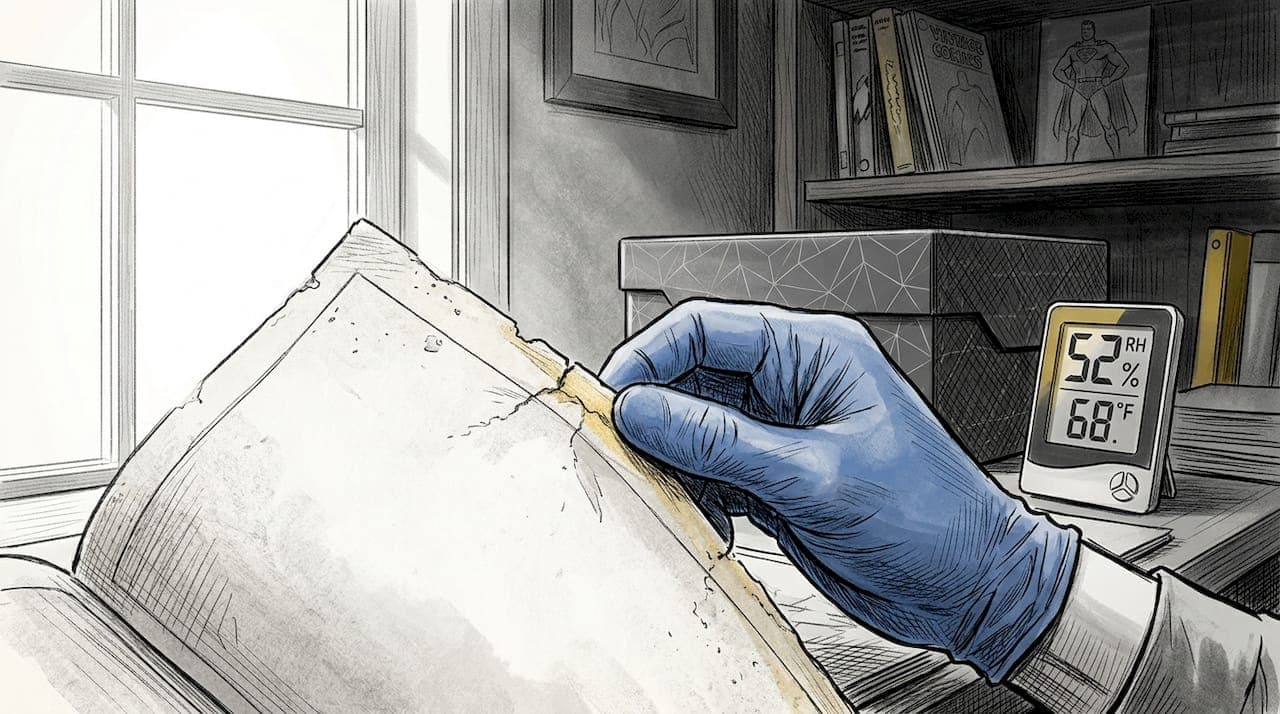
Comic paper brittleness is chemical weakening of paper fibers, a process conservators call chain scission, that leaves pages fragile and prone to chipping, splitting, and powdering. If you've flexed a page and heard a faint crackle before a corner crumbled off in your hand, that's what you're dealing with.
Here's what to do right now, before you read another word:
- Stop handling the book. Every flex accelerates fiber breakage.
- Move it to a stable environment, away from heat vents, sunlight, and damp basements.
- Isolate it from non-archival materials like regular cardboard, newspaper, or PVC-based sleeves.
- Photograph the cover and interior pages for your own condition records.
The honest verdict: chemical brittleness is essentially irreversible. We can stabilize a book and slow the damage, but no cleaning or pressing service can restore original paper strength once the fibers have broken down.
Key Takeaways
Comic paper brittleness is a largely irreversible chemical breakdown of paper fibers, and the only real leverage collectors have is slowing it down through storage, handling, and professional stabilization.
| Point | Details |
|---|---|
| Brittleness is chemical, not cosmetic | Acid hydrolysis and oxidation break cellulose chains, and no cleaning restores original fiber strength. |
| Era determines baseline risk | Golden and Silver Age newsprint carries far higher lignin and acid content than modern alkaline-buffered stock. |
| Environment controls the pace | Stable relative humidity near 30 to 50 percent and steady temperature slow chemical reactions and reduce fiber stress. |
| Grading treats it as structural | CGC caps page-quality grades for brittle designations regardless of cover appearance. |
| Professional help has limits and value | Pressing Issues offers non-restorative cleaning, pressing, and grading prep that stabilize and document condition without promising a full reversal. |
Table of Contents
- What Is Comic Paper Brittleness and Why Does Paper Age Differ by Era?
- What Causes Comic Paper to Become Brittle?
- How Do You Recognize Brittle Comic Pages Without Causing Damage?
- How Do You Store Comics to Slow Further Brittleness?
- Can Brittle Comic Pages Be Repaired or Only Stabilized?
- When Should You Send a Brittle Comic to a Professional?
- How Do You Avoid Buying Comics That Are Already Brittle?
- Do Any Home Remedies Actually Fix Brittle Comic Pages?
- What Does a Professional Comic Cleaning and Pressing Service Actually Do?
- Frequently Asked Questions
- Sources
What Is Comic Paper Brittleness and Why Does Paper Age Differ by Era?
Not every comic ages the same way, and knowing why saves you from a lot of guesswork at the back-issue bin. The paper stock a publisher used in 1948 behaves nothing like the paper stock used in 1988, and understanding that timeline tells you which books in your collection deserve the most careful watch.
Golden Age (1930s to early 1950s): These books were printed on raw wood-pulp newsprint, cheap, fast, and never meant to survive decades of handling. That newsprint carries high lignin content and starts out acidic, which sets a self-destruct timer running from the day it left the press.
Silver and Bronze Age (mid-1950s through the 1970s): Paper quality improved marginally, but most titles still used lignin-heavy pulp stock. Acidity levels varied by publisher and print run, which is why two comics from the same year can show wildly different brittleness.
Modern era (1980s onward): Publishers shifted toward chemically purified, often alkaline-buffered paper that resists the same acid-driven decay. This is a major reason modern books rarely show the tanning and chipping common in vintage newsprint stock.
A detail that trips up new collectors: paper weight and brittleness are not the same conversation. Heavier stock resists tearing and creasing during handling, but weight has nothing to do with the underlying chemistry. A thick, sturdy-feeling page can still be chemically acidic and headed toward brittleness, while a thinner page made with acid-free, lignin-free composition can outlast it by decades.
- Golden Age newsprint: highest risk, assume acidic unless proven otherwise.
- Silver/Bronze Age: moderate to high risk, varies by publisher.
- Modern alkaline-buffered stock: low risk from chemistry, though still vulnerable to poor storage.
What Causes Comic Paper to Become Brittle?
Brittleness comes down to two chemical processes working together: acid-catalyzed hydrolysis and oxidation. Hydrolysis breaks the cellulose chains that give paper its tensile strength, and oxidation, often triggered by light and heat interacting with lignin, speeds that breakdown further. Acidic newsprint accelerates this on its own, but the surrounding environment decides how fast it happens.
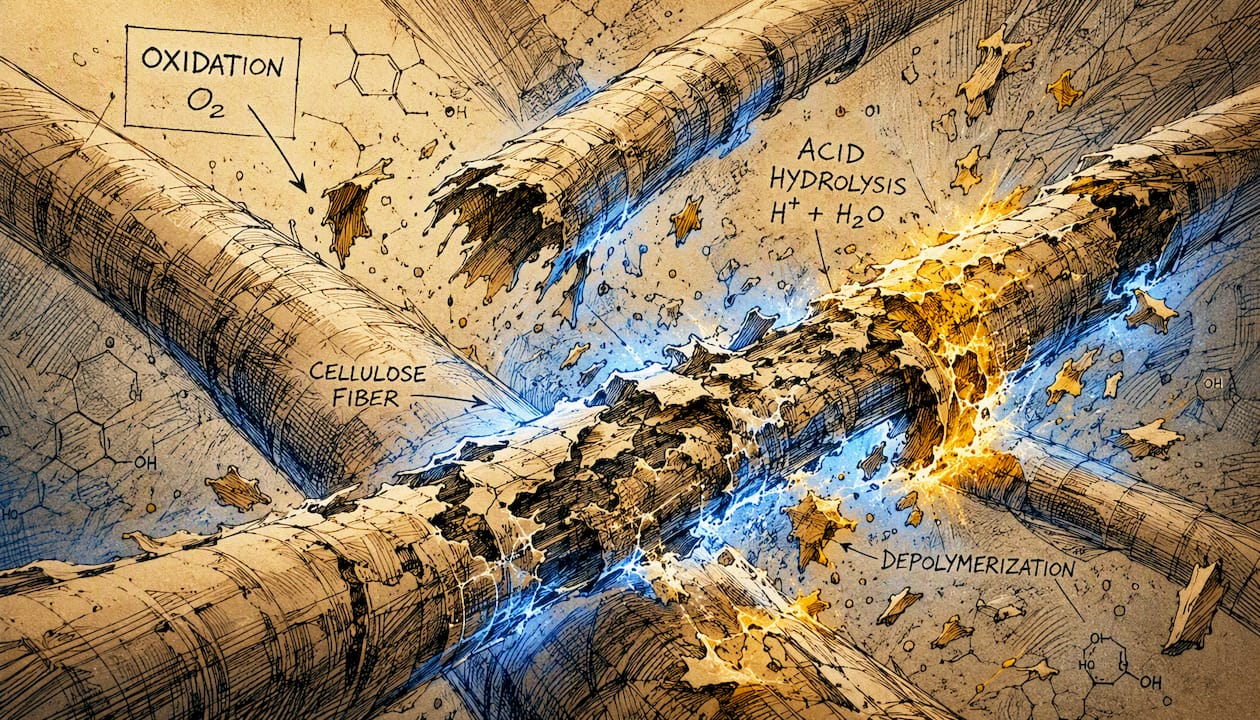
Conservators at the Canadian Conservation Institute note that acidic papers held at typical room temperature and moderate humidity can suffer significant structural damage can occur within a relatively limited time frame. That's not a hundred-year clock. For a Golden Age book stored in a hot attic, it can be much shorter.
Several environmental factors act as accelerants:
- High or fluctuating temperature speeds up every chemical reaction happening inside the paper.
- Relative humidity swings stress fibers repeatedly, even when average humidity looks fine on paper.
- UV light and even prolonged fluorescent exposure drive oxidation and visible tanning.
- Pollutants and residual metal contaminants from manufacturing can catalyze further breakdown.
Statistic Callout: Comic Preservation's analysis of comic-grade paper notes that acids in pulp and lignin reacting with oxygen and light are the core drivers of yellowing and strength loss in early newsprint, and that mechanical flexing turns that chemical weakness into visible chipping and spine splits.
That last point matters more than most collectors realize. Chemistry does the damage quietly, but mechanical stress, opening a book too wide, stress on staples, dimensional changes from humidity, is what actually breaks a weakened page into pieces. A brittle page sitting untouched in a sealed bag might look fine for years. The moment someone flips through it, the fibers that have already lost their tensile strength give way.
How Do You Recognize Brittle Comic Pages Without Causing Damage?
You don't need to flex a page hard to know it's in trouble. A few careful, low-risk checks tell you almost everything.
Look first at the classic visual signs: chipping along the edges, a fine powder residue in the gutter, brown or tan discoloration creeping in from the page edges, and any existing splits along the spine or corners. Stiff pages that feel more like a dry cracker than paper are a strong warning sign on their own.
For a non-destructive check, gently test a single outer corner, not the spine, with the lightest possible pressure. Hold the page under indirect, angled light to spot micro-cracks you'd otherwise miss. Photograph anything you find for your own records.
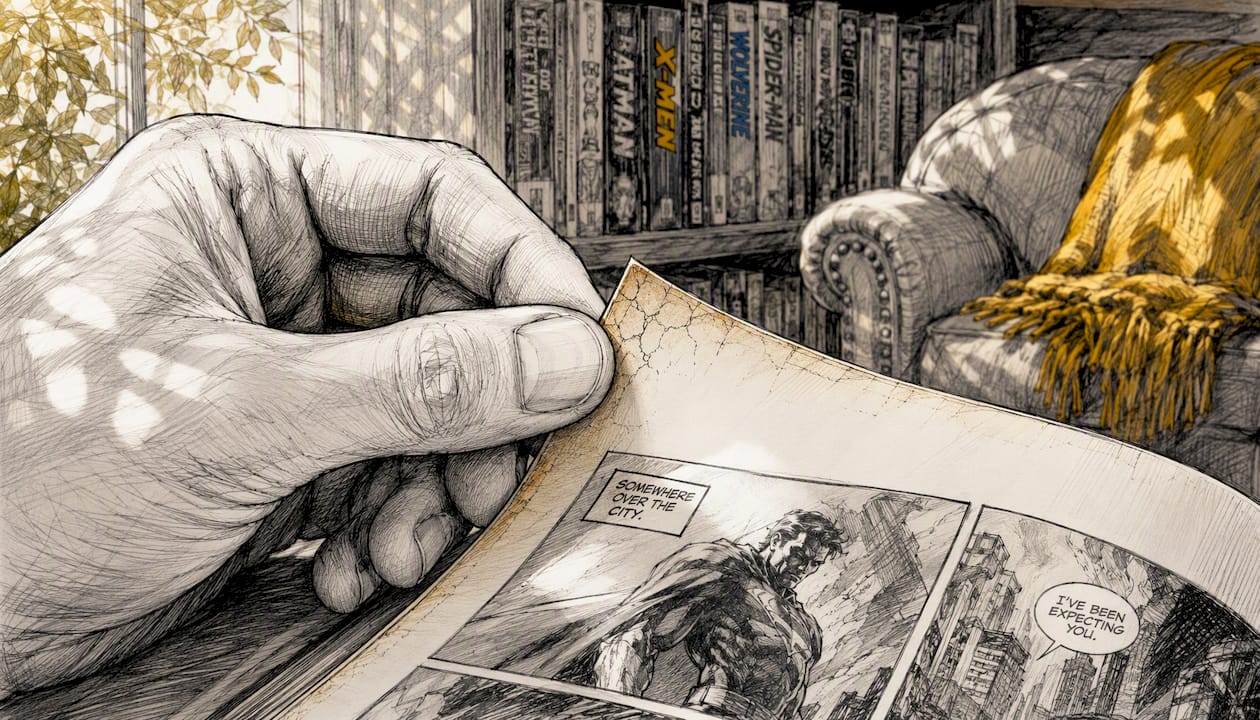
What not to do: never force a book fully open to inspect the gutter, and never stack weight on a suspected-brittle book to "flatten" it. Both actions turn a hidden weakness into a visible tear.
Check these zones first, in this order:
- The gutter and inner margins, where flexing stress concentrates.
- The staple line, where metal contact and repeated tension cause early failure.
- Outer corners and edges, the first place chipping shows.
Pro Tip: Support the whole cover with one flat hand underneath the book while turning pages with the other. Never let a brittle book hang unsupported, even for a second, while you're deciding what to do next.
How Do You Store Comics to Slow Further Brittleness?
You can't reverse chemical damage that's already happened, but you have real control over how fast it continues. Environment is the single biggest lever collectors have.
Relative humidity matters more than most people expect. NIST research on paper physical properties shows that bursting strength and folding endurance both shift with relative humidity, with strength properties measurably changing across small swings. Aim for stable relative humidity in the 30 to 50 percent range and moderate, consistent temperature. The goal isn't a perfect number. It's avoiding the swings that repeatedly stress fibers that are already chemically compromised.
Here's a practical sequence for setting up long-term storage:
- Move comics away from attics, basements, garages, and any space with wide seasonal temperature or humidity swings.
- House each book in an acid-free, lignin-free backing board sized to the comic.
- Slide the book and board into an archival-quality sleeve, Mylar or PET rather than PVC-based plastic, which off-gases and accelerates degradation.
- Store books upright in acid-free boxes, not stacked flat under weight.
- Check on brittle books periodically without repeated handling, using a quick visual pass rather than pulling the book out.
A few additional notes worth committing to memory:
- Handle with clean, dry hands rather than gloves for most paper handling. Gloves reduce tactile feedback and can make you grip harder than you realize.
- Avoid displaying brittle books flat-open or under any pressure. A slanted book stand distributes weight more evenly than a flat lean.
- Minimize handling frequency above almost everything else. Every flex of a brittle page is one you can't undo.
For a book you've just identified as brittle, treat the first hour like triage: stop handling it, bag and board it in archival materials, note the condition with photos, and set it aside from your regular reading stack until you decide on next steps.
Pro Tip: Sealed enclosures aren't automatically safer. Trapped moisture or off-gassing materials inside a sealed bag can concentrate degradation products right against the page. A ventilated archival sleeve inside a stable-climate box often protects a brittle book better than a fully airtight seal, according to conservation physics research on paper and humidity.
Can Brittle Comic Pages Be Repaired or Only Stabilized?
Professional treatment can do a lot for a comic's appearance and handling safety. It cannot rebuild broken cellulose chains. Every option below stabilizes or manages brittleness rather than reversing it.
Pressing relaxes creases and minor waves using controlled heat and pressure, and it's a genuinely effective, non-restorative technique for cosmetic defects. It does nothing for the underlying chemistry of a brittle page, and applying pressure to a truly brittle sheet carries real risk of cracking it further.
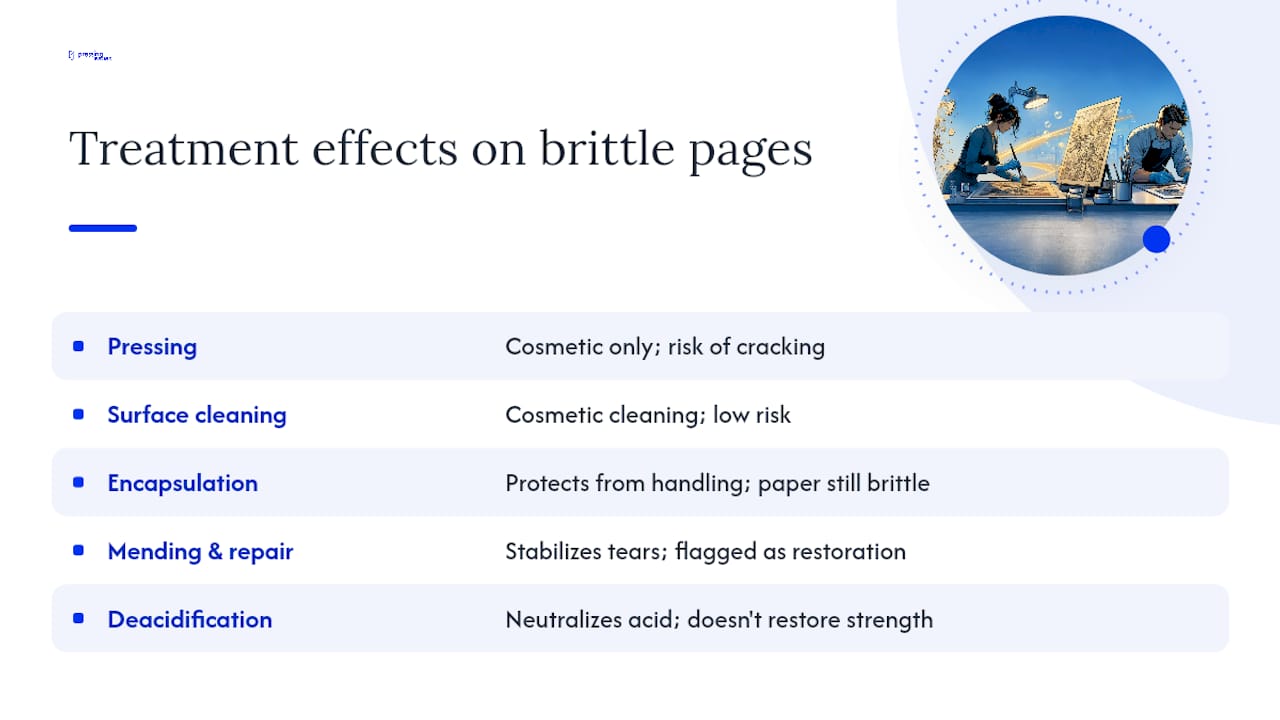
Surface cleaning removes surface grime and light soiling without touching the paper's internal structure. It's low-risk and often improves both appearance and grading potential.
Encapsulation, sealing a fragile book in inert Mylar, protects a brittle comic from further mechanical handling damage. It's a containment strategy, not a cure. The paper inside is exactly as brittle after encapsulation as before.
Mending and repair using archival tissue and reversible adhesives can stabilize a tear so it doesn't spread further. This crosses into restorative territory that CGC and other graders flag distinctly on a label.
Deacidification treatments can neutralize existing acid and slow future hydrolysis in some cases, but they can't undo strength already lost, and application on fragile Golden Age paper carries handling risk of its own.
The grading impact is where this gets concrete for collectors thinking about value. CGC's page-quality scale treats the "brittle" designation as a structural defect that caps the achievable grade, often at 3.5 or lower, regardless of how clean the cover looks. That ceiling exists because brittleness is a physical property of the paper itself, not a cosmetic issue a treatment can polish away. Non-restorative work like pressing and cleaning can raise a grade by addressing cosmetic defects. It won't move a brittle designation off the label, and treatments that cross into restoration get flagged as such, which affects resale value in its own way.
When Should You Send a Brittle Comic to a Professional?
A reasonable pro workflow looks like this: intake assessment of the book's condition, detailed photography of trouble spots, a cost estimate before any work begins, non-restorative cleaning or pressing where appropriate, and full documentation you can hand off with a grading submission.
Send a book to a professional rather than attempting anything yourself when you see extensive spine splitting, pages that have come loose from the staples, severe powdering along the edges, or when the book carries enough market value that a mistake would cost real money.
What a legitimate pro will tell you upfront: the risks involved, the non-restorative scope of the work, realistic turnaround time, and the fact that stabilization, not restoration, is the honest goal. Anyone promising to "fix" brittleness back to original strength isn't giving you an accurate picture.
Your decision checklist:
- DIY-safe: gentle archival rehousing, careful photography, environmental improvements.
- Call a professional: visible spine splits, detached pages, high-value books, or any book you're planning to submit for CGC grading.
How Do You Avoid Buying Comics That Are Already Brittle?
A little diligence before you buy saves a lot of disappointment after.
Before purchasing an older book, check high-resolution photos of the edges, gutter, and staple area specifically, not just the cover. Ask the seller directly about storage history, attic, basement, smoke-free home, and whether the book has been bagged and boarded.
Know the era risk for the title you're chasing. A Golden Age book demands more scrutiny than a book from the alkaline-buffered modern era, regardless of how sharp the cover looks.
On pricing, remember that a brittle designation caps the achievable grade no matter how the cover presents, so factor that ceiling into any negotiation. And if the conservation or stabilization cost on a "bargain" brittle book would exceed what the book is worth afterward, that bargain isn't one. Walk away.
Do Any Home Remedies Actually Fix Brittle Comic Pages?
A lot of well-meaning advice online will do more harm than good. A few myths deserve a direct correction.
"Moisture or steam can reverse brittleness." False, and dangerous. Introducing water to acidic, weakened paper risks staining, mold, and page fusion, not repair.
"Household tape fixes tears." Pressure-sensitive tape leaves acidic residue that accelerates yellowing and embrittlement in the surrounding paper.
"Freezing stops brittleness." Freezing can help with pest issues, not chemistry. It does nothing to reverse fiber breakdown.
Do not: run water baths on brittle pages, apply household tape, iron pages, use an oven to "dry" a book, or force open a stiff spine to inspect the gutter. Each one turns manageable damage into permanent loss.
A Presser's Perspective on Brittle Books
The pattern we see most often at Pressing Issues isn't dramatic damage. It's a collector who's owned a Golden Age book for years, handled it occasionally without thinking twice, and only notices the brittleness when a corner finally gives way during a routine flip-through. The damage was always there. It just became visible the moment mechanical stress met chemistry that had already been failing quietly for decades.
Pro Tip: If a page feels stiffer than the rest of the book, treat the whole issue as brittle until proven otherwise. Uneven brittleness within one book is common, and one confirmed brittle page changes how carefully you should handle every page around it.
What Does a Professional Comic Cleaning and Pressing Service Actually Do?
Pressing Issues works with collectors and dealers across Seattle and Portland who want an honest read on a book's condition before deciding what, if anything, to do about it. We're not in the business of promising a brittle book will come back to life. We're in the business of stabilizing what can be stabilized and telling you plainly what can't.
Our process covers non-restorative surface cleaning, careful pressing for cosmetic defects, and full preparation for CGC grading submissions, including the shipping and paperwork most collectors would rather not deal with themselves. Every assessment starts with a straightforward look at the book: what's fixable, what's cosmetic, and what's structural damage that pressing simply can't touch.
You'll get documentation of the book's condition before any work begins, and a conservative recommendation, including a candid "this one isn't worth treating" when that's the honest answer. If you have a book you suspect is brittle and you're not sure what to do next, request a cleaning and pressing assessment and we'll walk you through your realistic options.
Frequently Asked Questions
What is comic paper brittleness exactly? It's the chemical weakening of paper fibers through acid hydrolysis and oxidation, which makes pages fragile, prone to chipping, and likely to crack when flexed.
Can brittle comic paper be restored to its original condition? No. Chemical brittleness is essentially irreversible. Professionals can stabilize the book and slow further damage, but the original fiber strength can't be rebuilt.
Which comics are most likely to have brittle pages? Golden Age comics from the 1930s through the early 1950s carry the highest risk because of their high-lignin, acidic newsprint. Modern comics printed on alkaline-buffered stock are far less prone to it.
How does humidity affect comic paper brittleness? Both extremes and frequent swings in relative humidity stress paper fibers and accelerate the chemical reactions behind brittleness. A stable range around 30 to 50 percent RH is generally safest.
Should I press a brittle comic myself at home? No. Pressing a truly brittle page without professional experience risks cracking it further. Have a professional assess the book first to determine whether pressing is safe or advisable.
Sources
- Comic Book Paper - Comic Preservation
- CGC Grading Scales | CGC
- Physical Properties of Paper in Relation to Moisture Content and Humidity (NIST Circular 445)