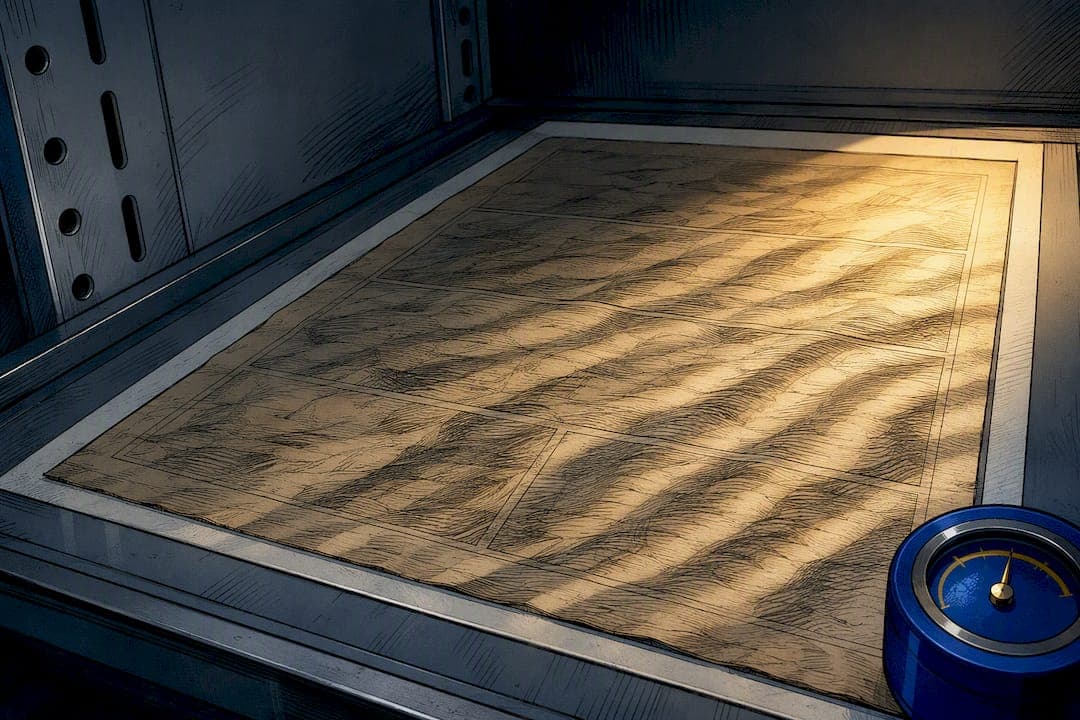
Mild humidity waves in comic books are often improvable with controlled, professional pressing. Severe cases, where the paper has oversaturated or mold has taken hold, can leave permanent fiber damage that no amount of pressing will fully correct. Your first move should never be a hair dryer or a stack of heavy books. Isolate the comic, get it into a stable, low-humidity room, check closely for mold or mildew, and if the book carries real value or shows signs of oversaturation, call a professional presser before you touch it further.
TL;DR:
- Humidity waves typically cause subtle page ripples and swelling near staples without stains, unlike water damage which results in stains and page fusing.
- Raising humidity above 55-60% significantly increases the risk of mold and permanent fiber distortion, especially in older porous paper stock.
- Mild waviness may respond to careful, low-weight flattening in a stable, low-humidity environment, but uneven fibers often prevent complete resolution.
- Professional pressing involves a controlled humidity cycle, gradual fiber relaxation, and stabilization, which prevents reversion and improves outcomes for severely warped books.
- Environment management, including maintaining 40-50% relative humidity and proper storage, costs less than remediation and is key to preventing humidity-related damage.
Table of Contents
- What Are Humidity Waves in Comics, and How Do They Differ from Water Damage?
- Why Does Paper Wave When It Absorbs Humidity?
- How Do You Assess Damage and Decide What to Do First?
- Can You Fix Humidity Waves at Home, and Where Does DIY Fail?
- What Does Professional Comic Pressing Actually Involve?
- How Should You Store Comics to Prevent Humidity Waves?
- When Should You Hire a Professional Presser, and What Should You Ask?
- A Practitioner's Take on Humidity Waves and What Actually Works
- Sources
What Are Humidity Waves in Comics, and How Do They Differ from Water Damage?
Humidity waviness looks like rippled pages or a subtly warped cover, without staining and without pages stuck together. The paper absorbed ambient moisture slowly, over weeks or months, and the fibers swelled just enough to distort the sheet. There's no visible tide line, no yellow-brown bloom, no glued signatures.
Water damage from a spill, flood, or leak is a different animal. It typically leaves behind stains, discoloration, and pages fused together at the edges or throughout. The distortion tends to be more severe and localized around the point of contact.
Graders and buyers treat these two conditions very differently, and that distinction matters for what you do next:
- Humidity waviness: A recognized defect that can lower a grade, but according to the grading community, it isn't always a dealbreaker for market value.
- Water/liquid damage: Generally treated as a more severe defect, since staining and stuck pages are harder to reverse and more visually obvious to a buyer.
- Edge ripples without discoloration: Usually humidity related.
- Swelling near the staples: Common early sign of moisture exposure, often the first place waves show up.
- Cover haze with no stain lines: Points toward ambient humidity rather than a liquid event.
If you're unsure which one you're looking at, our guide on types of comic book damage breaks down the visual differences in more detail. Getting this identification right before you decide on a remedy saves you from either overreacting to a fixable problem or underestimating a serious one.
Why Does Paper Wave When It Absorbs Humidity?
Paper is made of cellulose fibers that behave like tiny sponges. When relative humidity climbs, those fibers pull moisture from the air and swell. Not evenly, though. Edges and thinner sections absorb faster than the denser center, and that uneven swelling is what creates the rippled, wavy texture you see across a cover or page.
Once the fibers dry back out, they don't always return to their original shape. Paper has a kind of memory, and if it dried unevenly or under stress, it locks into that wavy form. This is the core reason pressing sometimes fails: a press can force the fibers flat temporarily, but if the paper isn't fully stabilized at the right humidity before, during, and after the process, the waves creep back within days. Practitioners call this reversion, and it's one of the most common frustrations collectors run into when they try quick fixes.
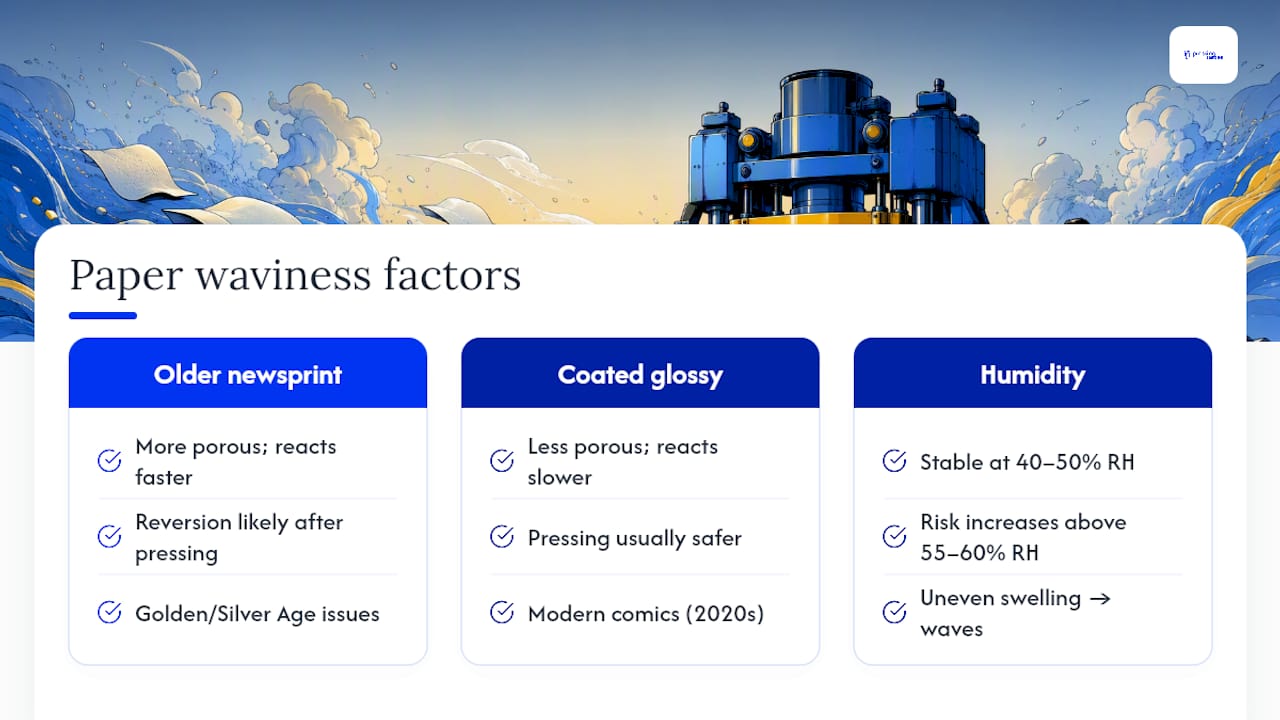
Paper type matters too. Older newsprint stock, common in Golden and Silver Age books, tends to be more porous and reacts faster to humidity swings than the coated, glossy stock used in most modern comics. That's part of why a pressing approach that works fine on a 2020s book can be too aggressive for a brittle 1960s issue.
At roughly 40 to 50% relative humidity, paper fibers generally stay flexible without swelling. Push much past 55 to 60%, and paper starts absorbing more moisture than it can shed, setting the stage for both waviness and mold.
How Do You Assess Damage and Decide What to Do First?
Before you press, ship, or even Google another solution, run through a quick triage. This tells you whether you're dealing with a simple case or something that needs professional hands.
- Look closely under good light. Check for rippling across the cover and interior pages, and note any swelling right around the staples.
- Smell the book. A musty or sour odor is a red flag for mold, even if you can't see it yet.
- Check if pages are stuck. Gently flex (don't force) the corner of a page. If it resists or you see fibers tearing, stop immediately.
- Test edge flexibility. Brittle edges that crack rather than bend mean the paper has lost moisture content over time and needs extra caution.
- Use a hygrometer if you have one. Knowing the current room humidity tells you whether the environment is actively making things worse.
- Photograph the book from multiple angles. This gives you a condition record before you attempt anything, which matters if you later consult a presser or file for grading.
Once you've assessed the book, isolate it from your other comics right away and move it to a room with stable, moderate humidity. If pages are loosely touching, you can gently separate them with a bone folder or your fingers, but never pull or peel.
Pro Tip: If you find any sign of mold or mildew smell, quarantine that book completely away from your collection in a sealed bag before doing anything else. Mold spores travel, and one contaminated book can put your entire long box at risk.
What you should never do: reach for a heat gun, hair dryer, steam, a microwave, an oven, or a clothes dryer. Heat and steam can set waves permanently or scorch fragile paper, and aggressive flattening on brittle pages tears fibers you can't put back together. For a fuller breakdown of early intervention steps, see how to fix comic waviness before it costs you a grade.
Can You Fix Humidity Waves at Home, and Where Does DIY Fail?
Mild cases sometimes respond to careful, low-risk methods you can try yourself, but the margin for error is thin.
Gentle weighted flattening is the safest DIY option. Place the comic between two pieces of acid-free board, then stack a modest, even weight on top, a few large hardcover books work, and leave it in a stable, moderately dry room for several days. This won't fix real fiber distortion, but for very light waviness it can help.
- Use acid-free interleaving boards, never plain cardboard, which can transfer acid and cause new staining.
- Keep the room's relative humidity low and stable throughout the process, not just at the start.
- Check the book every day or two rather than leaving it untouched for a week.
- Never apply direct heat sources, including sunlight through a window, during flattening.
Pro Tip: If a wave hasn't budged after four or five days of gentle weighted pressure in a dry room, it's not going to respond to more time or more weight. That's your signal to stop and consider professional pressing instead.
Controlled humidification, where a small amount of moisture is reintroduced to relax fibers before flattening, is a legitimate technique in professional hands, but it's genuinely dangerous to attempt at home. Steam sources are hard to control precisely, and oversaturation can cause flaring, warped covers, and cockling rather than fixing anything. This is exactly why pressing services use enclosed humidity tanks with monitored levels instead of a kettle and a prayer.
DIY reaches its limit fast when you're dealing with oversaturated paper, visible mold, brittle vintage stock, or covers with specialty inks and textured finishes. Certain gemstone or foil covers can develop permanent surface hazing when exposed to humidity, so what helps a standard cover can ruin a specialty one.
What Does Professional Comic Pressing Actually Involve?
A professional pressing workflow starts with assessment, not equipment. A presser examines the book for the type and severity of damage, checks for mold, and separates any contaminated books into quarantine before they touch a healthy collection.
From there, the general sequence looks like this:
- Humidity and cold press stage: The book goes into a controlled humidity environment, sometimes for hours, sometimes for a couple of days on difficult cases, to gradually relax swollen fibers without shocking them.
- Extended cold press for stubborn cases: Practitioners sometimes run a multi-day cold press before applying heat, which lets fibers relax gradually and lowers the odds of reversion.
- Hot press stage, when appropriate: If the paper and cover stock can tolerate it, a heat press sets the flattened fibers more permanently.
- Stabilization: The book rests in a controlled RH environment afterward so the fibers "set" in their new shape rather than snapping back to wavy.
The reason this works better than a DIY attempt isn't the equipment alone. It's that environment control before, during, and after pressing is the real determinant of whether the fix holds. Keep humidity too low or too erratic during stabilization, and waves creep back within a week.
Realistic outcomes vary by severity. Mild to moderate waviness often flattens out well. Oversaturated books with deep fiber distortion may improve significantly but never return to perfectly flat, since some fiber changes are irreversible. Turnaround and pricing depend on severity, book value, and whether cleaning is bundled in, which you can review on our comic book pressing services page.
How Should You Store Comics to Prevent Humidity Waves?
Prevention costs a fraction of what remediation does, and it's mostly about environment discipline rather than special equipment.
- Keep relative humidity between roughly 40 and 50%. This range keeps paper fibers flexible without letting them absorb enough moisture to swell.
- Monitor with a hygrometer, not a guess. Cheap digital hygrometers cost very little and give you a real-time read on your storage room.
- Run a dehumidifier or air conditioning in any room prone to humidity swings, especially during summer months.
- Bag and board every book using Mylar or Mylite bags with acid-free backboards, which slow moisture exchange even if room conditions dip briefly.
- Pack long boxes fully, using filler boards so books don't shift and warp from uneven pressure over time.
- Avoid attics, basements, and garages entirely. These spaces swing wildly with the seasons and are the most common source of humidity damage collectors report.
- Check your collection after storms or power outages, since a lost air conditioner during a humid stretch can do real damage in just a few days.
If a book does get exposed to actual standing water rather than ambient humidity, timing matters even more. Our guide on pressing water-damaged comics within 24 to 48 hours covers that faster-moving scenario.
When Should You Hire a Professional Presser, and What Should You Ask?
The decision usually comes down to four factors: the book's value affected by artwork condition, how severe the waviness is, whether you see mold or staining, and how brittle the paper feels. A $15 back-issue with light rippling might be worth a DIY attempt. A key issue worth hundreds or thousands of dollars deserves a professional's hands the first time, every time.
Before you hand over a book, ask the presser these questions:
- Do you use cold pressing, and under what circumstances would you use heat instead?
- What relative humidity and temperature range do you work within during the process?
- Have you handled books of this era and paper stock before, particularly Golden or Silver Age newsprint versus modern glossy stock?
- What's your quarantine procedure if you find mold on a book?
- Do you carry insurance in case of accidental loss or damage during handling?
Expect honest disclaimers rather than blanket guarantees. A reputable presser will tell you upfront if a book's waviness looks permanent rather than promising a flawless result. Pricing is commonly calculated per book, with adjustments for severity, book value, and whether cleaning or CGC submission handling is bundled in. Details on typical rates and turnaround times are worth reviewing before you commit.
A Practitioner's Take on Humidity Waves and What Actually Works
Most humidity cases that come across our bench fall into two buckets: mild waviness that responds well to controlled cold pressing, and neglected books where months of attic or basement storage left fibers permanently set into ripples. The difference between those outcomes almost never comes down to the press itself. It comes down to whether the environment around the book was controlled before anyone applied pressure.
Collectors tend to fixate on the press as a machine that fixes paper. In practice, it's the humidity and temperature management around that press, before, during, and after, that determines whether flattening holds or reverts within a week. Skipping stabilization is the single most common mistake we see, usually from a well-meaning DIY attempt gone sideways.
Charles has spent years handling exactly these cases for collectors across the Pacific Northwest, and the honest expectation matters more than the sales pitch: some fiber damage doesn't come back, no matter how good the process is.
— Charles
Sources
- Using Humidity Tanks with Comic Books — ComicBookCPR
- Grading 101: Humidity Damage Vs. Water Damage — Go Back To The Past