For high-value U.S. comic collections, specialized scheduled or standalone collectors insurance with agreed-value coverage is usually the correct first step. Get a condition-verified valuation, either a qualified appraisal or a CGC/CBCS grading certificate, on any book worth roughly $1,500 or more, and secure transit coverage before anything leaves your hands for a grader, auction house, or convention. Everything else in your insurance strategy builds from those two moves.
TL;DR:
- Most high-value comics need a specialized collector's insurance policy with agreed value, not just a homeowner's rider, especially for items valued over $1,500.
- Insurers require third-party grading, certificates, and recent auction comparables to determine true market value before approving coverage.
- Proper documentation, including photos, receipts, and regular reappraisals, significantly speeds up claims and reduces disputes during loss events.
- Transit coverage is essential since most claims occur during shipping, and tips include photographing packaging and using insured carrier services with tracking.
- Costs vary based on security, location, and collection size, but tailored quotes with current appraisals offer the most accurate premiums, and a strong paper trail improves claim success.
Table of Contents
- Insure High Value Comics: Choosing Between Riders, Schedules, and Standalone Policies
- How Do You Value and Document a High-Value Comic for Insurance?
- What Transit Coverage Do You Need When Shipping Comics?
- What Determines Your Comic Insurance Premium?
- How Do You File a Successful Comic Book Insurance Claim?
- Pressing Issues' Checklist for Appraisal-Ready, Insurance-Ready Comics
- What Does It Cost to Insure High-Value Comics?
- Step-by-Step: Buying Insurance for a High-Value Comic Collection
- Comparing Insurance Options for Serious Comic Collectors
- The Gap Between Insurance Advice and What Collectors Actually Do
- Get Your Comics Insurance-Ready With Pressing Issues
- Sources
- FAQ
Insure High Value Comics: Choosing Between Riders, Schedules, and Standalone Policies
Most collectors start with a homeowner's or renter's policy and assume it's enough. It rarely is. Standard policies cap "valuables" categories at a few thousand dollars total, often lump comics in with vague personal property language, and pay actual cash value rather than what the book is actually worth on today's market. If your Amazing Fantasy #15 burns in a house fire, actual cash value might net you a fraction of what a CGC 9.0 copy commands at auction.
Here's how the main options stack up:
- Homeowner/renter valuables rider: Adds a modest scheduled amount to your existing policy for a handful of named items, useful only for smaller collections under a few thousand dollars in total value.
- Scheduled (itemized, agreed-value) coverage: Lists individual comics by title, grade, and value, guaranteeing that exact payout on a covered total loss rather than a post-loss appraisal fight.
- Blanket policy: Covers your whole collection up to a stated limit without itemizing every book, faster to set up but less precise for genuinely rare keys.
- Standalone collectors policy: A dedicated all-risk policy built for comics, cards, and similar collectibles, typically bundling agreed value, transit coverage, and flexible deductibles into one product.
The decision point is usually your most valuable single item. If one book is worth more than your entire homeowner's valuables cap, a rider won't cut it. Collectors with a few key issues in the low thousands often do fine scheduling those items on an endorsement. Once your collection includes multiple CGC 9.4+ Silver or Bronze Age keys, or anything into five figures, a standalone collectors policy built for comic books, complete with agreed value and transit protection, tends to be the more defensible route.
How Do You Value and Document a High-Value Comic for Insurance?
Insurers don't take your word for what a comic is worth. They want proof, and the proof needs to hold up if you ever file a claim. That means building a documentation trail well before anything happens to the book, not after.
Start with grading. A CGC or CBCS certificate gives you dated, third-party proof of condition, and the slab serial number becomes the anchor point for everything else. Insurers pricing graded comics look at recent auction comparables at that exact certified grade, pulled from venues like Heritage, ComicConnect, or ComicLink, and they factor in population reports to judge how rare your specific copy really is within its grade tier.
For anything crossing roughly $1,500 to $2,000 in value, a formal appraisal from a qualified appraiser, ideally one working to USPAP standards, gives you a documented basis for the agreed value on your policy. The same appraisal principles that apply to fine art and sculpture apply here: a credentialed appraiser, a defensible methodology, and a report that would survive scrutiny from an adjuster.
Build your inventory around these fields:
- Title, issue number, and publisher.
- Grading company, certified grade, and slab serial number.
- Purchase price, date, and seller (with invoice or receipt).
- High-resolution photos of the front, back, and slab label.
- Current agreed value and the date it was last set.
Store copies both in the cloud and on a physical drive kept somewhere other than your home. Reappraise your key issues every 2 to 3 years, or sooner if a movie announcement, streaming deal, or major auction result suddenly reshapes demand for that character.
Pro Tip: Keep a running screenshot folder of recent auction comparables for your top five books. When it's time to revalue or file a claim, you'll already have the evidence instead of scrambling to find it.
What Transit Coverage Do You Need When Shipping Comics?
The moment a comic leaves your house, most homeowner policies start pulling back coverage. Off-premises limits are often lower than in-home limits, and some policies exclude transit losses for collectibles entirely. That's a real gap, because high-value books spend plenty of time in transit: heading to a grader, consigned to an auction house, or carried to a convention for a sale.

A transit endorsement or collector's transit policy closes that gap. These typically cover accidental damage in transit, disappearance during shipping, and loss at a third-party location like a grading facility, on top of the in-home coverage your main policy provides.
On the shipping side, your practical choices break down like this:
- USPS Registered Mail offers declared-value protection collectors commonly use for mid-value shipments, though the process is slower and has its own claim limits.
- Carrier-declared value insurance (through FedEx or UPS) covers higher amounts but requires airtight packing documentation to win a claim.
- Specialized transit insurance or CGC's own shipping insurance programs offer broader protection for collectors shipping frequently or shipping five-figure submissions.
Whichever method you choose, photograph the book and packaging before you seal the box, keep the tracking number and declared value receipt, and follow a packing standard built specifically for comics rather than generic shipping advice. If you're managing recurring grading submissions, a dedicated guide to insured comic shipping and CGC shipping insurance options will save you from learning these lessons the expensive way.
What Determines Your Comic Insurance Premium?
Insurers pricing a collectors policy look past the total dollar value and dig into how that value is structured and protected. Four factors do most of the work: home security (alarm systems, safes, fire suppression), how concentrated your value is in a small number of items versus spread across many, your claims history, and the general risk profile of your location, including flood, wildfire, and crime rates in your zip code.
Agreed value coverage can include an inflation guard feature that automatically adjusts your payout upward by up to about 6% in the event of a covered total loss, protecting you against the collection appreciating faster than you remember to update the schedule.
Agreed value itself is the mechanism that makes premiums predictable. Instead of an adjuster arguing over what your Incredible Hulk #181 was "really" worth at the moment of loss, the policy pays the number you and the insurer agreed on when you scheduled it. That number needs to stay current, which is why insurers favor recent appraisals and grade-specific auction data over stale purchase prices from a decade ago.
Deductibles work the usual way here: a higher deductible lowers your premium but raises your out-of-pocket exposure on smaller, partial losses. For a genuinely valuable collection, a modest deductible on a low overall premium is often the better trade, since the real risk you're insuring against is total loss, not a scratched corner. Underwriting factors like dispersion of value and loss history also shape whether an insurer offers standalone terms at all.
How Do You File a Successful Comic Book Insurance Claim?
A claim typically starts with a notice of loss, where you report what happened and when. The insurer then requests documentation: your inventory records, the original appraisal or agreed-value schedule, photos, and grading certificates. For larger claims, an adjuster may bring in an independent appraiser to verify condition and value before settlement.
Most denied or reduced claims trace back to gaps that were preventable:
- Missing purchase receipts or invoices, leaving no proof of what you actually paid.
- An agreed value that was never updated after the book's market price moved.
- A shipping loss that fell outside a transit exclusion the collector didn't know existed.
- No off-site backup of photos or records after a fire or flood destroyed the originals.
Keep a claims-ready folder that includes photos of every high-value book, invoices, CGC or CBCS certificates with serial numbers, a notarized inventory if your insurer requires one, and a backup copy stored somewhere other than your home.
Pro Tip: Email yourself a copy of your full inventory once a year. A dated email thread with attachments is a simple, free way to prove your records existed before a loss, not after.
Pressing Issues' Checklist for Appraisal-Ready, Insurance-Ready Comics
Getting a comic ready for grading or appraisal isn't just about improving its market value. Every step also builds the documentation trail your insurer will want if you ever file a claim. At Pressing Issues, we treat condition documentation as part of the job, not an afterthought.
Here's what that looks like in practice:
- Before and after photos of every book we clean or press, timestamped and stored for the customer.
- Detailed condition notes covering spine ticks, corner wear, and any defects addressed, matched against what the grader later confirms.
- Careful, non-restorative pressing and cleaning that reduces the odds of new handling damage before a book ever reaches a grading company.
- Structured packing and labeling for submissions heading to CGC or to auction houses, matched with the shipping paperwork needed for transit coverage.
- Value analysis that flags which books are strong candidates for a formal appraisal before you schedule them on a policy.
That combination, clean condition, solid photo evidence, and a documented submission trail, gives collectors a stronger foundation when it's time to set an agreed value or file a claim.
What Does It Cost to Insure High-Value Comics?
Premiums for collectors policies vary based on your total scheduled value, your security setup, and where you live, so there's no single number that applies across the board. What you can control are the factors that push your rate up or down.
A tightly documented collection with grade-verified valuations and strong home security tends to price better than a loosely valued one, because the insurer faces less uncertainty. Collections concentrated in a handful of extremely valuable books can sometimes see higher per-dollar rates than a more spread-out collection of the same total value, since a single event could wipe out a larger share of the schedule.
Location matters more than most collectors expect. A home in a flood zone or a high-crime area typically pays more for the same coverage than an identical collection in a lower-risk area. Deductible choice moves the number too: a higher deductible on a high-value, low-frequency-of-loss item like a comic collection is often a reasonable way to keep annual premiums manageable without sacrificing the protection that actually matters, full replacement of agreed value on a total loss.
The most reliable way to get an accurate number is to request quotes directly from a specialized collectibles insurer once your appraisal and inventory are in hand. Quotes based on real, documented values are far more useful than any generic estimate, and they typically come back faster once your CGC serial numbers and appraisal figures are ready to submit.
Step-by-Step: Buying Insurance for a High-Value Comic Collection
Getting covered follows a predictable sequence, and skipping steps is usually what leads to underinsurance or claim disputes later.
- Inventory everything. List every comic worth insuring individually, with issue, grade, and estimated value.
- Grade or appraise your top-tier books. Submit key issues to CGC or CBCS, and get a formal appraisal for anything without a clear market comparable.
- Decide on policy type. Match your total value and concentration against the rider, schedule, blanket, or standalone options covered earlier.
- Request quotes from specialized insurers. Provide your inventory, appraisal, and grading documentation up front to speed up underwriting.
- Review agreed-value terms and transit coverage. Confirm the policy protects items in transit to graders, auctions, and shows, not just items sitting at home.
- Bind the policy and store your documentation. Keep a digital and off-site copy of everything you submitted, since it becomes your claims evidence.
- Set a reappraisal calendar. Mark a 2 to 3 year review cycle, and revisit sooner after any major media announcement tied to your key characters.
Collectors who front-load the documentation work almost always get smoother underwriting and faster claims. Insurers can price and pay claims quickly when the evidence is already organized; they slow down when they have to chase it.
Comparing Insurance Options for Serious Comic Collectors
There's no single "best" provider for every collector, but the field breaks into a few clear categories worth understanding before you shop.
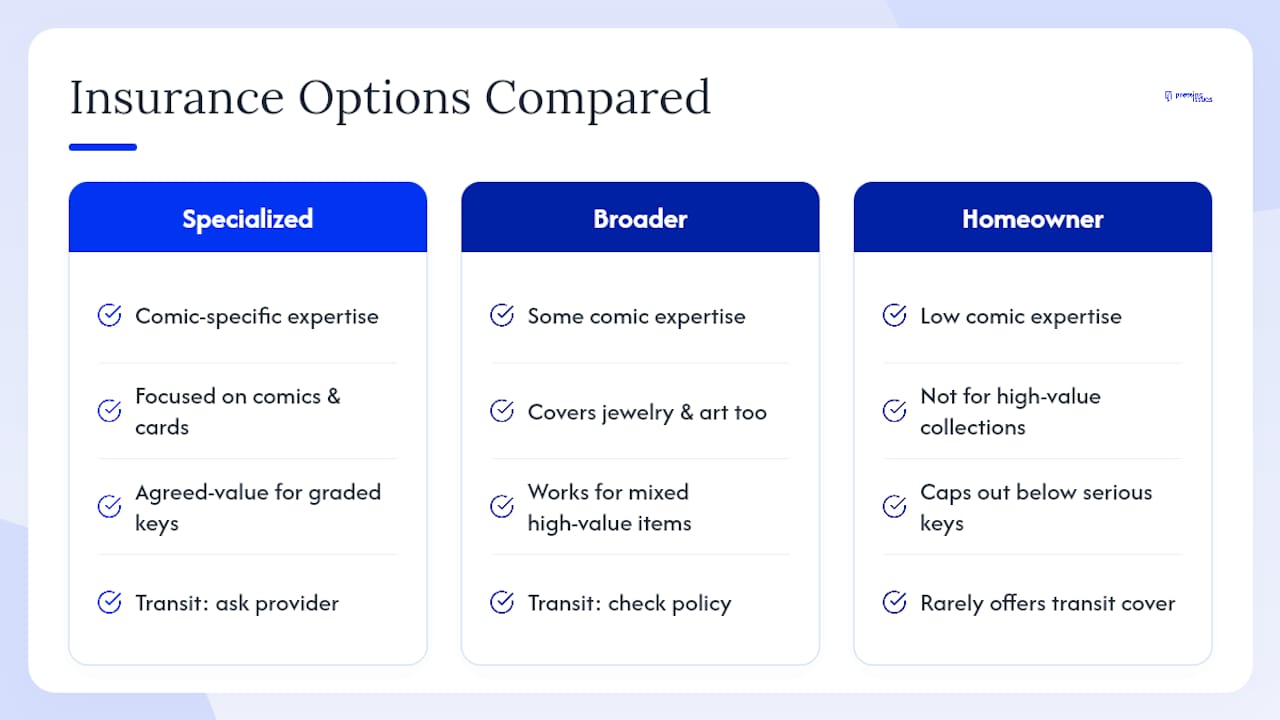
Specialized collectibles insurers focus specifically on comics, cards, and similar hobbies, and they tend to understand grading terminology, population reports, and auction comparables without needing extra education from the customer. These insurers are usually the fastest path to accurate agreed-value terms for graded keys.
Broader personal collections or fine art insurers sometimes extend into comics as part of a wider high-value personal property policy, which can make sense if you also insure jewelry, art, or other collectibles under one umbrella.
Standard homeowner insurers offering endorsements work fine for smaller collections but generally cap out well below what a serious key-issue collector needs, and they rarely offer the transit protection that matters for active buyers and sellers.
When comparing options, ask each provider three questions directly: Do you offer agreed value with inflation guard? Is transit coverage included or an add-on? And do you require grading certificates and serial numbers for scheduled items above a certain value? The answers will tell you more about fit than any marketing page will.
The Gap Between Insurance Advice and What Collectors Actually Do
Most comic insurance advice online treats appraisal and transit coverage as separate line items you check off once and forget. That's backwards. The real risk isn't the absence of a policy, it's a policy built on stale values and undocumented condition, which shows up the moment you file a claim and the insurer starts asking questions you can't answer.
The conventional wisdom also underweights transit risk. Collectors obsess over fire and theft at home, then ship a five-figure key issue in a flat-rate box with a declared value they guessed at. That's where a lot of real losses happen, not on the shelf.
If you take one thing from this guide, prioritize the paper trail before the policy. Grade your key books, get comparable-based appraisals, and photograph everything, then shop for agreed-value coverage with the documentation already in hand. Insurers move faster and pay fairer when you've done that work first. The policy matters, but it's only as strong as what backs it up.
— Charles
Get Your Comics Insurance-Ready With Pressing Issues
Before you can get an accurate agreed-value quote, your comics need to be in the best condition possible and properly documented, and that's where preparation makes the real difference. Pressing Issues handles the groundwork insurers and graders actually look for: professional cleaning and pressing that removes non-restorative defects like spine ticks and surface dirt without altering the book's authenticity, plus value analysis that flags which books are worth scheduling on a policy in the first place.
Services that manage shipping and paperwork for CGC grading submissions help ensure books arrive documented and protected instead of sitting in a box with no record of their condition before they left your hands. That combination, clean condition, photo evidence, and a handled submission process, gives you a stronger starting point when you sit down with an insurer to set agreed values.
Check our full service list and turnaround times and reach out to request a value analysis before your next grading submission or policy renewal.
Sources
A few sources back up the core claims in this guide, and they're worth a direct look before you shop for coverage. American Collectors Insurance explains agreed value and inflation guard mechanics in plain terms. Kelly Insurance Group details how grade-specific auction comparables and slab serial numbers factor into scheduled values. Distinguished covers underwriting factors like security and loss history that shape your premium. For appraisal standards generally, HD Asian Art's overview of USPAP is a useful reference point even outside the comics world.
This article is general information, not a substitute for advice from a qualified financial advisor. Consult a qualified financial professional about your own circumstances before acting on anything here.
- Comic Book Collection Insurance | American Collectors Insurance
- Comic Book Collection Insurance | Trading Card Coverage (Kelly Insurance Group)
- Comic Book Insurance: What Clients Need to Protect These Modern Classics
FAQ
What Is the Best Insurance for Collectibles Like Comics?
Specialized collectors policies with agreed-value coverage are generally the strongest fit for high-value comics, since they guarantee a pre-set payout and typically bundle in transit protection that homeowner policies lack.
How Much Does It Cost to Insure a USPS Package for $3,000?
USPS Registered Mail and insured shipping fees scale with declared value, and collectors shipping items in that range often pair USPS coverage with a dedicated transit endorsement for fuller protection, since USPS claim limits and processing can be restrictive for high-value collectibles.
How Do I Sell My Comic Books for the Highest Value?
Getting comics graded by CGC or CBCS before selling, backed by clean condition and documented provenance, tends to produce stronger offers, since buyers and auction houses price against certified grade and recent comparables rather than a seller's own estimate.
How Much Does It Cost to Get Comics Appraised?
Appraisal costs vary by appraiser and the number of books involved, and formal appraisals are generally recommended once an individual comic's value crosses roughly $1,500 to $2,000, since that's the range where insurers start expecting documented proof of value.
When Should I Get a Standalone Collectors Policy Instead of a Homeowner Rider?
Once your collection includes multiple high-grade key issues or any single book worth more than your homeowner policy's valuables cap, a standalone policy with agreed value and transit coverage is usually the more defensible choice.