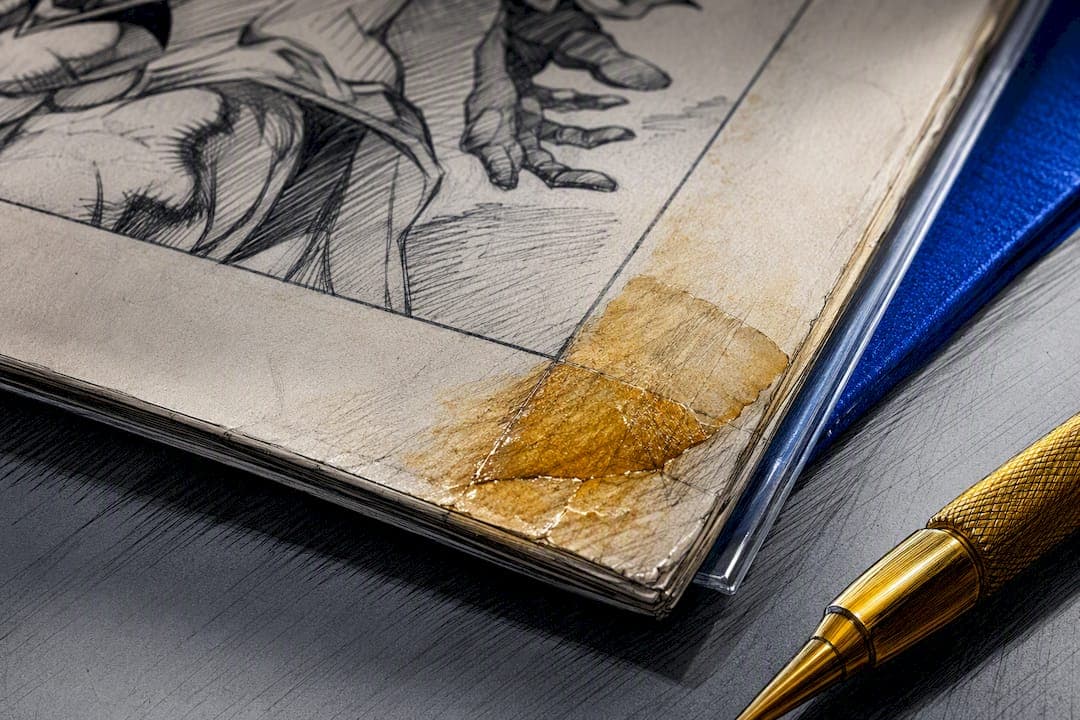
Some tape shadows can be lightened, but adhesive stains that have already penetrated the paper fibers are often permanent, and aggressive cleaning attempts to tend to make them worse, not better. Stop handling the taped area, skip household solvents on anything valuable, and assess the book's worth before you touch it. Low-value comics can tolerate cautious, reversible DIY tests; anything mid-grade or higher, brittle, or signed belongs with a professional.
TL;DR:
- Tackiness indicates residual tape, which can often be removed gently, whereas discoloration and spread suggest a permanent tape stain that may need professional treatment.
- Adhesive penetration occurs through plasticizer migration into the paper fibers, worsened by heat, humidity, time, and pressure, making removal more difficult over time.
- DIY solvent removal should be limited to low-value books and involves careful diagnosis, mechanical cleaning, and testing solvents in well-ventilated areas, but sometimes causes irreversible damage.
- Avoid attempting removal on brittle, ink-unstable, multi-stuck pages, or high-value books, as damage can escalate quickly beyond simple surface stains.
- Professional assessment before any chemical treatment ensures that only reversible or treatable issues are addressed, preventing costly mistakes on valuable collectibles.
Table of Contents
- Tape Stain Vs. Tape Residue: What You're Actually Looking At
- Why Tape Stains Form: Adhesive Chemistry Meets Old Paper
- DIY Tape Stain Removal: A Cautious, Step-By-Step Approach
- When DIY Makes It Worse: Red Flags To Stop On
- Preventing Tape Stains Before They Start
- What Professional Conservators Do Differently
- The Real Lesson Collectors Miss About Tape Damage
- Get A Professional Opinion Before You Risk The Page
- Sources
Tape Stain Vs. Tape Residue: What You're Actually Looking At
Collectors often lump these together, but they behave differently and grade differently. Tape residue is the leftover sticky substance or carrier film still sitting on the surface. Tape stain is what's left after that residue has chemically reacted with the paper itself, usually showing up as a brown or amber discoloration that spreads past the original tape outline.
Check three things before deciding what you're dealing with:
- Tackiness: if it's still sticky to the touch, that's residue, not a permanent stain.
- Translucence: hold the page to light. A greasy, see-through patch means adhesive has soaked into the fibers.
- Color migration: brown or yellow bleeding beyond the tape's edges signals a chemical stain, not surface film.
- Tape type: cellophane tape yellows and brittles fast, standard "Scotch" tape leaves a waxy amber shadow, and cloth or duct tape often pulls surface paper off entirely when removed.
CGC's grader notes distinguish these as separate defects — residue is treated as a substance issue that can complicate encapsulation, while an actual tape stain is graded as a stain, with severity and spread determining how many points it costs. A dime-sized tape stain on a splash page can knock a book down multiple grades, while a faint shadow tucked in the gutter margin barely registers.
Quick triage: if it's tacky and localized, you likely have residue you can address gently. If it's translucent, spreading, or discolored, treat it as a stain, and treat the book as a candidate for professional review before your value estimate assumes it's fixable.
Why Tape Stains Form: Adhesive Chemistry Meets Old Paper
Pressure-sensitive adhesives aren't a coating that sits on top of paper. They're formulated to flow, and that flow is the entire problem. Once applied, the adhesive's polymer base and its plasticizers migrate downward into the cellulose fibers, following capillary paths the same way ink soaks into newsprint.
Peeling off the visible tape backing doesn't stop that process. The film comes off; the plasticizers that already worked their way into the paper stay behind, which is why a "cleaned" spot so often leaves a shadow anyway. A few forces speed this up:
- Heat softens adhesive polymers, pushing them deeper into the fibers faster.
- Humidity swells cellulose, opening more pathways for migration.
- Time compounds both. A book taped for a week behaves differently than one taped for ten years.
- Pressure, like a stack of long boxes weighing down on a taped cover, drives penetration further.
Conservators are blunt about the underlying problem: there is no such thing as archival pressure-sensitive tape for paper repair, and the longer tape stays applied, the harder removal becomes. Museum-level guidance backs this up, noting that adhesives and plasticizers migrate steadily once contact is made, with heat and humidity acting as accelerants rather than triggers.
Pro Tip: If you find old tape still stuck to a comic, don't peel it off cold. Let the book sit at stable room temperature first. Peeling a brittle, sun-warmed adhesive often tears the surface paper away with it.
DIY Tape Stain Removal: A Cautious, Step-By-Step Approach
This applies only to lower-value books where an experiment gone wrong costs you little. If the comic has real resale value, skip ahead. Otherwise, here's the order collectors typically follow, safest step first.
- Diagnose before you touch anything. Use a loupe or magnifier to check whether the tape is still tacky (residue) or has already stained (translucent, discolored). A UV flashlight can reveal how far staining has spread beneath the surface, often further than it looks under normal light.
- Try mechanical removal first. A soft vinyl eraser or a surface cleaning sponge can lift loose residue without introducing any chemicals. Work in short, light strokes, never grinding.
- Consider a microspatula for stiff carrier film. Gently lift an edge and work slowly. Stop the moment you feel resistance from the paper itself rather than the tape.
- Only then consider a solvent, and only on a test patch. Collector forums document using low-boiling petroleum ether, hexane, or pentane to soften adhesive enough to lift it, along with isopropyl alcohol for lighter residue. These aren't archival products, and outcomes documented in collector discussions are mixed at best, with some attempts lifting ink or weakening the paper's sizing.
- If you proceed, work in a ventilated space with gloves and eye protection. These solvents are flammable and produce fumes you shouldn't breathe for long stretches. Test on a blank margin or the inside back cover first, never the affected area itself.
- Blot, never rub, and let the page air dry flat under light, even weight, away from direct heat.
- Watch for stop signals. Ink lifting, gloss disappearing, or the paper turning translucent means stop immediately. That damage doesn't reverse.
Photograph the book from multiple angles before you start. If something goes wrong, you'll want a clear record of the original condition, and it forces you to slow down and actually commit to the plan rather than improvising mid-process.
Pro Tip: If your test patch shows any color change at all within the first 30 seconds, that's your answer. Walk away and call a professional instead of pushing further.
Collector-sourced solvent recipes circulate constantly, but the inconsistency in reported results is exactly why professional assessment makes sense for anything with real value. What works on one book's paper stock can ruin the next.
When DIY Makes It Worse: Red Flags To Stop On
Some books simply aren't candidates for kitchen-table chemistry. Walk away and call a professional if you see any of these:
- Brittle or tanned pages. Old, dry paper cracks and tears under the gentlest solvent work.
- Ink that's already unstable. If colors smear when lightly touched with a damp cotton swab, solvents will make it worse.
- Multiple pages stuck together. Forcing them apart tears paper that solvent alone won't fully separate.
- Signatures, sketches, or high market value. A five-figure book isn't the place to practice.
- Mold or rust stains layered with tape damage. These combined issues need lab-controlled handling, not a home fix.
Signs a DIY attempt has already gone wrong include ink that's started "swimming" across the page, a sudden loss of surface gloss, or spots that have gone translucent and greasy. Professional cleaning and pressing typically runs from a range of prices per book depending on condition and treatment complexity, with turnaround measured in days to a couple of weeks, far cheaper than the value lost from a botched solvent job on a book worth hundreds.
Preventing Tape Stains Before They Start
The cheapest fix is never needing one. Tape should never touch a comic page, spine, or cover, period. When a book needs temporary reinforcement, use acid-free boards, removable archival paper slips, or a fresh archival sleeve instead of reaching for the tape dispenser.
Storage conditions matter just as much as what you do in the moment. Conservators recommend keeping comics in stable environments, within a stable, moderate temperature and humidity range recommended for preservation (https://www.thehenryford.org/collections/explore/articles/comic-book-preservation-tips-from-our-conservators), since both heat and humidity accelerate any adhesive reaction already in progress.
A few habits protect your collection long-term:
- Bag and board every book in acid-free polypropylene or polyethylene sleeves with matching boards.
- Encapsulate valuable or graded books for permanent, sealed protection once they've been professionally assessed.
- Never improvise repairs during shipping prep. Reinforcing a loose cover with tape "just to get it in the mail" is one of the most common ways collectors create the exact damage this guide addresses.
- Store boxes upright, never stacked flat, to avoid uneven pressure on covers.
Pro Tip: Keep a roll of acid-free tape reserved strictly for sealing outer shipping boxes, never the comics themselves. It sounds obvious until you're rushing to pack an order.
What Professional Conservators Do Differently
Professionals don't start with a solvent. They start with an assessment, because the first job is figuring out whether a stain is even treatable before anything touches the page. That distinction, treatable residue versus penetrated staining, determines the entire plan.
From there, the typical professional sequence looks like this:
- Non-invasive cleaning first, using dry mechanical methods before anything chemical enters the picture.
- Localized solvent work only under controlled conditions, applied to the specific affected area rather than the whole page.
- Pressing and stabilization to address any surface distortion left behind after cleaning.
- Setting honest expectations, since some staining is chemically permanent no matter how skilled the treatment.
This mirrors conservator guidance broadly: paper conservators and restoration professionals agree that adhesive penetration is often permanent, and removal work is inherently limited by that chemistry, not by lack of effort. Pressing Issues follows the same documentation-first, client-approved treatment model that governs conservation work generally, and Pressing Issues' own guides, including a companion piece on water stain removal, walk through comparable stain categories in more depth.
The Real Lesson Collectors Miss About Tape Damage
Most advice on this topic treats tape stains as a solvable puzzle: find the right chemical, apply it correctly, and the shadow disappears. That framing is misleading. Adhesive chemistry doesn't care how careful you are. Once plasticizers have migrated into cellulose fibers, you're not removing a stain anymore, you're gambling on whether solvent can undo a reaction that's already happened.
The bigger blind spot is timing. Collectors wait months or years to deal with a taped book because the damage looks stable, but adhesive doesn't hold still. It keeps migrating, and every year of delay narrows your treatment options. A book that could have been cleaned conservatively at year one might only tolerate cosmetic improvement by year five.
My honest read: DIY has a real, legitimate place for common back-issue boxes and reading copies. It has no place on anything you'd hesitate to grade. The instinct to "just try it and see" is understandable, but paper doesn't forgive a bad guess the way most other collectibles do.
— Charles
Get A Professional Opinion Before You Risk The Page
Pressing Issues gives you what a solvent bottle and a forum thread can't: a trained assessment before anything irreversible happens. Instead of guessing which stain is treatable, you get a professional evaluation of the exact book in your hands, followed by a treatment plan you approve before any work begins.
The process starts with an honest look at the book. Pressing Issues documents the stain's severity and location, explains what conservative, non-restorative comic book cleaning can realistically improve, and gives you a clear cost and timeline estimate before touching the page. Nothing invasive happens without your sign-off, and value analysis is included so you know whether the treatment is worth the investment for that specific book. If you're weighing a grading submission afterward, Pressing Issues also manages the CGC submission paperwork and shipping, so the book moves from your shelf to a graded slab without you juggling separate vendors.
If you've got a tape-stained comic sitting in a long box right now, start by requesting an estimate through Pressing Issues and let a professional tell you what's actually possible before you reach for a cotton swab.
Sources
- CGC Comics Grader Notes Guide: Stain
- Comics: Things to Avoid During Restoration - iBookBinding
- Comic book preservation tips from our conservators | The Henry Ford
- Anyone have any suggestions for how to remove tape from a comic book? - CGC Forums